One of the most significant events in Fort Worth's history was President Theodore Roosevelt's visit in 1905. Although any moment can retrospectively be described as "historic," the people of Fort Worth recognized at the time how exceptional this occasion was. Everyone who owned a camera grabbed it and went out to welcome the president. People later looked back fondly on the photographs they took, which is why more photographs of this event have survived than of any other from Fort Worth's early days.
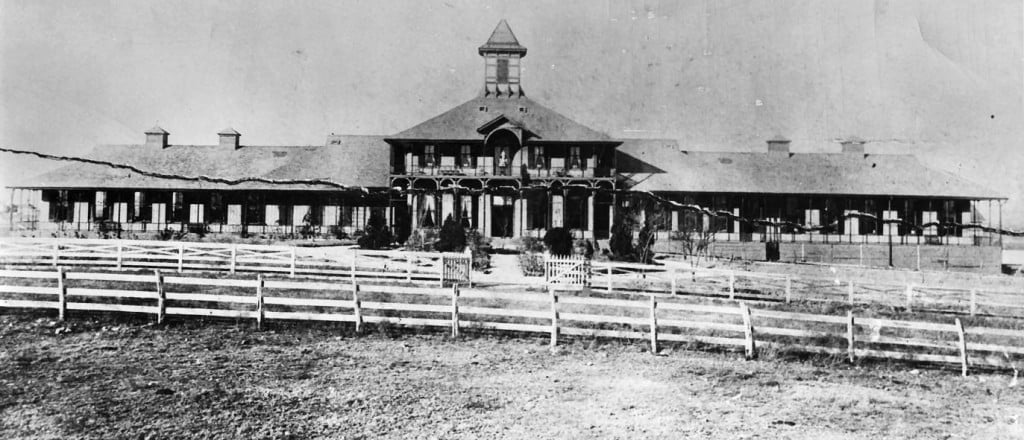
At the time, Fort Worth had existed as an independent city for barely thirty years (since 1873), and no other visit had generated such interest. Roosevelt was the first sitting or former president ever to come here. In 1889, the city invited President Benjamin Harrison to the grand opening of the Texas Spring Palace, but he unsurprisingly declined. What political benefit would a trip to the Texas plains hold for the president of the United States, especially if that president was a Republican?
This was far from Roosevelt's first encounter with Texas. He had visited twice before, first in April 1892 on a hunting expedition at W. T. "Tom" Waggoner's ranch. Four years later, he returned, this time to San Antonio, where he trained his "Rough Riders" before the Spanish-American War. Now he was coming again, in 1905, and once again it was not about politics. He was preparing for another hunt. Two of his friends, Burk Burnett and Tom Waggoner, both of Fort Worth, had invited him to hunt wolves in Indian Territory, and the occasion was also to include negotiations on extending white farmers' grazing leases on Indian reservations. Quanah Parker handled the local arrangements, which was another reason Texas ranchers liked him so much.
The trip was planned to coincide with a reunion of Roosevelt's Rough Riders in San Antonio. The president had not seen his former comrades-in-arms since 1898, so he could kill two birds with one stone. He intended to spend almost two months away from Washington. Although the trip was not politically motivated, the train journey across Texas clearly resembled a traditional whistle-stop campaign tour. The first stop was in Denison on April 5, followed by Sherman, where 30,000 people were waiting, and then Dallas, where the crowd was even larger. Roosevelt also spoke briefly from the rear platform of the train in Hillsboro, Waco, Temple, Austin, San Marcos, and New Braunfels before arriving in San Antonio on April 7. It was an exhausting schedule indeed, but exactly the kind Roosevelt loved. He did not rest in San Antonio either, celebrating with old friends in the evening and already aboard a train heading north again by midnight.
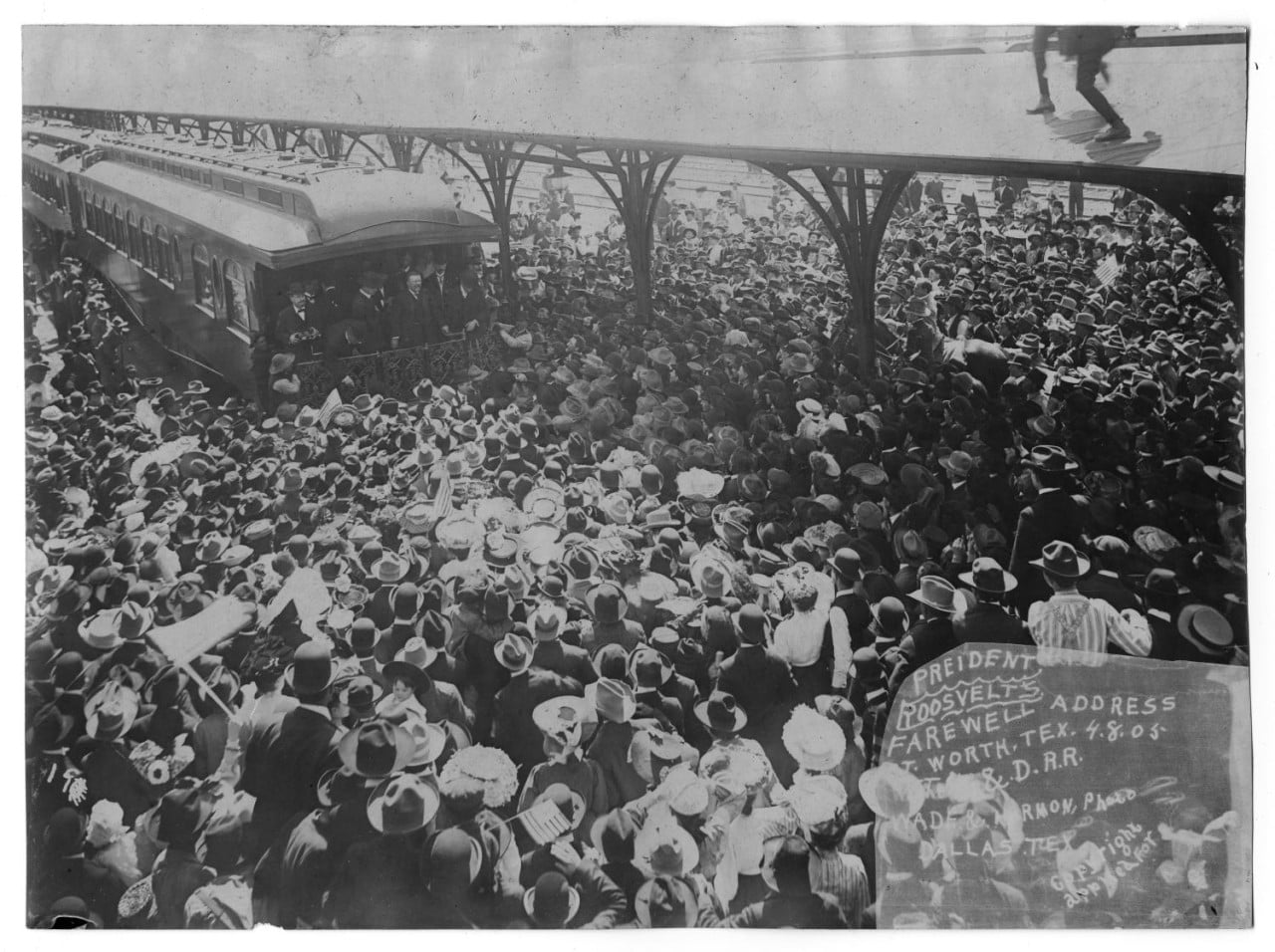
He arrived in Fort Worth on Saturday, April 8, at 9:45 in the morning, after several hours of sleep along the way. The city had prepared to welcome the first president ever to visit Fort Worth. The Fort Worth Telegram followed every step of the president's journey from the moment he left Washington and carefully chronicled the preparations for his grand reception. City Hall was determined to ensure that Fort Worth's welcome surpassed those at every other stop. Although the state's politics were firmly Democratic, Fort Worth was not particularly hostile toward Republicans. The first Republican political club in the entire state had been founded here; in 1905 it had 250 members and was appropriately named the Central Roosevelt Club in the president's honor. Labor unions were also urged to participate in the presidential procession in the greatest possible numbers. The cattle raisers' association regarded Roosevelt as one of their own (he had once ranched in Dakota himself) and stretched a large banner across Main Street bearing the president's photograph and the words: "The Texas Cattle Raisers' Association Welcomes the President, Friend of the Ranchers." Roosevelt had to pass beneath it on his way downtown.
The welcome at the Texas and Pacific station was thunderous. It is estimated that more than 20,000 people gathered. They filled the platforms and spilled onto the tracks: men in suits and ties, women in dresses and hats, children sitting on their fathers' shoulders, and quite a few attendees in military uniforms. A welcoming committee composed of prominent Fort Worth citizens formally greeted him and escorted him to a platform erected in front of the station building. The crowd filled the entire street, with people standing on the monument in the Al Hayne Triangle, leaning out of windows, and sitting on the roof of the Texas and Pacific freight depot. All along Front Street (now Lancaster), everyone who hoped to catch even a glimpse of the president crowded together, even if they could not hear him. They waved both American and Confederate flags, which did not bother Roosevelt at all. He liked to say that his parents came from opposite sides of the Mason-Dixon Line, and he himself championed the idea of a united country. The welcoming committee decorated both the passenger station and the freight depot with red, white, and blue garlands. Among the photographers documenting the event were local photographer Charles Swartz and presidential photographer H. A. Stohmeyer.
Roosevelt was introduced by Mayor T. J. Powell, and the president thanked the crowd for its warm reception in his booming voice. Then, mindful of the limited time, he climbed into the waiting carriage with his secretary William Loeb, Mayor Powell, and Sam Davidson, representing the Cattle Raisers' Association and the Chamber of Commerce. The open carriage was the finest Fort Worth had to offer, drawn by a perfectly matched team of white trotters, with its wheels adorned with flowers and the presidential seal and initials "T.R." on its sides. An American flag flew from the rear of the carriage, almost touching the ground. The original procession route ran along Main Street to the county courthouse, then west on Weatherford Street, on to Houston Street, and south to Ninth Street, with a detour past City Hall and the federal building, back along Eleventh to Houston, and from there back to the station. However, because Arbor Day fell on that date and Roosevelt was a great lover of nature, the route was modified to include a stop at the Carnegie Library, where a tree-planting ceremony was to be held. Time was precious, since the schedule allowed Roosevelt barely an hour in Fort Worth. The new route ran along Jennings past the federal building and City Hall to Ninth Street, where the tree was to be planted, then via Houston Street to the county courthouse and back to the station along Main Street. A special grandstand was erected at the Peter Smith Triangle (where Jennings and Throckmorton met) for the city's highest-ranking officials and their families. White schoolchildren gathered at the county courthouse to welcome the president as he passed, while a group of 600 Black schoolchildren waited for him outside City Hall, waving American flags and singing "The Star-Spangled Banner." This was politically important because Roosevelt supported the so-called "Black and Tan Alliance," which sought to mobilize voters from both groups for the Republican Party. He was so moved that he ordered the carriage to stop so that he could wave his hat and accept a bouquet of carnations from a little girl.
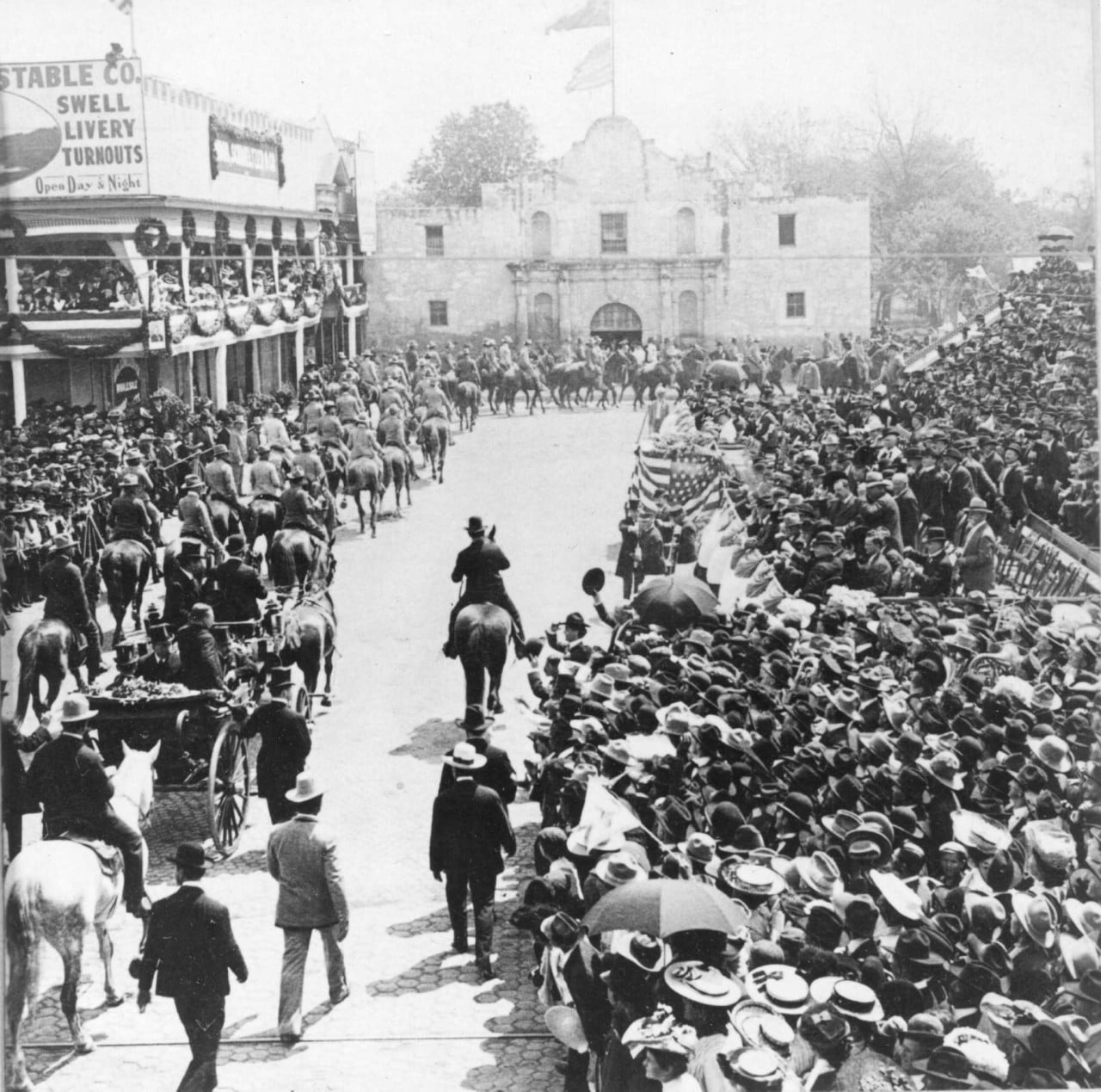
The procession consisted of a brass band, mounted members of the sheriff's department, and several state military units from across North Texas, including the Fort Worth Fencibles, totaling as many as 500 men, as well as veterans of the Mexican, Civil, and Spanish-American wars—in other words, everyone who could still squeeze into his uniform and march. All participants were asked to assemble on Front Street no later than 8:30 in the morning. The crowd lining the procession route was estimated at 30,000, with many coming directly from the station and then hurrying downtown to secure a place along the route. Although it was Saturday, every office window was filled with people waving flags and cheering. Not all of them were Fort Worth residents. A delegation of 336 people came especially from Weatherford. They crowded into open windows, stood on awnings and rooftops, and filled the sidewalks. Photographers sought elevated vantage points for their pictures. Several surviving photographs were taken from the roof of the Flatiron Building at the corner of Ninth and Houston, opposite the library. Roosevelt was so delighted by the crowd that he stood throughout the procession, saluting onlookers with his hat on both sides of the carriage.
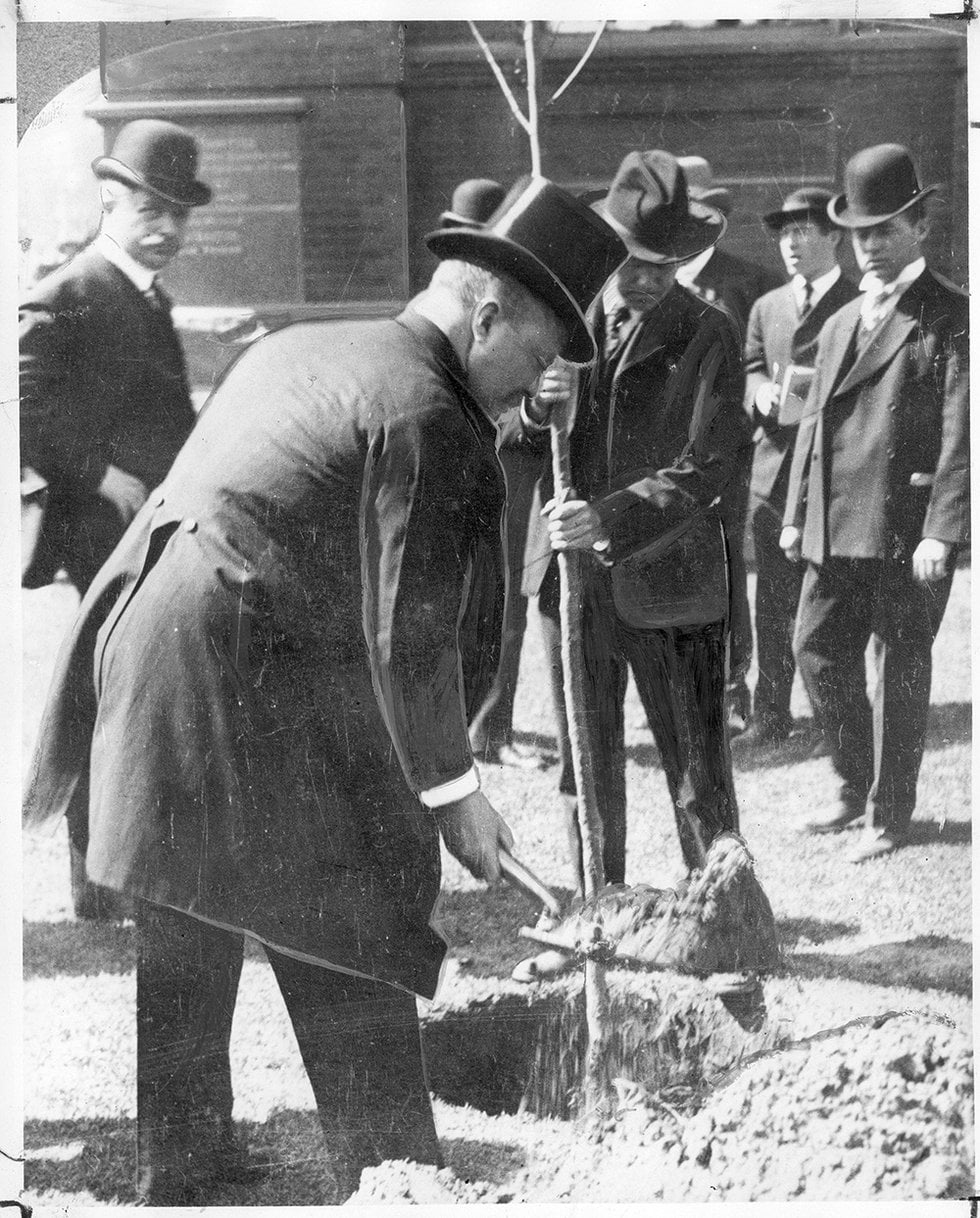
The tree planting was largely a theatrical gesture. The eastern lawn in front of the library was selected as the site, beating out Hyde Park across the street and the front lawn of City Hall. The hole had been dug in advance, and a small elm sapling waited with its root ball ready for planting. No one expected the president to do any real work. Without removing his hat or coat, Roosevelt set to work, shoveling several spadefuls of soil into the hole while dignitaries held the sapling upright. Elegantly dressed wealthy citizens and ordinary people in everyday clothes crowded side by side. The librarians watched from the windows with respectful reserve. Because of the lack of time, Roosevelt gave no speech. That came at another time and place, on another Arbor Day several years later, when he said: "A people without children would face a hopeless future; a country without trees is almost as hopeless."
The president returned to the station in time to deliver his speech while standing beside the flag-draped platform and speaking without notes. His aides told reporters that it was "the best speech of his entire trip." (They probably said that at every stop.) By 11:00 in the morning, Roosevelt was back on the train, ready to depart. As he stood on the rear platform, the crowd pressed close. One old soldier in a gray uniform climbed onto the car to shake the president's hand. Altogether, Roosevelt spent only seventy-five minutes in Fort Worth, yet during that time he delivered two speeches and planted a tree. They were undoubtedly the most memorable seventy-five minutes in Fort Worth's history. Such a large number of people had not gathered in the city for the arrival of the railroad in 1876 or for the Texas Spring Palace in 1889 and 1890.
The visit to Fort Worth made such a profound impression on Roosevelt that he wrote home about it in letters to his two eldest sons, Theodore Jr. and Kermit. Although he wrote more enthusiastically about the wolf hunt that followed, he nevertheless praised the warm reception in Fort Worth.
The presidential train left Fort Worth on the Fort Worth and Denver tracks toward Vernon in the Texas Panhandle. There, the hunting party disembarked and crossed the Red River to hunt wolves with Roosevelt's friends W. T. "Tom" Waggoner and Burk Burnett. The president left most of his entourage in Fort Worth, including personal secretary William Loeb and fourteen others, who waited for his return. As the Fort Worth Telegram noted, the telegraph line from Kingola in Oklahoma Territory to Fort Worth was the president's only link to the outside world and to his own government.
Roosevelt's visit to Fort Worth was a great success, but the tree did not fare nearly as well. The Fort Worth Telegram jokingly remarked that it hoped the tree would grow into a "big stick," alluding to Roosevelt's famous "Big Stick" foreign policy toward Latin American neighbors. William Loeb, meanwhile, declared that if the tree died, he would personally return and plant a new one. At first, the sapling seemed to thrive. On April 23, the Telegram optimistically reported that the tree had sprouted leaves and buds. The library groundskeeper charged with caring for the tree predicted that it would grow to "respectable proportions." When the city council announced a month later that it intended to open a passage through the rear of the library property, it promised that the tree would remain untouched, and the library board voted to spend $30 on installing a wrought-iron fence around it. All these precautions and promises, however, proved futile. By autumn, the president's elm was dead. When Roosevelt was informed of its demise at a White House reception, he said, "I am very sorry," adding that he would have to look into the matter. He did indeed send a replacement, this time a Chinese cherry tree, which also died, much to the city's embarrassment. The story of the little elm that did not survive turned into an epic saga of man versus nature.
The legend of the president's tree proved more enduring than the tree itself. After the Carnegie Library was demolished in 1938 to make way for a new public library, someone spread the story that the elm, by then fully grown, had been successfully transplanted to the grounds of the Will Rogers Memorial Auditorium. This tale was not debunked until many years later, when the city forester declared that he could not identify any tree on the auditorium grounds old enough to have been Roosevelt's elm. The moral of the story recalls a variation on the famous line from the film The Man Who Shot Liberty Valance: When the tree dies, plant a rumor.
In 1911, Theodore Roosevelt visited Fort Worth again, this time as a former president. As before, the invitation came from "old and esteemed ranching friends." He himself called it a "friendly visit" and spent a single day in the city, beginning with an invitation-only breakfast at the Westbrook Hotel. He then visited the Fat Stock Show and commented to reporters on the "astonishing growth of your city" since his last visit.
Fort Worth felt a deep affection for Roosevelt. After his death in 1919, a different kind of memorial dedicated to the 26th president was proposed: a stone monument to be erected at a location yet to be determined. Some local residents contributed to a characteristically Fort Worth fundraising drive for the purpose, but the entire plan ultimately came to nothing. Among the donors were players from Fort Worth's "colored" baseball team.