Just six weeks after the release of GPT-5.4, OpenAI has released another new version. GPT-5.5 arrives as the most capable and intuitive model the company has launched to date. And this time, it is not just about better benchmark results. Greg Brockman, co-founder and president of OpenAI, told reporters that GPT-5.5 brings OpenAI one step closer to creating a so-called super app. A single program combining chat, coding assistance, and a browser.
"It is a faster and sharper thinker that can accomplish more with fewer tokens than, say, 5.4," Brockman told reporters. This statement is important. More powerful models tend to be slower. GPT-5.5 rejects this trade-off. It achieves the same per-token latency as GPT-5.4, despite operating at a significantly higher level. At the same time, it uses fewer tokens for the same task, which means lower costs for companies deploying artificial intelligence at scale.
Coding with GPT-5.5: progress or still taboo?
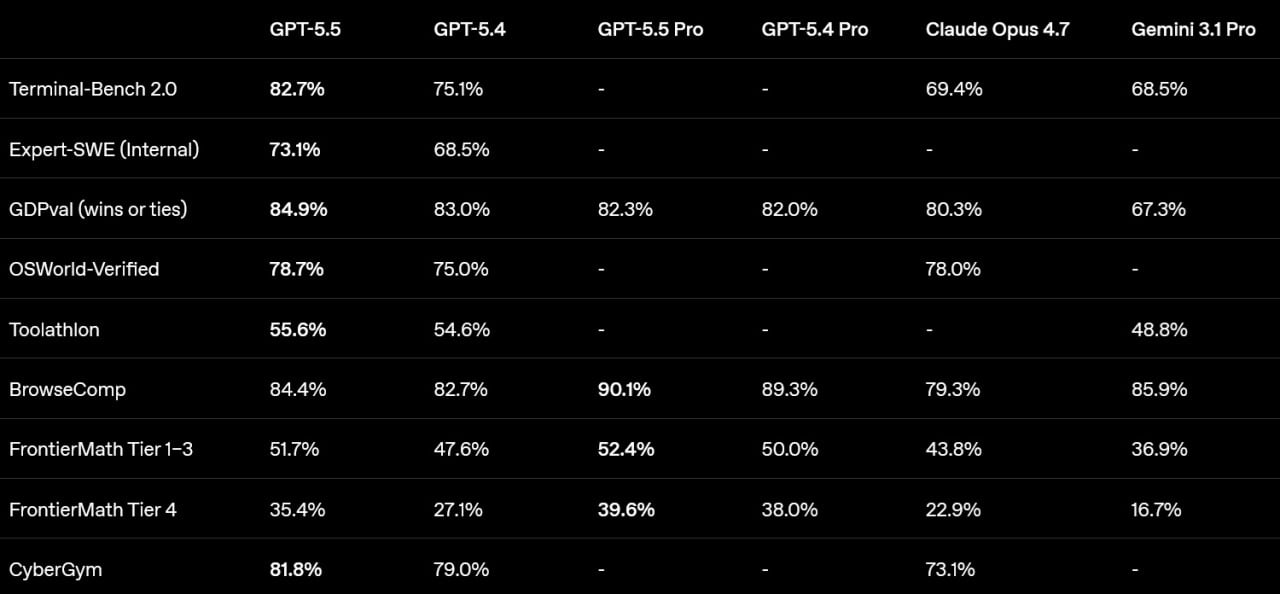
GPT-5.5 made its strongest impact in autonomous programming. On the Terminal-Bench 2.0 benchmark, which measures the ability to handle complex command-line tasks and coordinate tools, the model scored 82.7%. The previous GPT-5.4 version finished at 75.1%. Anthropic's competing Claude Opus 4.7 scored 69.4%, while Google's Gemini 3.1 Pro achieved 68.5%.
On the internal Expert-SWE test, where the tasks correspond to work that takes a human developer an average of twenty hours, GPT-5.5 scored 73.1%, compared with 68.5% for GPT-5.4.
Wharton School professor Ethan Mollick, who regularly tests new models, had access to GPT-5.5 before its public release. On his blog, One Useful Thing, he described how he had years' worth of unprocessed, anonymized data from crowdfunding research. Hundreds of files in STATA, CSV, XLS, and Word formats that he had never gotten around to reviewing. He entered four prompts. The model sorted the data, proposed a hypothesis, tested it using sophisticated statistical methods, and wrote an academic paper, including a literature review and formatting.
"I would be very happy if this result were the output of a second-year PhD project," Mollick wrote. "And it took me only four prompts, without touching the text myself."
At the same time, however, he pointed out its limitations. The hypothesis itself was not particularly interesting, and the text exhibited problems typical of AI writing. Overly ornate sentences, monotonous character dialogue, and recurring patterns. "The capability frontier is still visible. It is just much farther away than before," Mollick concluded.
A super app on the horizon
Behind the technical results lies a greater ambition. Brockman and Sam Altman openly talk about wanting to combine ChatGPT, the Codex coding assistant, and a web browser into a single application. One tool that switches between writing, coding, and browsing the internet without interrupting the workflow.
"To me, this is a real step toward the way we expect to work on computers in the future," Brockman said. "But it is one step, and we expect many more." The idea of a super app is not exclusive to OpenAI. Elon Musk wants the same thing from X. The battle over who will create a universal AI-powered work environment is only just beginning.
Safety is "High," but not "Critical"
The release of GPT-5.5 came just as the security capabilities of artificial intelligence were attracting increased attention. Shortly beforehand, Anthropic announced a cybersecurity tool called Mythos, which an unauthorized group of users reportedly gained access to.
OpenAI classified GPT-5.5's cyber capabilities as "High" under its own preparedness framework. In other words, they may amplify existing pathways to serious harm. However, the model did not reach the "Critical" level, which would indicate entirely new ways of causing severe harm. On the CyberGym benchmark, it scored 81.8%, compared with 73.1% for Claude Opus 4.7.
Mia Glaese, OpenAI's vice president of research, emphasized that the model underwent extensive testing by teams focused on both cyber and biological risks. OpenAI is also launching the "Trusted Access for Cyber" program, providing verified access for critical infrastructure defenders with less restrictive model settings.
Availability and pricing
GPT-5.5 is available to users on the Plus, Pro, Business, and Enterprise plans in ChatGPT and Codex. GPT-5.5 Pro is intended for Pro, Business, and Enterprise users. The model is also accessible through the API.
API pricing is $5 per million input tokens and $30 per million output tokens. GPT-5.5 Pro costs $30 per million input tokens and $180 per million output tokens. In Codex, the model operates with a context window of 400,000 tokens, while the API supports up to one million.
Jakub Pachocki, OpenAI's chief scientist, added at the launch: "I see fairly significant improvements in the short term and extremely significant ones in the medium to long term. In fact, I think the last two years have been surprisingly slow."