Fort Worth got its first purpose-built movie theater in 1910. It was the Odeon at 1004 Main, where silent one-reel films were shown. Admission cost five cents. Within just a few years, five theaters, including the Odeon, had opened downtown. At the time, going to the movies meant dressing up and heading downtown. Although there were smaller theaters away from the main thoroughfares, grand movie palaces sprang up on Seventh Street in the 1920s: the Palace (1919), the Worth (1927), and the Hollywood (1930). As the city expanded and new neighborhoods were built, people became less willing to travel all the way downtown to see a movie. And so the neighborhood theater was born.
Neighborhood theaters served a different audience, one that was younger, more casually dressed, and on a tighter budget, willing to pay for films that had already completed their downtown runs or for pictures from lesser-known studios. They had to do without some of the amenities offered by downtown theaters in the early days, such as supervised rooms for infants or teams of ushers patrolling the auditorium with flashlights. At the time, every theater had only one auditorium. The large movie palaces could boast bigger screens and better sound systems. Neighborhood theaters did their best business on weekends, when children were out of school. For those who grew up in Fort Worth in the 1950s and early 1960s, the so-called “baby boomer” generation, there was no better way to spend a Saturday afternoon than sitting in a darkened auditorium and watching a double feature. This was before amusement parks and swimming pools began enticing us outdoors during the long, hot summers. The theater was within walking distance, admission cost just a few coins, and parents were happy to have their children out of their hair for a few hours. No one worried that danger might be lurking in the darkened auditorium.
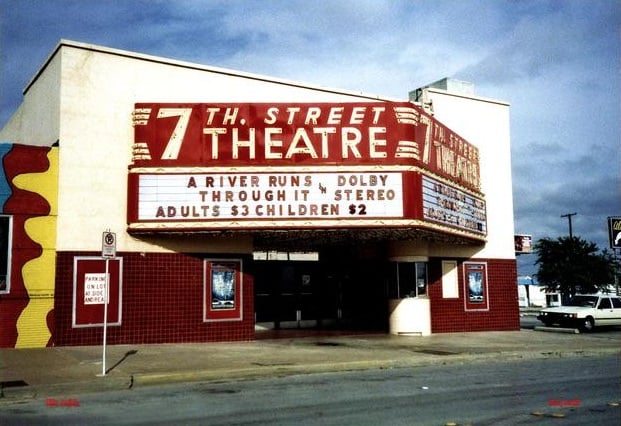
The names of those old theaters still resonate in our memories. For those who remember them, their names evoke the smell of fresh popcorn and the thrill of the big screen. Depending on which part of town you lived in, you will never forget the Tower, Parkway, New Isis, Bowie, 7th Street, Heights, Grand, Poly, Varsity, or Tivoli, to name only the most prominent. Every neighborhood had at least one. There was no need to trek all the way downtown to the Hollywood, Worth, or Palace on “Show Row.” These neighborhood houses had everything a child wanted. Sure, they showed B movies and older pictures, but who cared? And there was almost always a cartoon or two as well.
Fort Worth’s first neighborhood theater predated double features, Bugs Bunny, and the Road Runner by many years. It was the Isis theater on North Main, which opened around 1915 and served the North Side neighborhood. From the beginning, it was strictly a movie theater rather than a vaudeville house, and on a typical Sunday it reportedly sold as many as 3,200 tickets across all its screenings. And therein lay the problem: operating on Sunday violated the Sunday closing law. The Isis was the first theater convicted of violating the law, which had originally been aimed at saloons and dance halls; the municipal court fine was $50. Less than a year later, the city fathers concluded that going to the movies did not disturb the peace of the Sabbath in the same way as, say, a trip to the saloon, and they let the matter drop. They probably also noticed that Sunday screenings gave the business a healthy boost on what had traditionally been its weakest day.
In the 1920s, most Fort Worth residents still preferred going to the movies downtown. The Isis remained the city’s only neighborhood theater. The 1930s changed that, and that decade, together with the 1940s, brought a wave of neighborhood theater construction that has never been repeated. The Great Depression and World War II deepened people’s desire to escape into the fantasy world of the movies. Vaudeville theaters were practically dead before the mid-1930s, opening the way for small movie theaters to fill the entertainment void. It also helped that operating a movie theater was considerably cheaper than running a vaudeville stage, since management did not have to book live acts. During the war, gasoline and tires were scarce, making it convenient to have a theater within walking distance. Most of the theaters built during these years belonged to the Dallas-based Interstate Theater chain, though several were privately owned.
When the New Tivoli opened on Magnolia in the summer of 1935, it was billed as the “first deluxe neighborhood theater.” Its success spurred the creation of others: the White Theater (Hemphill) in 1940, the Rosen (Lake Worth) in 1941, and the Bowie (Camp Bowie) and Tower (Six Points in Riverside), both in 1942. The New Isis on North Main opened on March 27, 1936 (the original Isis from 1914 burned to the ground in 1935). As new suburban developments grew, they built their own theaters, such as the Poly, Haltom City, and River Oaks. Having a theater was a sign that a neighborhood had “come of age.” There was not a single shabby hole-in-the-wall among all these theaters. Each had a marquee bearing its name and a box office in front of the entrance, as well as a well-stocked concession stand inside. Seating capacity generally exceeded 700; the New Tivoli could accommodate as many as 1,000 patrons (240 in the balcony), and the Tower boasted “more neon lights in front of its entrance than any other theater in Fort Worth.” Construction typically cost less than $100,000, and operations were kept as economical as possible: high school students staffed both the concession counter and the entrance. The Tower and Parkway belonged to the Interstate chain, which comprised 150 theaters scattered throughout the state. The TCU theater on University Drive was independent from its first day until it was demolished as part of so-called urban renewal in 2006. The best way to launch a theater was to hold a gala Hollywood premiere, but for a small neighborhood house that was an almost unattainable goal. The grand premieres took place at the downtown movie palaces.
The mainstay of their revenue came from films that had already completed their downtown runs, foreign pictures, and low-budget productions from studios such as Republic or Monogram. Much of the programming was aimed at young audiences, which meant an abundance of Italian historical epics featuring lesser-known stars such as Richard Egan, Rory Calhoun, or Steve Reeves. Who could forget Hercules (1960) or The Colossus of Rhodes (1960)? Horror movies were also shown in abundance, including American International’s Attack of the Crab Monsters (1956) and the Japanese films Rodan (1956) and The Mysterians (1957). These were often double features. Attack of the Crab Monsters was paired with Not of This Earth. Two movies for the price of one! What child would not have been delighted?
Each theater adapted to its neighborhood. The Berry on Hemphill (formerly the White, named after its owners, not its admission policy) showed exclusively Spanish-language films from 1961 onward. So did the Rose Marine Theater on North Main, which opened in 1943 for the large Hispanic community on Fort Worth’s North Side. The New Isis, another North Side theater near the stockyards, attracted a rough-and-tumble audience that favored action films and slapstick comedies. For a time in the 1970s, it showed martial arts films exclusively. The Grand Theater on Fabons was patronized exclusively by Black audiences from nearby Terrell Heights and showed many older films featuring Black actors that would never have been screened in white theaters. The TCU theater on University (1946 to 2006) mixed higher-quality second-run films (To Kill a Mockingbird, 1964) with more sophisticated pictures (Far from the Madding Crowd), both aimed at the local university audience. College students did not necessarily have more money in their pockets, but they had more refined tastes.
By the late 1960s, shopping malls and multiplexes had begun driving small local single-screen theaters out of business. They closed one after another, although the New Isis survived until the early 1980s. “Urban development and redevelopment” was cited as the reason for the demise of other theaters, such as Interstate’s Parkway (Eighth Avenue) in 1964. Even the three great downtown movie palaces, the Hollywood, Worth, and Palace, did not survive into the 1970s. Today’s theaters have ten or more auditoriums, reclining seats, and surround sound, and tickets can be purchased online. They also have concessions that cost more than an entire meal at a good restaurant once did. What they lack, however, is the magic of those old neighborhood theaters, where you dropped a quarter into the box office outside, bought popcorn for ten or fifteen cents (a large one with butter), and immersed yourself for three hours in air-conditioned excitement.
Some of these old neighborhood theaters have been repurposed, though none as movie theaters, since the old houses have no chance of competing with multiplexes featuring giant screens and surround sound. The former Bowie Theater now serves as a bank, while the former Haltom Theater, which opened on December 28, 1941, is trying to survive as an art gallery. The Rose Marine Theater has become a live performance venue. The remaining theaters have either disappeared or stand vacant and decaying, silent reminders of an era that was literally magical for a child with twenty-five cents in his pocket.