Today’s southwest medical district includes four major hospitals, private clinics, and an almost countless number of rehabilitation facilities. Together they constitute a multibillion-dollar operation that drives the local economy and serves Fort Worth’s continually growing population. This was not always the case, nor was the city always equipped with first-rate healthcare facilities.
In 1901, hospital care in Fort Worth was provided by three institutions: the Catholic St. Joseph’s Hospital, the Episcopal All Saints Hospital, and the teaching hospital of Fort Worth Medical College, which was part of the local university. St. Joseph’s Hospital, administered by the Sisters of Charity of the Incarnate Word, was both the oldest and the largest. It opened its doors in 1885 at the southern end of Main Street, but soon burned to the ground and was rebuilt in brick in 1889. It admitted both paying patients and the poor, regardless of their background. All Saints Hospital began operating in 1900 as a project of Trinity Episcopal Church, with the goal of providing medical care to those in need. Fort Worth Medical College was established in 1891 as part of the local university by a group of physicians that included Elias J. Beall, Bacon Saunders, and William A. Duringer. Financial support was also provided by some of the city’s leading businessmen, who viewed the project as both a worthy cause and an opportunity to promote the city’s development. They included Julian T. Feild and Edgar D. Capps. In 1894, the school moved into its own building at the corner of Seventh and Rusk Streets. The medical college had a fifty-bed clinic that served primarily indigent patients as part of its teaching program.
The standard rate for paying patients ranged from one to three dollars a day, for which the patient received a bed, basic nursing care, and all necessary medications. Ambulance transportation or special nursing care was charged separately. Medicine was not as lucrative a profession then as it became in later years. Physicians treated significantly fewer patients, since most people recovered at home under the care of their families, with the family doctor making visits as needed. Places where some patients went to recuperate were generally referred to as infirmaries, clinics, or sanitariums. Even among poor patients, whites predominated, both because they made up the majority of the population and because the Black population did not voluntarily go to hospitals. Their healthcare needs were met only by a few Black physicians, who visited patients in their homes or saw them in private offices.
There is, of course, nothing wrong with physicians seeking to make a profit, and wealthy people also become ill. The concept of premium healthcare was no different from that of premium hotels or restaurants; it was intended exclusively for a select clientele. This was the rationale behind the opening of the Protestant Sanitarium in 1901. It was a purely private, for-profit enterprise whose mission was to meet the healthcare needs of affluent clients accustomed to superior service. The term “sanitarium” distinguished the facility from an ordinary public hospital. At the time, the word was not merely a euphemism for a psychiatric hospital, but rather an elevated term for a private hospital offering individualized care and private rooms, with physicians and nurses available around the clock. The designation “Protestant” further distinguished the facility from St. Joseph’s Hospital and gave it a distinctly American character.
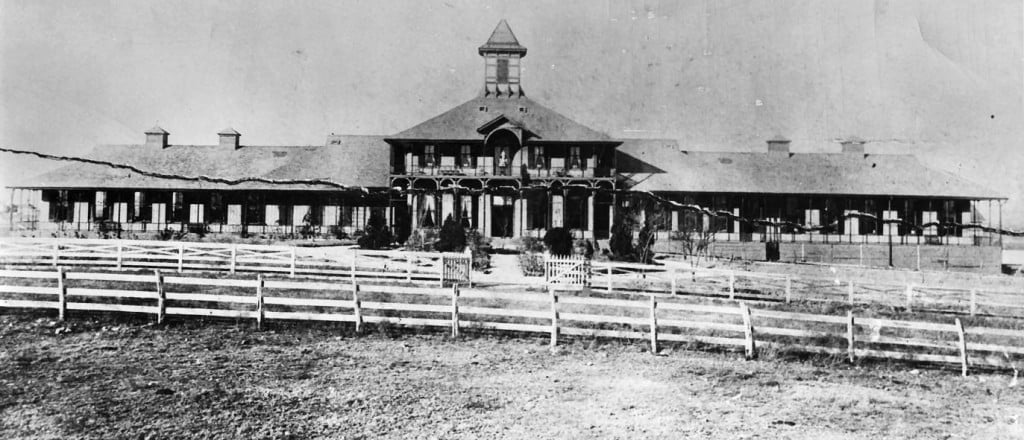
The sanitarium building was constructed at the southwest corner of Main Street and Railroad Avenue (now Vickery) for $25,000. The investors included physicians Amos C. Walker and Edgar D. Capps, as well as Winfield Scott, Sam Levy, and John B. Slaughter. All were respected figures, and with the exception of Levy (who was Jewish), they came from an Anglo-American Protestant background. More importantly, they were not motivated by altruism alone. Fort Worth’s wealthy residents had no desire to be treated in charity wards or in an environment where they would encounter immigrants. The sanitarium was deliberately designed not to look like an institution modeled after St. Joseph’s Hospital. It occupied two spacious buildings on extensive grounds overlooking downtown. The larger building had a façade nearly 230 feet long, with deep verandas extending around its entire perimeter, and was divided into surgical and convalescent wings. Hospital stays for the purpose of recovery were still a novelty at the time, but the fortunate patients of the Protestant Sanitarium enjoyed care comparable to that of a spa retreat without having to travel to places such as Mineral Wells, Texas, or Hot Springs, Arkansas. The administration building stood separately so that the facility’s operational and treatment areas remained apart. The grounds were attractively landscaped with shade trees, shrubs, walking paths, and fountains.
Because it was a for-profit enterprise, advertising was essential; it was not enough simply to wait for customers to arrive on their own. Advertisements promised “the most modern scientific practice in medicine, surgery, and gynecology,” with gynecology then ranking among the most progressive branches of medicine and replacing care previously provided by midwives and general practitioners. Other advertisements boasted that the sanitarium had “the finest specialists in every field of practice” and enjoyed “significant professional recognition throughout the Southwest.” Although physicians made regular rounds, the facility’s day-to-day operations were entrusted to a “competent superintendent” assisted by “a staff of trained nurses.”
The physicians were also among the principal investors and ranked among the city’s most respected professionals. At their head was Dr. Walker, a professionally trained surgeon who came to Fort Worth after more than twenty-five years of medical practice in Texas. His associate, Dr. Capps, was a “specialist in mental and nervous disorders,” which placed the Protestant Sanitarium in direct competition with the Arlington Heights Sanitarium on the city’s western outskirts. The nonmedical investors included ranchers Winfield Scott and John Slaughter and merchant Sam Levy. Men like these were always looking for profitable investments, whether in real estate or new business ventures. Together, these men and their friends invested $50,000 in initial capital in the Protestant Sanitarium. Seventeen men attended the organizational meeting on May 25, 1901, and all soon became officers or members of the board of directors.
The sanitarium’s affluent patients were allowed to participate actively in the course of their treatment and make decisions about their health together with advisers and family members, an approach more consistent with a traditional business model than a purely medical one. The sanitarium’s founders were entirely correct that Fort Worth needed such a facility. During its first few years, the enterprise proved highly profitable. Then came May 1903, when the sanitarium’s good name appeared in the newspapers in sensational tabloid fashion. One of the patients was Oran Hoskins, who lived with his mother at 901 E. Belknap. Oran was not part of the sanitarium’s usual affluent clientele, yet he ultimately ended up there after claiming that he had been struck by a Frisco Railroad train and lost consciousness. Oran’s mother filed a lawsuit against the railroad company and had her son admitted to the sanitarium for observation. After three weeks as a paying patient, Oran was prepared to undergo exploratory brain surgery performed by Dr. Walker. One can only speculate whether the physician truly intended to operate or was playing a game of his own. Almost literally on the threshold of the operating room, Oran experienced a miraculous recovery and protested against the surgery. He then confessed the fraud to the police, who charged both him and his mother. Both ended up in jail, and Dr. Walker assured reporters that he had suspected the fraud from the very beginning. The alternative explanation—that the sanitarium’s distinguished physicians had been completely deceived by a con man—would not have been good publicity for the sanitarium or its doctors.
The Protestant Sanitarium once again appeared in the newspapers, this time for a completely different reason. In April 1909, a catastrophic fire raged on the city’s south side, destroying twenty blocks of businesses, churches, and private homes and causing damage equivalent to $44 million today. It was the most destructive fire in Fort Worth’s history, and the Protestant Sanitarium did not escape it. Dr. Walker’s personal losses reached $53,000, in addition to an estimated $25,000 in damage to the buildings and equipment.
The Protestant Sanitarium was never rebuilt. Projected long-term profits were insufficient to cover the enormous financial losses caused by the fire. This did not mean, however, that the city’s upper class lost access to the finest medical care. Other hospitals, both public and private, took the sanitarium’s place and today form the medical district. The original southwest medical district, which nearly burned to the ground, rose from the ruins like the mythical phoenix. Drs. Walker, Capps, and the other physician-owners continued practicing in Fort Worth for many years before retiring. Dr. Walker is buried in Oakwood Cemetery. The other nonmedical investors found other opportunities to profitably invest their funds.