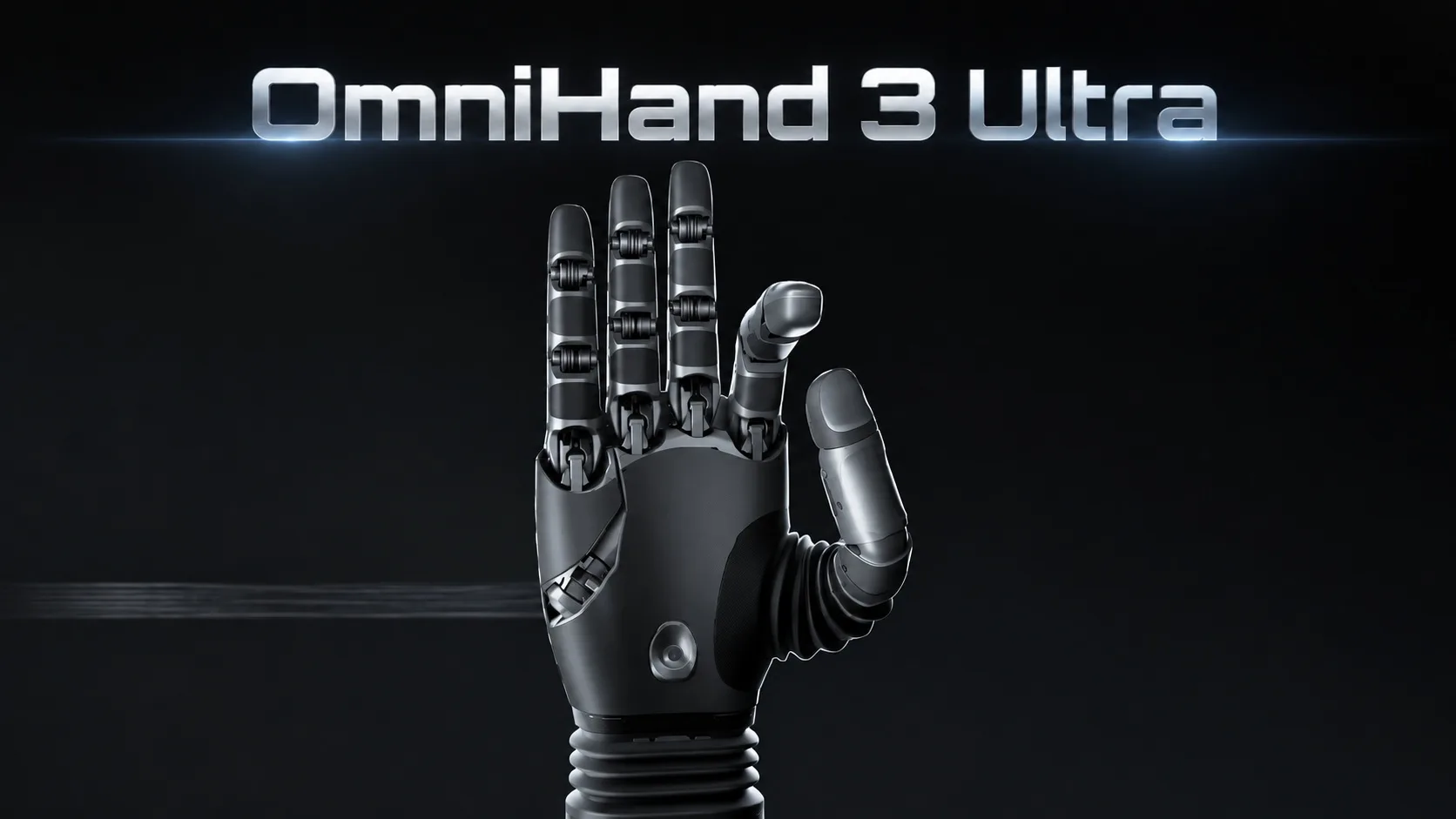
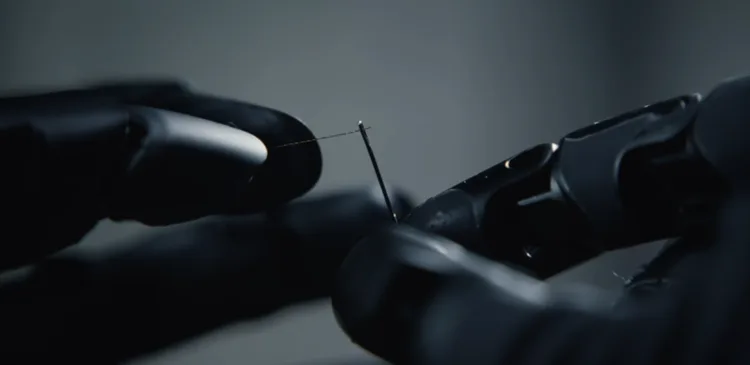
Chinese company Agilink has taught a robotic hand to embroider with silk. The hand, called OmniHand 3 Ultra, managed to split a silk thread into extremely fine fibers, thread a needle, stretch fabric in an embroidery hoop, and make its first stitches. Its teacher was Fu Xianghong, a renowned master of traditional embroidery from the Chinese city of Suzhou. This craft has a history spanning more than two and a half thousand years.
At first glance, it is an impressive video. But the demonstration addresses one of the biggest challenges facing humanoid robots. Machines today can see and move, but when they have to pick up something fragile, they can easily destroy it. Without a delicate sense of force, a robot could not work safely alongside people without causing damage or injuring someone.
Silk is a nightmare for a robot
Silk thread has no fixed shape. It bends, slips, and changes form with even the slightest change in pressure. Humans can handle it thanks to the sense of touch in their fingers, but for a machine it is one of the most difficult tasks of all. The foundation of Suzhou embroidery is splitting the main thread into sixteen individual fibers. One finger carefully pulls the fibers apart while the others keep the thread taut. When twisting the thread, the tips of opposing fingers must remain in contact with the fiber while allowing it to rotate freely. Threading the needle and sewing itself then require precise finger positioning, correctly measured force, and perfect coordination of the entire hand.
According to the company, silk has no shape of its own and is shaped by the force of the fingers. Embroidery therefore tests both the hand’s mechanics and its control software at the same time.
How the hand learned
Master Fu demonstrated each step to the robot, and Agilink combined two methods during training. The first consisted of teleoperation data, where a person controls the hand remotely and it learns from their movements. The second was so-called reinforcement learning, in which the robot attempts the task over and over and gradually discovers which movements lead to success. In the final task, the hand had to twist the thread and then lift it in a single fluid motion. The thread landed in a different place each time, so the robot could not simply replay a learned procedure. It had to adapt to what it was seeing and feeling at that moment.
A single silk thread demonstrates just how dexterous the OmniHand 3 Ultra’s fingers are, said Agilink CEO Qiao Tianjie, who also serves as vice president of parent company AgiBot. According to him, the demonstration suggests that machines could also take over more delicate work. Master Fu took it in stride and remarked that people would gain an extra pair of hands for delicate tasks.
The hand’s mechanism
Agilink did not specify exactly which version appears in the video, but visually it matches the OmniHand 3 Ultra-M model. It is roughly the same size as a human hand and weighs 630 grams. It can steadily hold three kilograms, lift up to eight kilograms, and open or close in about a third of a second. It can return to the same position with an accuracy of around two-tenths of a millimeter.
The hand has twenty-one degrees of freedom. Put simply, it can control twenty-one joint movements independently of one another. The designers chose direct drive, with motors moving the joints directly, without tendons, cables, or gears transferring force between them.
Sensors in each fingertip provide the sense of touch. They work somewhat like a small camera that observes the soft pad from inside and monitors even the slightest changes in its shape. According to the company, they measure force in all three directions and detect indentations as small as eight-hundredths of a millimeter. The hand can therefore tell whether an object is slipping or whether it is merely touching it lightly. The palm also contains a sensor with three hundred touch points.
Five fingers or four?
Several companies are developing dexterous robotic hands, and each takes its own approach. With its Linker Hand L30 Pro model, China’s LinkerBot copies human anatomy. Five fingers are driven by tendons, much like those of a human, while the hand focuses on speed and the ability to repeat the same movement with consistent precision, such as when tightening screws or lifting thin sheets. However, a faithful copy of the human hand results in greater weight, and the company itself admits that fingertip strength is rather modest. Nevertheless, LinkerBot’s hands attracted attention at the InnoEx trade show in Hong Kong when robots made by Humanoid played keyboards and drums in a four-member band.
Boston Dynamics took a different approach, and the new hand for its Atlas robot has only four fingers. Technical director Zachary Jackowski had team members tie their little finger to their ring finger for an entire day and then assessed how much they missed it. It turned out they did not need the little finger, so it disappeared from the design. The company says that every additional finger increases the price and adds another component that can break down. Atlas is intended for factories, where it is expected to work with drills or welding equipment.
The Greek philosopher Aristotle called the hand the tool of tools, and Boston Dynamics took this statement to heart. According to the company, a universal robotic hand will succeed not by being as complex as possible, but by being able to work reliably with tools. Most factory tasks are unlikely to require a delicate touch for silk. However, it could prove useful in homes, where a robot might help care for older people without hurting them.
Sources: prnewswire.com and newatlas.com