Chinese companies manufacture the vast majority of the world's humanoid robots, and their shipments are growing at a pace rarely seen in other industries. But within a single month, a series of blows made all this optimism seem like nothing more than a dream. The best-known manufacturer went public, its shares lost almost half their value within a few weeks, Beijing's capital-market regulator began taking a tougher stance on other companies awaiting stock market listings, and the head of one of them publicly wrote that many competitors were simply making up their revenue.
Lots of Units, but Few Customers
A good place to start is with the figures published in August by the analytics firm Smart Analytics Global. Global shipments of humanoid robots jumped 272 percent year on year to 19,100 units in the first half of 2026. A total of 13,317 machines were sold last year, meaning that in six months the world surpassed the entire previous year. The estimate for this year is approaching sixty thousand, while the outlook for 2030 speaks of half a million units annually.
It is also important to consider where the machines come from and who buys them. Chinese manufacturers account for more than 97 percent of all humanoid robots shipped. At the same time, 85 percent of demand also comes from China. To a large extent, therefore, this is a market that revolves around itself. Two companies, AgiBot and Unitree, together control roughly three-quarters of shipments, with AgiBot having overtaken Unitree in the meantime.
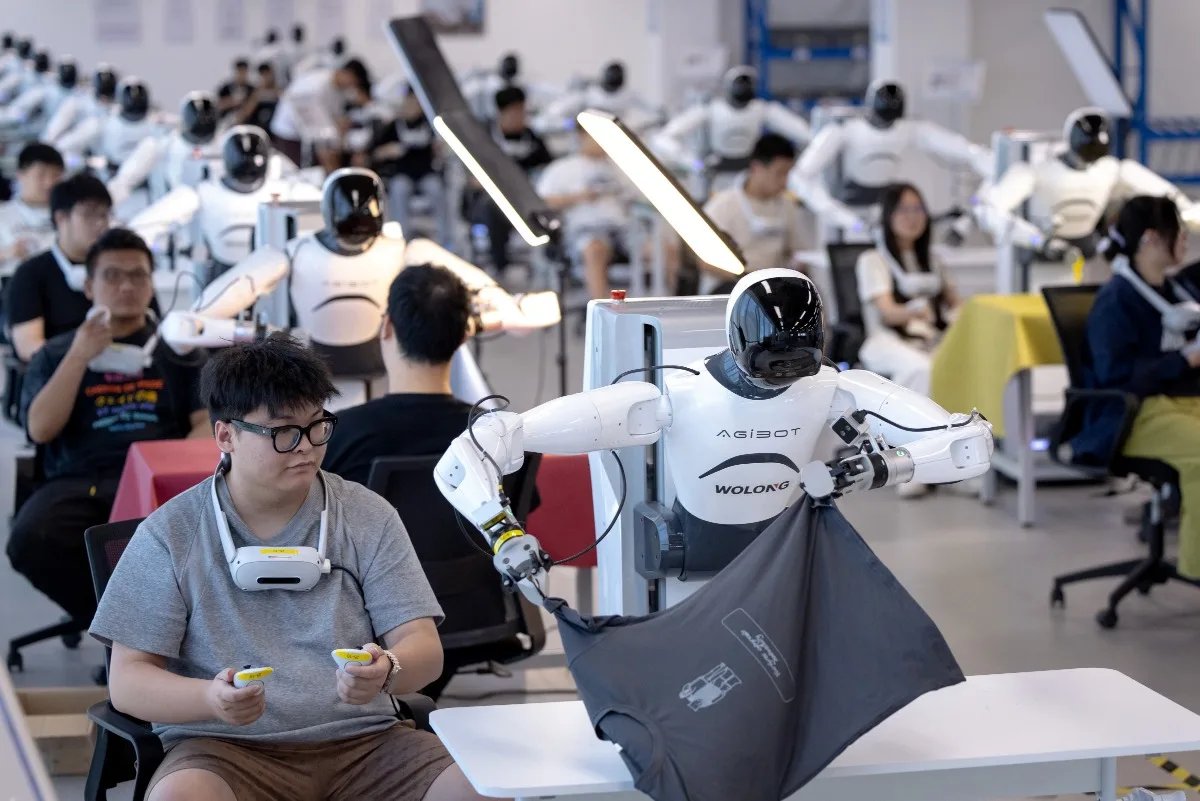
Nevertheless, some things are changing for the better. More than seventy percent of robots now go into industrial and commercial operations, compared with roughly half a year ago. The machines are moving from trade show stages into assembly halls and logistics centers. Revenue for the entire industry is estimated at $1.6 billion this year and should roughly double to three billion next year. For an industry that claims it will transform industrial manufacturing, those are still modest sums.
Rise and Fall on the Stock Market
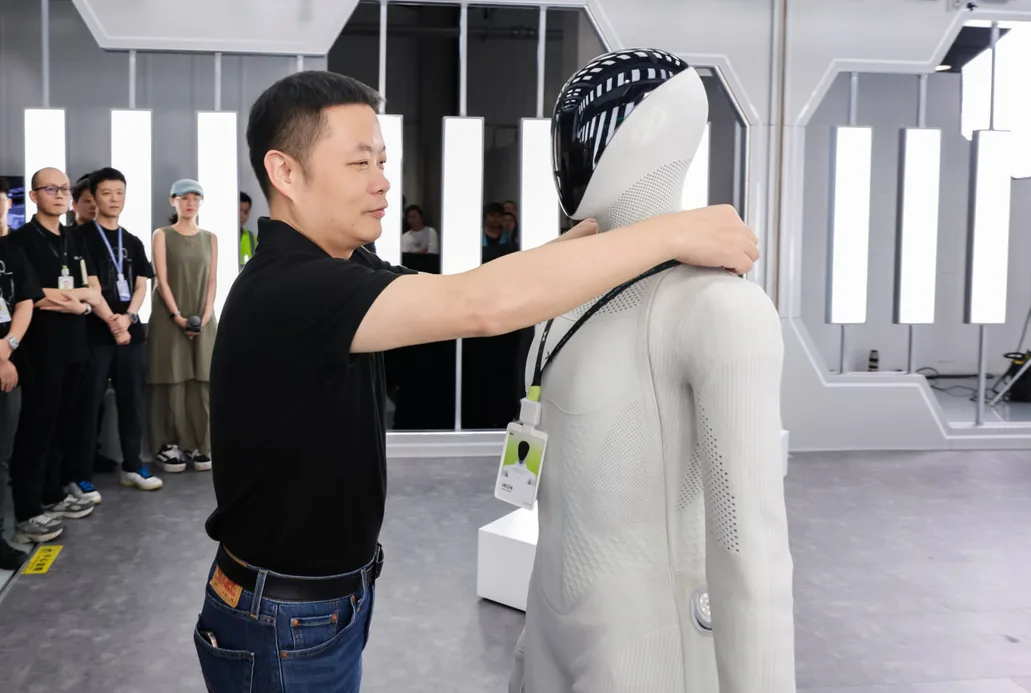
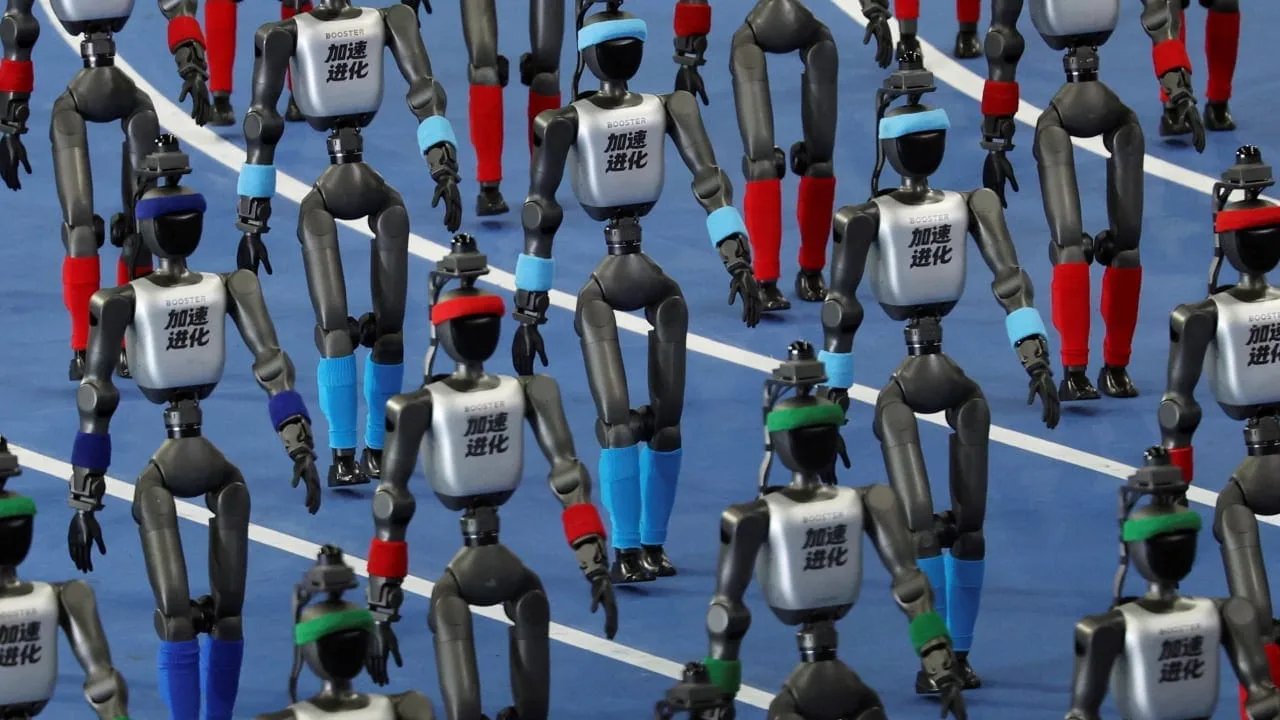
The company that best embodies this enthusiasm is Unitree. It was founded ten years ago by Wang Xingxing, and the wider public learned about it last year when its humanoids danced alongside people during the New Year's television gala, the most-watched program in China. Less than a month later, Wang was sitting in the front row at a meeting of entrepreneurs with President Xi Jinping, next to BYD chief Wang Chuanfu and Huawei founder Ren Zhengfei. This year, the robots added somersaults and jumps over obstacles at the same gala.
Its stock market debut came on August 19 on Shanghai's STAR Market. Unitree raised $900 million at a valuation of nine billion, but on the very first day of trading its shares jumped 460 percent and the company's value soared to $66 billion. America's Figure AI, with which Unitree is most often compared, was most recently valued at $39 billion. Such opening days are not unusual in China because the authorities deliberately keep IPO prices low to protect retail investors. But then the movement reversed. The shares fell nineteen percent on the second day, lost another two percent on Friday, and have continued to decline ever since. They have lost roughly forty-five percent from their peak.
Unitree's CEO Tempers Enthusiasm
In the midst of all this, thirty-six-year-old Wang spoke at the World Robot Conference in Beijing and said something that did not quite match investor behavior. According to him, robotics' breakthrough, something akin to the watershed moment for ChatGPT, will come in two to three years at the earliest, or in a worse-case scenario in five or even ten years. Yet at the same event last year, he described five years as the outer limit. He has therefore pushed back his own estimate.
He considers this breakthrough to be the moment when you place a robot in an unfamiliar environment and it can complete roughly eighty percent of tasks based solely on spoken or written instructions. Today, that is far from the case. Wang admitted that his machines work less efficiently than humans and must be retrained for every new task. In his view, it is precisely this inability to adapt to new situations that is holding the entire industry back.
The comparison with language models is not particularly apt. When ChatGPT was released at the end of 2022, it triggered an avalanche of competition and rapid improvement. Robots are more complicated because a capable brain must be paired with a body that does not break and can move precisely where it needs to. According to Wang, Unitree is working on a loop in which artificial intelligence tests the robot's control code and continuously scores the results together with humans. The goal is to perfect movement accuracy, because the machines most often miss their targets in the final centimeters or millimeters.
Beijing Tightens Rules for Stock Market Listings
In early September, it became clear that the sobering mood was not confined to shareholders. The China Securities Regulatory Commission sent informal guidance to some investment banks stating that approval of stock market debuts by humanoid robot manufacturers would become stricter. A company wishing to describe itself as such must demonstrate clear, recurring revenue as well as technological maturity. Promised potential and a high valuation are no longer enough on their own. There are several reasons for this. A great deal of private money has poured into the industry this year, the number of IPO applications has risen sharply, and the shares of newly listed companies are falling, led by Unitree. The authorities fear a bubble, losses for retail investors, and major shortcomings in the IPO process itself. They also said publicly what has long been discussed within the industry: that the market is full of imitators and genuine technological advances are scarce.
Tianlan Shao, co-founder and CEO of the Beijing-based company Mech-Mind Robotics, whose company also recently headed for the stock market, wrote on the Chinese social network WeChat that many Chinese companies working on physical artificial intelligence are creating fake and unsustainable revenue. He was responding directly to the report about stricter stock market listing requirements. If a large proportion of shipments go to customers who buy the machines for research, data collection, or to meet some kind of target rather than for actual work, shipment statistics look much better than the companies' financial performance. And that is precisely why the figure of 97 percent of global production can be interpreted in two ways.
Financing Continues to Accelerate
For now, the flow of capital has not stopped. Investors in China have poured record sums into robotics this year, and the queue for stock market listings remains long even after the rules were tightened. American and European companies are focusing on reliability and fine-tuning their products before beginning large-scale production. Moreover, the United States recently banned imports of new Chinese humanoid robots on national security grounds, giving domestic manufacturers a protected space in which they can grow without pressure from low-cost Asian competitors.
Sources: theinformation.com, forbes.com, finance.yahoo.com and wsj.com