- Atlas Robot Gets a New Four-Fingered Hand. It Can Handle a Drill, Nail Gun, and Welding Torch
- Why Doesn't Atlas's New Robot Hand Have a Pinky? Engineers Taped Their Fingers Together for an Entire Day to Find Out
- Boston Dynamics Unveils a Robotic Hand with 13 Degrees of Freedom. Humanoids Are Moving Toward Working with Tools
- Atlas No Longer Just Grasps Objects. Its New Hand Can Rotate Them Between Its Fingers and Sense Even a Gentle Touch
- A Hand That Learns in a Virtual World. Boston Dynamics Is Preparing Atlas for Real Factory Work
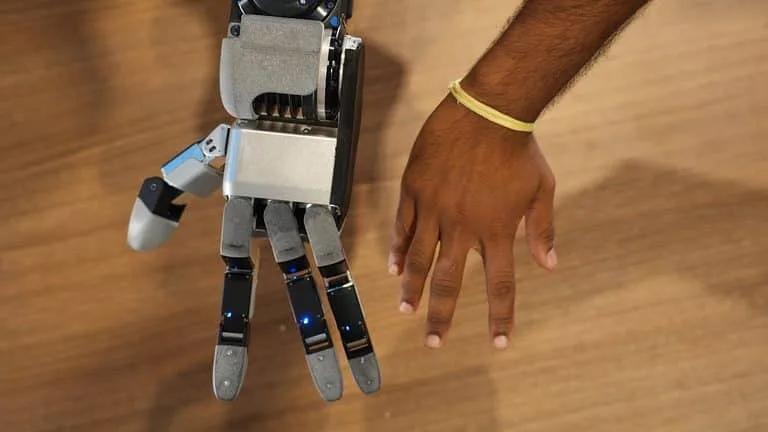
Boston Dynamics has unveiled a new hand for its humanoid robot Atlas. At first glance, it looks unusual because it has only four fingers. However, the engineers did not design it to replicate the human hand as closely as possible. They wanted the robot not only to grasp objects, but also to rotate them between its fingers, catch them if they slip, and, above all, work with common tools ranging from drills to welding torches.
The company says that developing a hand for a humanoid robot involves constantly seeking compromises between conflicting requirements. Dexterity, strength, durability, cost, ease of repair, and touch sensitivity often work against one another. The result is a solution that Boston Dynamics believes is ideal for real-world work in factories and warehouses.
Grasping and Handling Objects
Atlas's previous hand had seven degrees of freedom, and the developers designed it primarily to allow the robot to reliably hold as many different objects as possible. The new generation has thirteen degrees of freedom. The thumb moves along four axes and resembles a human finger much more closely than before. Each of the other three fingers has three degrees of freedom, allowing the robot to spread them apart and precisely control their tips.
As a result, Atlas can perform movements it could not manage before:
- run the tip of its thumb along both the length and width of the other fingers,
- grip a small object between the thumb and any other finger and move it,
- hold an object securely with three fingers while continuing to move it,
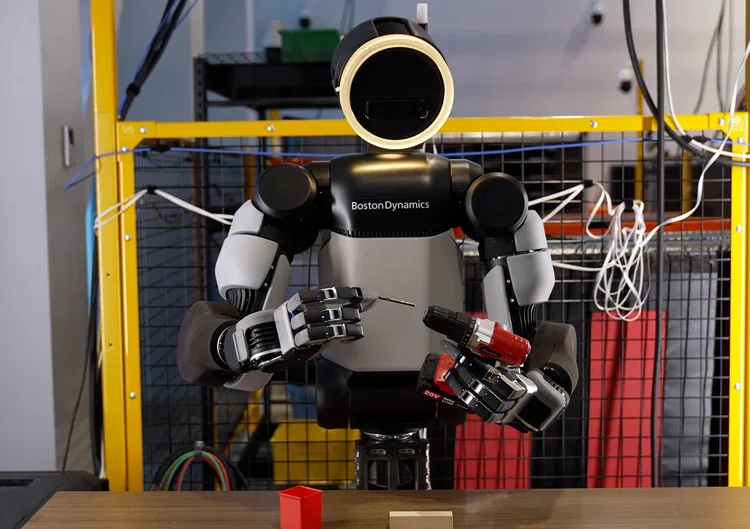
- wrap its fingers around a tool handle while simultaneously pressing its trigger.
It is this last ability that opens the way to using drills, impact wrenches, grinders, nail guns, and welding torches.
The hand is similar in size to a large human hand and, according to the developers, is also slightly stronger than the average person's hand. The engineers did not choose its dimensions randomly, because Atlas is intended to work in spaces built for people and reach into places workers normally access. Its similarity to human anatomy should also make it easier to learn from videos and recordings in which people demonstrate specific tasks.
The increased dexterity did not come at the expense of strength. The hand remains as powerful as its predecessor, which allowed the robot to carry a fully loaded mini fridge weighing more than 45 kilograms. Atlas itself can briefly lift around 50 kilograms and carry a load of approximately 30 kilograms for extended periods.
The developers also opted for simplicity inside the mechanism. It is powered by a single type of motor positioned directly in each joint. These motors are fully enclosed, and no fragile cables run through the structure. Such a hand is easier to manufacture in large quantities and also simpler to repair if necessary.
Why the Pinky Is Missing
The question of a fifth finger divided the development team from the very beginning. Adding a pinky would not have been technically difficult because the entire hand is composed of modules. The engineers even considered variants with two thumbs. In the end, a simple experiment settled the matter. Chief Technology Officer Zack Jackowski asked team members to tape their pinky and ring fingers together for an entire day and then describe which tasks this prevented them from performing. By the next day, it was clear that the robot did not need a pinky.
According to the company, four fingers are fully sufficient for rotating objects in the palm, catching items that are slipping, and holding tools while keeping their triggers pressed. A fifth finger would require three additional motors. That would mean a higher price, more space, greater energy consumption, and additional components that could fail. Boston Dynamics sums this up with the maxim that the best component is one that is not in the device at all.
The Hand Knows Where It Is
The designers created the hand so that its joints can also be moved by external forces. When a nearby object presses against a finger, the joint yields, and the robot uses the motors to determine exactly where its fingers are and how much force is acting on them. This phenomenon is known as proprioception, the same sense that allows people to know where their hand is even when they are not looking at it.
This feature also protects the hand during impacts. When the robot strikes something forcefully, the joint gives way. If the mechanism offered too much resistance or produced excessive friction, the gearbox would be damaged.
This internal awareness is complemented by sensitive pressure sensors covering the fingertips and palm. These sensors detect even very subtle signals upon contact with an object, which is especially useful for delicate manipulation.
Learning in a Virtual World
Human demonstrations provide an excellent starting point for the robot. Today, people wear special gloves or handheld sensing devices that record touches and changes in pressure while they work. However, Boston Dynamics notes that such recordings do not capture every detail. Fast and dexterous finger movements depend primarily on lightning-fast force control, which the robot cannot infer from human demonstrations alone.
The company has therefore opted for reinforcement learning in simulation, a method in which artificial intelligence learns through trial and error in a virtual environment. It already uses the same approach to train control of Atlas's entire body, including maintaining balance and recovering from a fall after tripping.
For this approach to work with the hand as well, the virtual model must behave exactly like the real mechanism. The engineers therefore fine-tuned three key areas: the geometry of the hand and the placement of its joints; the behavior of the motors, including friction, force, and backlash in the gears; and finally, how the fingers respond when touching objects. The control software also compensates for minor irregularities in motor operation and friction.
In simulation, the robot then trains across thousands of different variations. Motor strength, surface slipperiness, object shapes, and unexpected external interference all change. According to the company, the initial results look promising. The real Atlas successfully reproduced behavior that the robot had learned entirely in the virtual world, relying solely on data reported by the motors in its joints. The developers now want to deploy the entire process on a much larger scale.
More Capable Thanks to Tools
Why would a robot need such a dexterous hand when today's factories mainly automate the simple movement of parts from one place to another? Boston Dynamics gives two reasons. Traditional industrial robots work only when people precisely position parts for them and equip them with custom grippers. A humanoid, by contrast, is expected to pick up any object from anywhere, such as a shelf, bin, box, compartment, or pile. Moreover, most manual work that no machine has yet taken over revolves around tools, flexible cables, or picking parts from bins.
According to the company, there is no such thing as a universal hand. Sometimes soft fingers are useful to avoid scratching a surface, while at other times fingers as hard as pliers are needed to exert greater force. The engineers therefore refer to Aristotle, who called the human hand the tool of tools. It cannot perform every task on its own, but with the right tools it can accomplish almost anything. The developers want to apply the same logic to Atlas.
The hand was created as part of the latest fully electric version of Atlas, which Boston Dynamics is preparing for mass production. Together with carmaker Hyundai, the company is teaching the robot manufacturing and warehouse tasks at a dedicated training center in the U.S. state of Georgia. For now, the team is using the new hand primarily to train object rotation within the palm, because this ability is essential for future tool use and assembling parts.
Sources: bostondynamics.com, interestingengineering.com, and roboticsandautomationnews.com