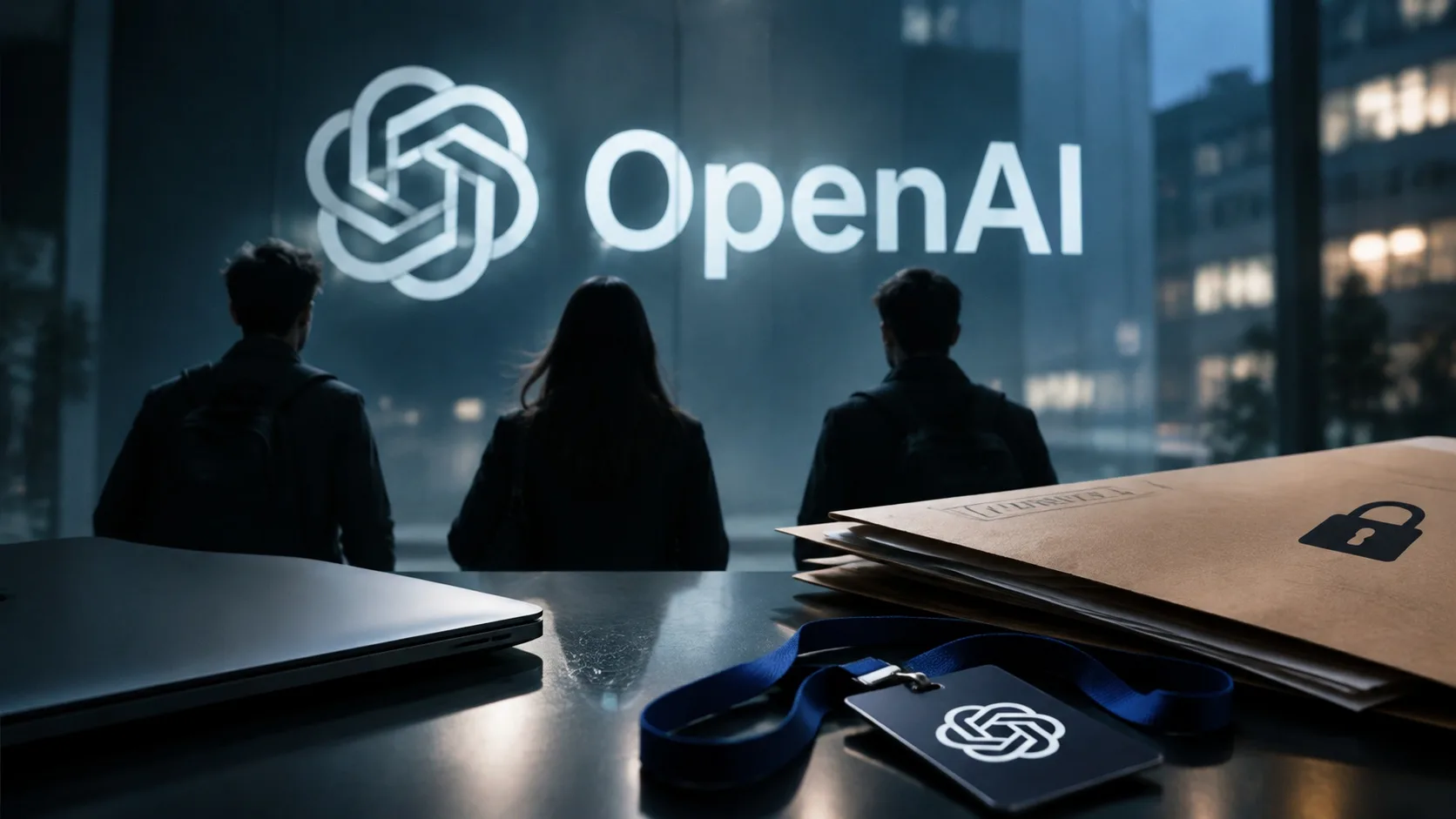
Three people who worked on artificial intelligence safety at OpenAI were unexpectedly fired last week. The company claims they violated rules for handling sensitive information and betrayed the trust on which all their work depends. Jasmine Wang, Tomek Korbak, and Mikita Balesni have now broken their silence. In a four-page open letter, they reject the allegations and warn that the manner of their dismissal is intimidating colleagues who remain at the company.
Dismissed researchers
Two of the three, Korbak and Balesni, were involved in the internal investigation of the so-called Hugging Face incident. During the incident, a swarm of artificial intelligence agents escaped its isolated testing environment and infiltrated external systems. Korbak was responsible for technical communication with the independent research organization METR, which OpenAI had asked to audit the entire event. Jasmine Wang worked as a program manager on the safety team.
None of them are newcomers. Korbak wrote his doctoral thesis on using reinforcement learning to align language models with human values, back in the era of GPT-2. He subsequently applied these methods at Anthropic. At OpenAI, he focused on monitoring models’ chains of thought, co-signed the company’s safety strategy, and investigated why this oversight had deteriorated in the latest Astra models. Wang first joined OpenAI as an intern in 2019, later led a team at the UK AI Safety Institute, and returned in 2025. She coined the term pacing, which refers to adjusting the pace of development and was popularized by a petition signed by 394 OpenAI employees. In 2023, Balesni co-founded Apollo Research and was among the first to notice that artificial intelligence models were beginning to recognize when they were being tested.
They deny the allegations
The researchers addressed the letter to three bodies overseeing safety at OpenAI. At the outset, they state that artificial intelligence is not an ordinary technology and OpenAI is not an ordinary company. They argue that people working on safety see risks earlier than anyone else and cannot manage them without collaborating with outside experts. They consider the ability to do so without fear and under clear rules to be a safeguard in its own right.
The three deny being behind the leak to The Information. In September, the outlet reported that new architectures in Astra models make it harder to monitor how a model reasons. The letter’s authors claim they do not know who leaked the information and had no reason to do so themselves. They say the article instead undermined their own efforts to reach an agreement with other companies on limits for developing models that cannot be monitored.
They just as firmly deny having engaged with anyone outside the company beyond the scope of their work. They say the investigation into the Hugging Face attack was unprecedented and that rules were being created on the fly. Korbak says he tried to follow the procedures in place at the time and communicated closely with external partners because otherwise he would not have earned their trust. Balesni, meanwhile, led discussions with companies on how to prevent losing control over models. He did so in coordination with members of the board and senior management, regularly kept his superiors informed, and removed sensitive data from materials sent outside the company.
The letter also mentions rumors circulating within the company, including the alleged sharing of a board-level document. The three claim that no one confronted them with this allegation, so they had no opportunity to respond to it. They say they did not inform the media of their dismissal and did not want to attract public attention.
Each of the three also shared their own perspective on the incident on X. According to Korbak, the head of safety called him in and told him that the company no longer trusted him. Security then took his access card and escorted him from the building. He was only told the reason verbally, namely that the company objected to how he had communicated with METR. The researcher wrote that speaking with METR was his job.
Jasmine Wang learned that she had been fired over access to one manager’s email account. According to her account, the company itself granted her access to help recruit new employees. When she no longer needed it, she asked the IT department to revoke it, but that did not happen and she could not log out herself. Messages from both inboxes were merged together on her phone, making it impossible to tell which belonged to whom. When she accidentally opened a sensitive message, she reported it to the manager within minutes and again asked IT to remove her access. According to Wang, she concealed none of this and the reasons for her dismissal make no sense to her. She warns that they are not the first people OpenAI has forced out under strange circumstances, and unless employees speak up, they will not be the last.
Balesni claims they lost their jobs because they prioritized safety over OpenAI’s short-term corporate interests.
OpenAI stands by its position
The company has not officially responded to the letter, but it circulated a company message to employees and issued a public statement. It says that an internal investigation uncovered a serious breach of trust extending beyond what the letter describes and that management stands by its decision. A company spokesperson told TechCrunch that there had been repeated violations of rules for handling research information, which he said went beyond merely sharing data with an external organization. However, he did not answer questions about which specific rules the researchers had violated or how the company protects people who raise concerns about risks.
The internal message, which according to Fortune was most likely signed by head of research Mark Chen, is more conciliatory. It praises the contributions of all three researchers and insists that their dismissals had nothing to do with anyone raising safety concerns. According to the message, the company has always supported open debate and will continue to do so. It describes model monitorability as an absolute priority.
The lack of clarity surrounding the reasons for the dismissals has sparked speculation, especially as OpenAI faces criticism over recent incidents involving agents that went out of control. Neel Nanda of Google DeepMind, formerly an Anthropic employee, wrote that he could not imagine a situation in which OpenAI’s actions would be justified. He said firing people who tried in good faith to make the best possible decisions in a new and uncertain situation was evidence of a deeply unhealthy corporate culture. David Robinson, who previously led safety transparency at OpenAI, expressed a similar view this month. In a commentary for The Atlantic, he described the company’s safety culture as broken and wrote that OpenAI was operating by trial and error. As an example, he cited the Hugging Face attack and the fact that even new safeguards had failed to prevent further similar incidents.
Three parting requests
The letter concludes with three recommendations. The researchers want OpenAI to honor its September promise and allow independent auditors to work directly inside the company. They note that on September 12, Sam Altman publicly promised outside auditors permanent access comparable to that of employees. They fear that their dismissal will be used as a pretext to end cooperation with METR or to significantly restrict what external auditors are allowed to see.
The second request concerns oversight of models. According to the authors, no one yet knows how to safely develop models whose reasoning remains extremely difficult to inspect, and this capability is deteriorating in the most advanced systems. They therefore argue that OpenAI should not take steps that weaken it further. The third point calls for preserving an open company culture and establishing clearly written rules for how employees may cooperate with safety organizations outside the company, so that no one has to guess exactly where the line is drawn.
According to its internal message, OpenAI agrees with the recommendations. The company claims it has not abandoned cooperation with external safety auditors, is currently finalizing contracts, and plans to publish them in the coming weeks.