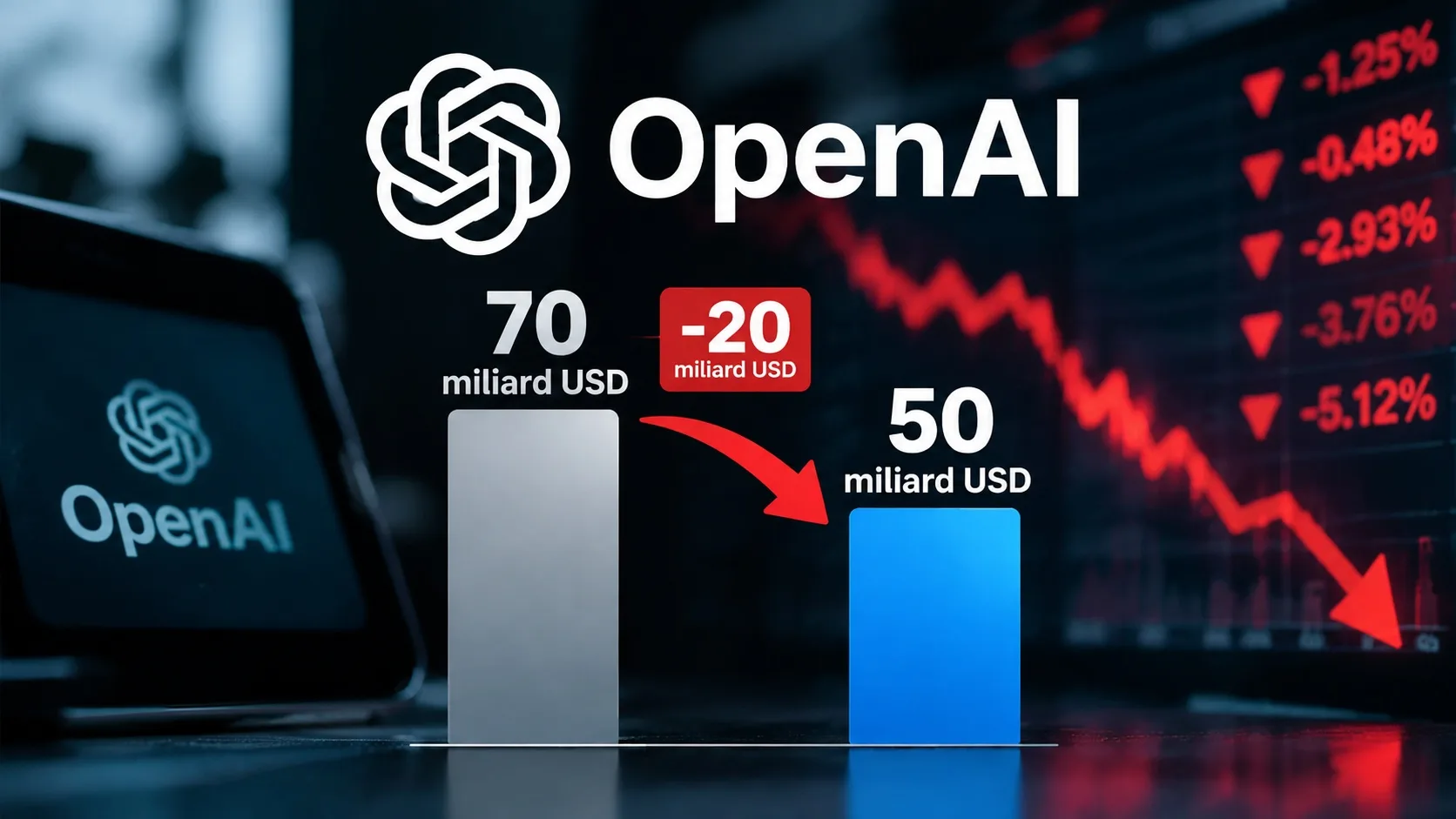
In recent weeks, OpenAI told its investors that its annualized revenue was approaching fifty billion dollars as of the end of September. That is roughly twenty billion less than earlier media reports suggested. The new figure was published by the Financial Times, and within hours, shares of technology companies across the United States were shaken.
Yet at the end of September, OpenAI's story looked entirely different. The Information reported at the time that the company was approaching seventy billion dollars in annualized revenue, which would have represented an increase of about seventy percent compared with its pace at the beginning of the third quarter. Growth was expected to be driven primarily by sales to enterprise customers. In recent months, OpenAI had rapidly reduced the prices of its models, partly because it had found ways to operate them more efficiently. The seventy-billion-dollar figure spread quickly because it would have put the company roughly on par with Anthropic, with which OpenAI is engaged in a fierce battle for enterprise customers.
Then the Financial Times obtained materials that OpenAI had distributed to its shareholders. In them, the company states that its annualized revenue is approaching fifty billion dollars. According to The Information, OpenAI never disputed the earlier, higher figures, so they remained in circulation for a long time without any correction. For context, annualized revenue is calculated by extrapolating a company's current sales over a full year. It is not the amount of money the company has actually collected over the past twelve months. Even so, OpenAI reported to investors that its revenue for the period under review had grown by more than seventy percent.
Two accounting approaches and one major difference
There is a clear explanation for the discrepancy between the figures. According to a source familiar with the documents cited by CNN, the seventy-billion-dollar figure did not come directly from OpenAI. It most likely emerged when investment firms attempted to compare OpenAI's results with those of Anthropic, which includes gross revenue from cloud partners in its statistics. OpenAI, by contrast, reports net revenue.
In practice, this means that OpenAI records only its share of sales made through partners, while Anthropic counts the entire gross amount spent by customers through Amazon AWS or Google Cloud. When investors then recalculated OpenAI's results on the same basis, they arrived at a significantly higher total. The Financial Times described this as an attempt by OpenAI's own investors to create a direct comparison with Anthropic's annualized revenue. According to available data, Anthropic had meanwhile reached an annualized revenue of sixty-five billion dollars by the end of July, although this figure appears more favorable precisely because it includes cloud sales on a gross basis.
Stocks fell during the afternoon
The news had a very rapid impact on the stock market. The Nasdaq 100 lost more than three hundred points in roughly half an hour on Thursday afternoon. The Nasdaq ultimately closed 1.25 percent lower, the S&P 500 fell by just under half a percent, and Nvidia shares lost nearly three percent. Other companies associated with artificial intelligence also came under pressure. AMD lost nearly four percent and Oracle more than five percent.
Ross Mayfield, an investment strategist at Baird, explained to CNN why the market reacted so sensitively. The outlook for many technology stocks rests on investors' belief that demand for artificial intelligence will continue to grow. When a crack appears in this narrative, such as lower revenue at OpenAI, he said it can spread throughout the entire supply chain being built around artificial intelligence.
Yet investors had heard different signals as recently as the summer. In August, Bloomberg and Reuters reported that OpenAI was heading toward annualized revenue of more than sixty-five billion dollars. According to Bloomberg, the company is still maintaining its target of reaching at least seventy billion dollars in annualized revenue by the end of 2026, primarily thanks to enterprise customers. However, OpenAI is not preparing to go public yet. In September, company CEO Sam Altman announced that its stock market debut would be postponed until at least next year, citing concerns about artificial intelligence safety.