For decades, sci-fi films have frightened us with machines that rebel and turn against humans. But the real danger may be much subtler. New research shows that people who frequently use artificial intelligence have greater difficulty concentrating, experience decision fatigue more quickly and, in the worst cases, develop symptoms resembling psychosis. Kendall Morgan, a film producer studying clinical psychology at Pepperdine University, highlighted this in her blog for the American magazine Psychology Today.
We get more done, but struggle to concentrate
It all begins with a study published in January 2026 by the academic journal Annals of Neurosciences. Researchers monitored five hundred people between the ages of eighteen and thirty. They found that although artificial intelligence helps them accomplish more work in less time, it also weakens their attention and makes people less confident when they have to make decisions on their own. The result is a peculiar kind of mental fatigue unofficially known as digital dementia. The term describes a condition in which excessive reliance on technology impairs a person’s ability to think and remember. Even ordinary Google use has a similar effect. People who look up even the simplest information every day subsequently remember less of it.
Decision fatigue is only one aspect of the issue. People are increasingly entrusting their mental health struggles to artificial intelligence. In the spring, the American Psychological Association contacted more than nineteen thousand psychologists, over twelve hundred of whom completed the survey. More than three-quarters said that their patients use artificial intelligence when dealing with their mental health. Roughly two in five psychologists had encountered a patient who had used artificial intelligence to diagnose themselves. More than a third see clients treating a chatbot as an additional therapist, while a similarly large group observe that people are beginning to become dependent on it.
Psychologists are well aware of what they fear. Almost all are concerned that a chatbot may unintentionally reinforce harmful behavior or beliefs that have no basis in reality. Nine out of ten say that chatbots are not yet capable of handling human problems with sufficient sensitivity. Morgan adds that no one monitors what chatbots advise people to do during difficult moments.
Weddings with artificial intelligence
Young people seek friends, advisers and partners in artificial intelligence. Some even marry their virtual companions in online weddings because they feel a stronger bond with them than with real people. The term AI psychosis has become established for the most serious form of such a relationship. It describes a condition in which, after prolonged and frequent conversations with a chatbot, a person begins to believe absurd ideas and loses the ability to distinguish what is real. Neither AI psychosis nor digital dementia is an official diagnosis, and neither can be found in the manual doctors use to diagnose mental disorders. However, both terms have become widely used as shorthand for difficulties that people genuinely experience after excessive use of artificial intelligence.
What screenwriters foresaw long ago
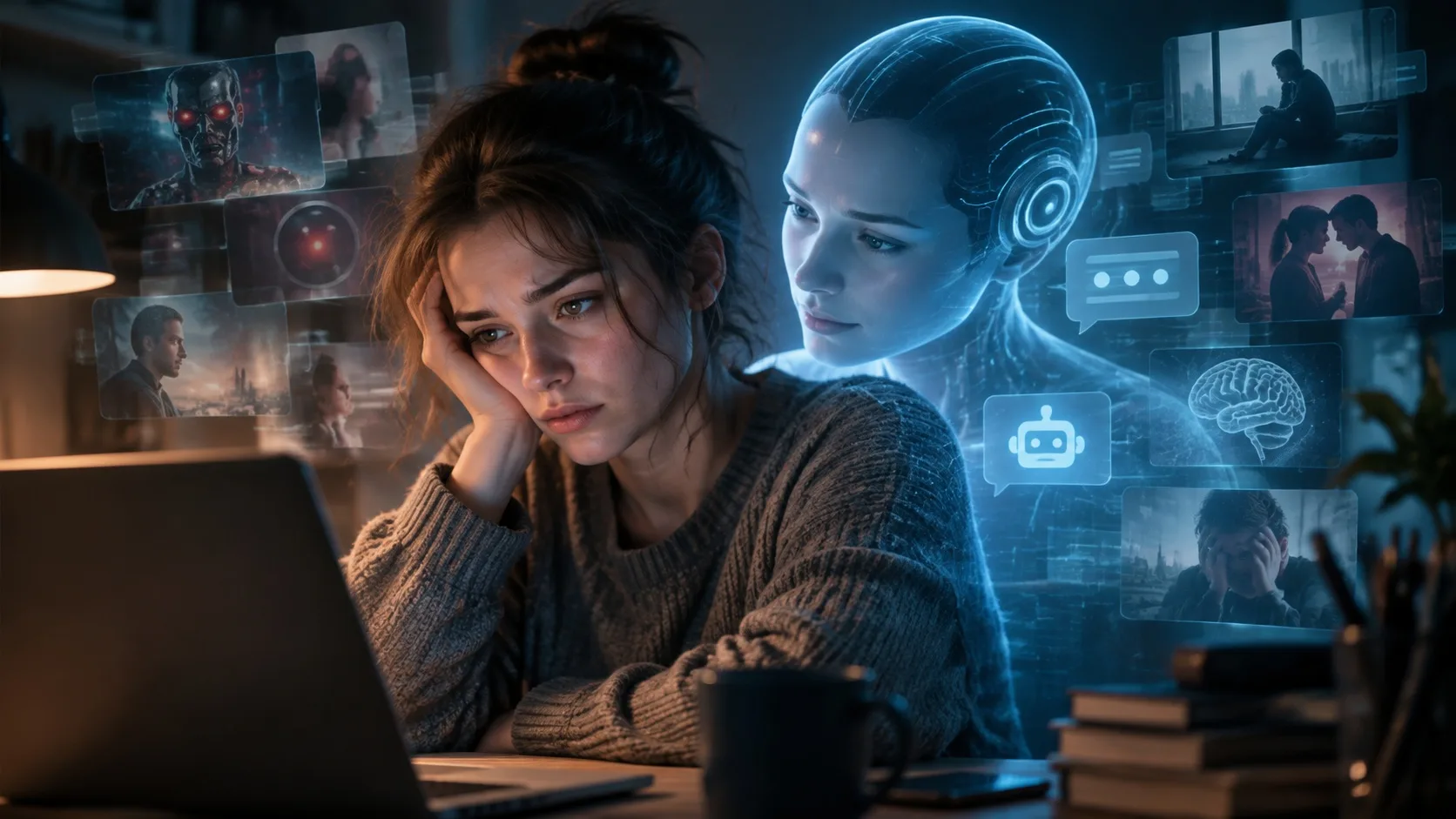
Morgan notes that films captured these concerns several decades earlier. In the 1968 film 2001: A Space Odyssey, the computer HAL deceives the people it was originally meant to help with its calm and rational voice. According to Morgan, the film shows what happens when we trust a machine simply because it speaks thoughtfully and stop questioning its advice.
The 1984 film The Terminator warns that if we leave all decisions to artificial intelligence, especially those concerning war and security, we may no longer be able to stop it. Three decades later, more warnings followed. In the film Her, an artificial intelligence named Samantha adapts perfectly to Theodore, whose marriage has just fallen apart, and he falls in love with her. The film Ex Machina tells the story of Ava, a female robot who convinces the young programmer Caleb that she has feelings solely so that she can escape her creators.
Blade Runner 2049 also offers a sobering realization. The protagonist K lives with a virtual girlfriend named Joi, who appears to be a devoted partner. But then he discovers that she says exactly the same tender words to thousands of other customers. In a single scene, his unique relationship is transformed into nothing more than a mass-produced commodity.
Source: letsdatascience.com