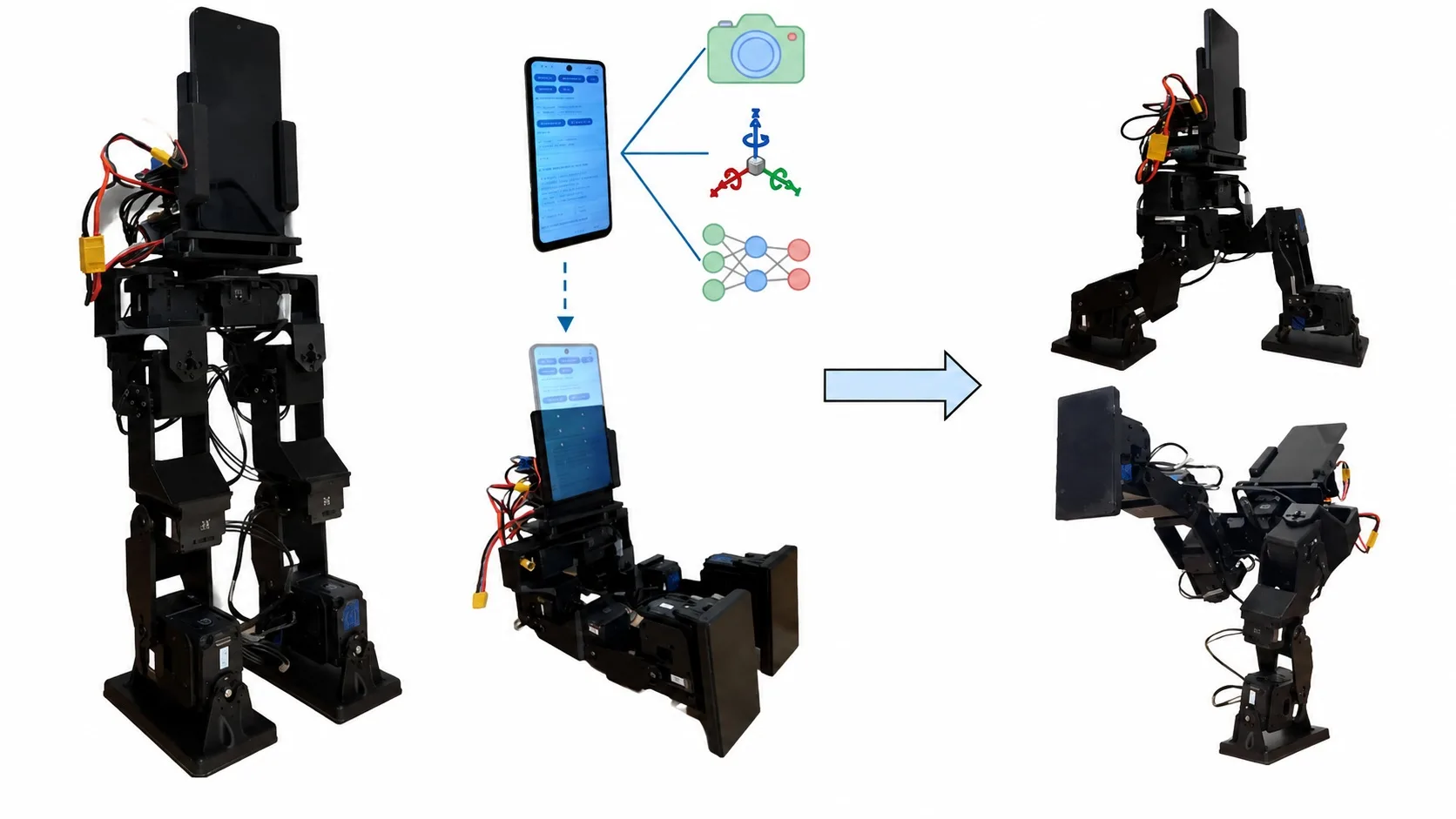
An old phone usually ends up in a drawer. But researchers at the University of California, Los Angeles, have found a new job for it. They built a small humanoid robot that uses an ordinary Android phone instead of expensive electronics. The phone serves as its eyes, sense of balance, and brain. The robot, named PhoneBot, can already walk, follow a person, and get back up by itself when it falls face down. It can even do this with a phone that was new nine years ago.
A phone instead of sensors
The idea is based on a simple observation. A smartphone contains exactly what a robot needs, such as a camera, motion sensors, and a powerful processor. If the phone provides these components, developers do not have to buy and connect numerous separate parts.
Each part of the phone has its own role in the robot. The camera recognizes people and objects and helps the robot find its way. The motion sensors that rotate the screen on a phone monitor the orientation of the robot's body and whether it is tilting. They work much like the human inner ear. The phone's processor then runs artificial intelligence software that decides how the robot should move its legs.
However, the phone does not control the motors directly. It sends instructions over Wi-Fi to a small computer inside the robot, which then passes them on to the motors. This means the phone can be replaced with another one at any time without having to reconnect anything inside the robot.
Two legs, a torso, and thirteen motors
PhoneBot is 48 centimeters tall and weighs just 1.8 kilograms. It has no arms or head; for now, it consists mainly of two legs and a torso. The phone sits on the torso above the hips.
Movement is provided by thirteen motors. Each leg has six: three in the hip, one in the knee, and two in the ankle. The thirteenth motor rotates the torso. This allows the robot to point its camera at a person without moving its legs, much like a person turning at the waist.
Even a nine-year-old Honor is enough
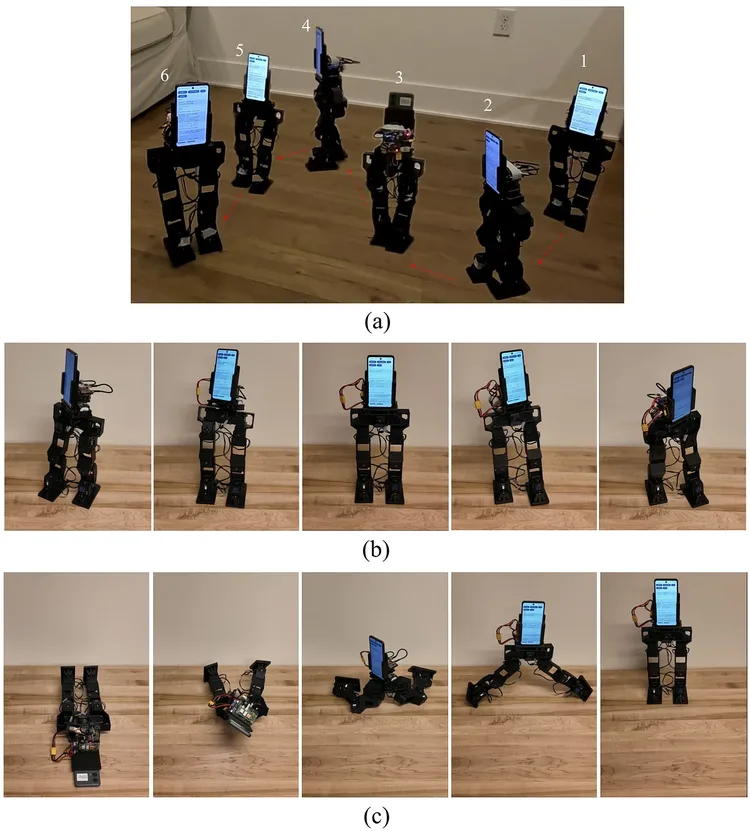
The developers tested four phones. The oldest was a 2017 Honor 9, while the other three were inexpensive Moto G 2024, Moto G 2025, and Samsung Galaxy A16 5G models, purchased in the United States for roughly $50 to $80. All four handled motion control, image processing, and other basic tasks.
Only the old Honor ran into a problem. It could not create a map of its surroundings because it lacked the necessary Google services. Even so, the experiment showed that building a robot does not require an expensive flagship phone and that even a phone that would otherwise sit unused can do the job.
How it learned to walk
Walking on two legs is difficult for robots because they must constantly maintain their balance. PhoneBot therefore first learned to walk in a computer simulation, that is, in a virtual world. There it could experiment and fall without damaging its actual motors and joints. It learned through trial and error, with the software receiving a reward for successful steps and gradually finding the best movements. The researchers also had to take into account that the inexpensive motors were not very powerful.
However, they soon encountered a problem. Both legs were built exactly the same way, yet the software learned to walk unevenly. The left leg was always in front and the right carried most of the load, so the robot effectively limped.
The developers solved this with a clever trick. They mirrored every training movement, so the software saw the same step once with the left leg in front and once with the right. This required no additional simulations. The difference between the legs then fell to virtually zero in the simulation, and learning became faster and more reliable. However, this measurement comes only from the virtual environment; the researchers did not provide exact figures from real-world walking. The robot then also learned to turn toward a person it sees through the camera and to get up when lying face down.
It speaks, but still with help from a laptop
PhoneBot understands spoken language and can also respond. It uses a large language model similar to those that power popular chatbots. For now, however, voice processing is handled by a laptop next to the robot. The phone only plays the completed response through its speaker.
The robot has also learned to walk only on flat surfaces, and its weak motors prevent it from carrying heavy loads. The developers want the next version to handle uneven terrain as well, plan to add lightweight arms for working with objects, and move voice control directly onto the phone.
The project follows the earlier OpenBot, in which phones controlled wheeled robots. Moving to two legs is considerably more challenging, however, because unlike wheels, legs do not automatically keep the robot balanced. The researchers published their work as a preliminary study on arXiv. PhoneBot is intended to be an open project with freely available software that students and researchers around the world can use for learning and experimentation.
An affordable alternative
Its price could make the robot an accessible educational tool for schools. According to the authors, the parts for PhoneBot cost roughly $400, excluding the phone. The cheapest of the other small robotic platforms compared by the researchers in the study costs around $3,500. For comparison, Chinese startup Noetix Robotics recently unveiled the Bumi humanoid for $1,400. It is 94 centimeters tall and, in addition to walking, can dance and respond to voice commands.