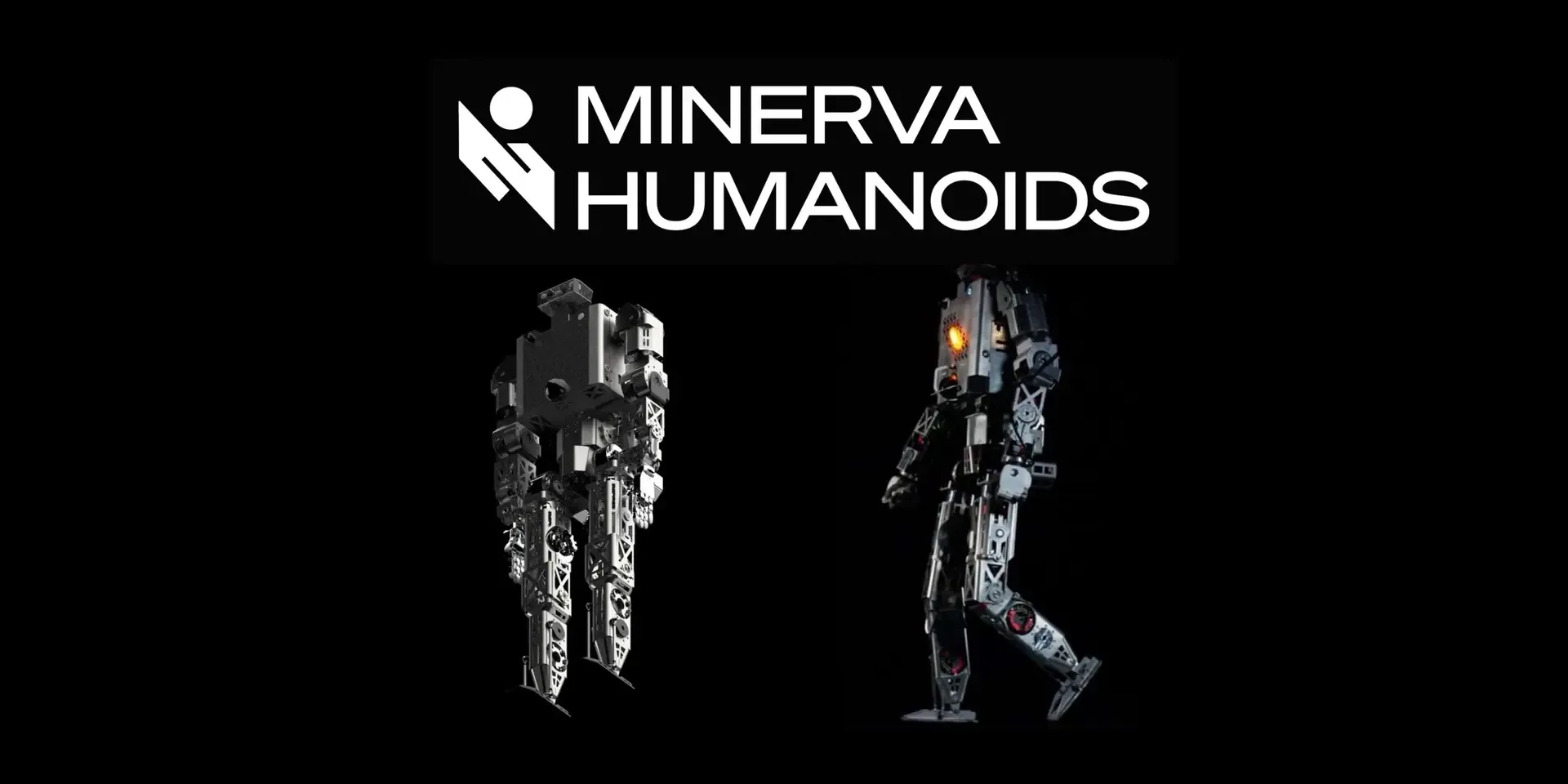
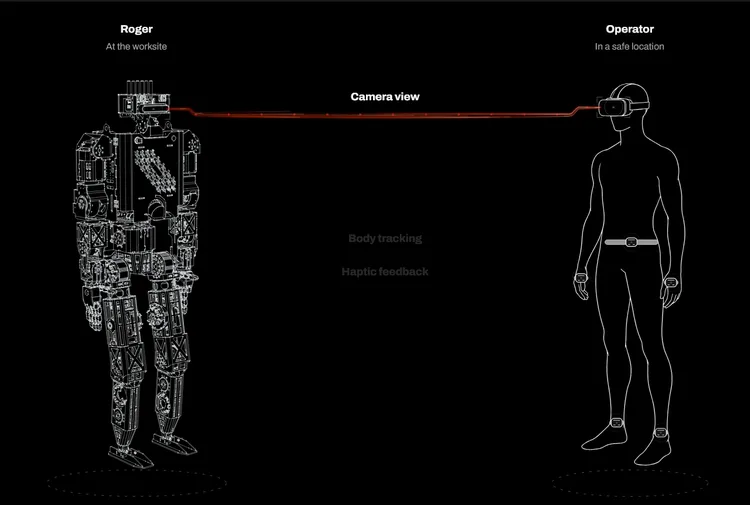
A bomb disposal technician sits safely, wearing a virtual reality headset and special gloves. Several hundred meters away, a humanoid robot stands beside a suspicious device, precisely copying every movement of his fingers. This is exactly how the young startup Minerva Humanoids envisions bomb disposal work. Its robot Roger was developed in five months, and the company unveiled it to the public for the first time in early October. The project is backed by people who have built humanoid robots for the biggest names in the industry. Software development takes place in the US, while the prototypes are built in Germany. Two Czech investment funds have also invested in the company.
Humans decide and AI controls
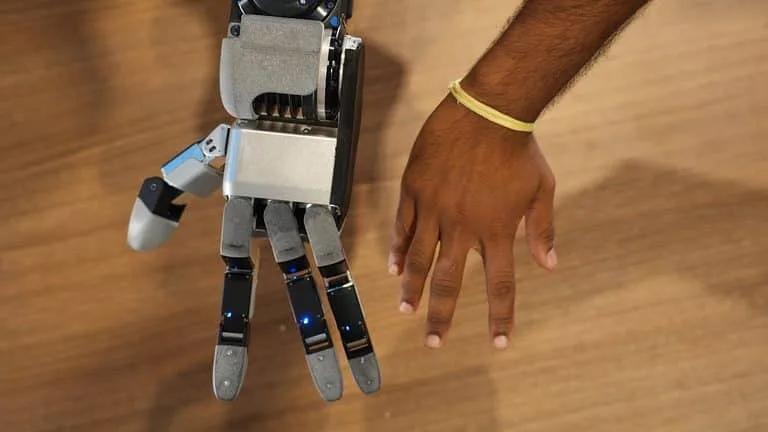
Roger is not a fully autonomous robot. A specialist controls it remotely and can see through its cameras in real time what is happening around the machine. The gloves also provide a sense of touch, allowing the operator to feel what the robot is touching with its hands. Thanks to the high-speed connection, the machine replicates the person's movements almost instantly.
A proprietary artificial intelligence system called Minerva Intelligence handles complex technical processes for the operator. It maintains balance, adjusts the walking route, and helps the robot get back up if it falls. This allows the human operator to focus solely on the delicate work itself. According to the company, a technician can learn to control the robot's entire body in less than five minutes.
The robot is intended for use wherever work is too risky for humans. In addition to bomb disposal, this includes handling toxic substances, working around high voltage, and operating on offshore oil platforms or in refineries.
The long walk every bomb disposal technician knows
Bomb disposal technicians have been using robots for years. However, these are usually tracked or wheeled vehicles with a single mechanical arm. They are sufficient for basic tasks, but when great precision or the simultaneous use of both hands is required, a person still has to approach the explosive device.
This problem is described by Dominic Asquith, a veteran of the British special forces who heads Minerva's hazardous operations division. According to him, every bomb disposal technician knows that long walk when the robot cannot complete the task and the operator has to put on a protective suit and approach the explosive device personally.
Roger is designed to spare people that very walk. An experienced specialist will continue to make every decision and control the work in as much detail as if they were standing at the site. The only difference is that they will remain safe.
Competitor L3Harris offers the T7, a single-arm tracked robot that can also climb stairs and provides the operator with tactile feedback. In February 2025, HDT demonstrated a two-arm version of this machine to the UK Ministry of Defence. Minerva will therefore have to show that a walking body with human proportions offers something extra in practice.
Design and manufacturing
Minerva was founded in late 2025 by Sandor Felber and Maurice Rahme. Felber, who leads the company, previously conducted humanoid robotics research at MIT's artificial intelligence laboratory and worked on Tesla's Optimus robot. CTO Rahme spent six years at Boston Dynamics, where he was one of the principal technical leads for the Stretch warehouse robot. He guided it from the first prototypes through to customer sales.
The team built the hardware from scratch and went from the initial idea to a fully functional walking prototype in five months. This period included the design, manufacturing, and assembly of Roger.
The company is headquartered in San Francisco and also has offices in Cambridge, Massachusetts, and Sindelfingen, Germany. The software is developed primarily in the US, while the first prototypes are manufactured and assembled in Germany. In the future, Minerva plans to manufacture in both countries.
Trials with NATO and at airports
Even before its official unveiling, Roger underwent testing at NATO's Explosive Ordnance Disposal Centre of Excellence in Šamorín, Slovakia. The company demonstrated the robot there and gave a presentation. Successful field trials were also conducted at two major international airports.
Minerva is collaborating with Mohamed bin Zayed University of Artificial Intelligence and Canada's University of Waterloo. Together, they are researching how the robot performs in dense smoke, complete darkness, or when its sensors suddenly fail.
The company also sees significant potential in the energy sector. According to its estimates, around 7,000 people worldwide die each year while working in this industry, equivalent to roughly one person every 75 minutes.
First contracts, but questions remain
The startup announced that it would launch its first paid pilot projects in the energy sector and bomb disposal in the fall of 2026. As of October 12, however, the company had still not confirmed that they had begun.
Experts point out that real-world performance will be decisive. Bomb disposal technicians will want to know how good the feedback from the gloves really is and how reliable the connection is. Equally important is what happens if visibility deteriorates or the signal is lost. If someone had to retrieve a damaged robot in person, it would reintroduce the very risk Roger is meant to prevent. The pilot project results should therefore show, in particular, how often the robot allows a technician to complete the work without having to enter the danger zone.
Funding also came from Prague
When Minerva emerged publicly, it announced an initial funding round of approximately $10 million. It was led by the American fund General Catalyst. It was followed closely by Prague-based Credo Ventures, which made money from companies such as UiPath and was among the first investors in ElevenLabs. Smaller investors include Hugging Face and another Czech fund, Kaya, which holds stakes in companies including E2B and Rohlik.
Kaya partner Karel Zheng explained why the fund decided to back the project. According to him, fully autonomous humanoids are still years away, but remote control already works today. Minerva can therefore begin selling immediately while collecting data that will gradually bring it closer to autonomy. The robot's human form also makes sense because refineries and emergency response sites are built for people, with ladders, valves, doors, and standard tools. Tracked or quadrupedal robots encounter limitations in such environments. Moreover, customers in this sector are not paying for cheaper labor, but to prevent people from having to risk their lives.
Karel Zheng added that he sees potential in the startup beginning in an area where the problem is urgent and customers are willing to pay significant sums, allowing it to expand from there into other high-risk industries such as mining, defense, or emergency management. At a time when Europe and NATO are developing their own security technologies, he believes a trusted Western supplier in this sector will be highly valuable.
Sources: newsukraine.rbc.ua, therundown.ai and lupa.cz