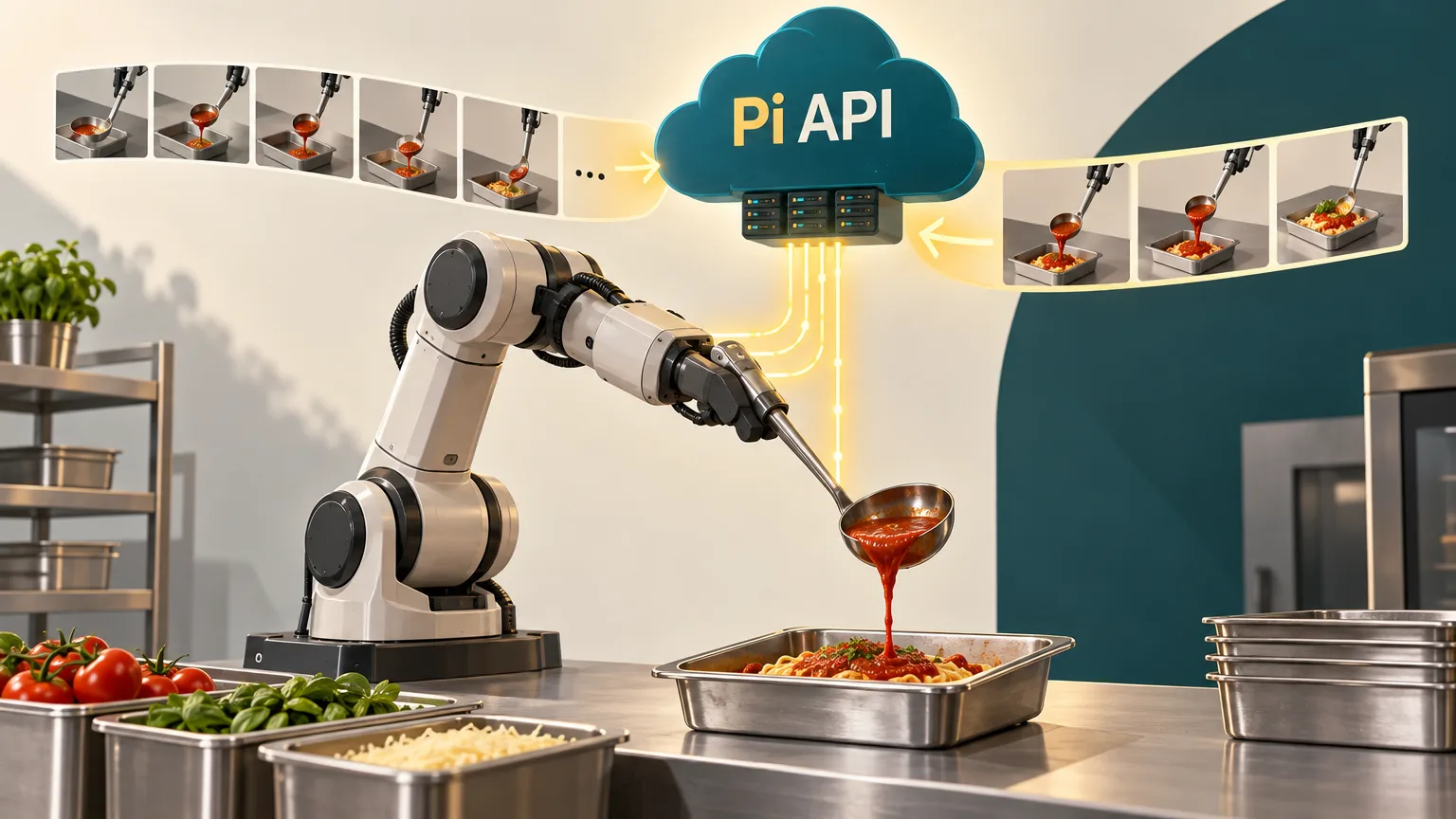
Physical Intelligence has launched the Pi API beta, giving outside teams access to its robot foundation models. Developers can upload data from their own robot, fine-tune a model and use it through a hosted inference interface. The company manages the computing infrastructure for training and serving models, work that teams have typically handled themselves.
From remote-controlled demonstrations to action predictions
Work with the API begins on the target robot. The team controls it remotely and records successful demonstrations of the intended task, then uploads the dataset to Pi’s infrastructure to fine-tune a foundation model. During operation, the robot connects to a hosted gateway that supplies action predictions.
The main change from adapting the open-source π0 and π0.5 models is who handles the infrastructure. Teams working with those models have typically provided their own training compute, data pipelines, deployment tools and model serving. Pi API takes over the computing infrastructure for fine-tuning and serving.
According to Physical Intelligence, subsequent training rounds should be guided by recorded failures. Teams collect targeted demonstrations of problem situations and retrain the model. The company’s examples include garments turned inside out and ingredients falling from a scoop, as well as manufacturing parts landing in the wrong position.
Almond built a deburring model in four days
Partner Almond provides a concrete example of work with the API. After four days of iteration, it produced a model for its dual-arm Axol robot, which removes burrs from spacers used in assembly.
At partner Actor, robotic control is being used for material handling. In a commercial deployment, an autonomous wheel loader scoops material and loads it into a dump truck without an operator inside the machine.
Other described applications include food preparation and plating at Chef Robotics, CloudChef and Omakase. In agriculture, AgRobotics uses robots to harvest strawberries.
Cloud inference puts demands on connectivity
Physical Intelligence says most partner applications used cloud-hosted inference. Partner projects took place in Japan, Switzerland and the United States.
Those deployments also exposed connectivity problems. With cloud-based control, the robot sends observations to a remote model and receives action predictions in return. Network latency and connection dropouts therefore become part of the control loop.
The team using the API remains responsible for robot integration, data quality and evaluation. It also retains responsibility for local safety systems, recovery from failures and respecting the hardware’s mechanical limits.
Beta access via waitlist, with newer models planned
Access to the beta currently requires joining a waitlist. Physical Intelligence says its latest model available through the API improves fine-tuning efficiency and partner performance.
The company also plans to make newer foundation models available through the same API endpoint.