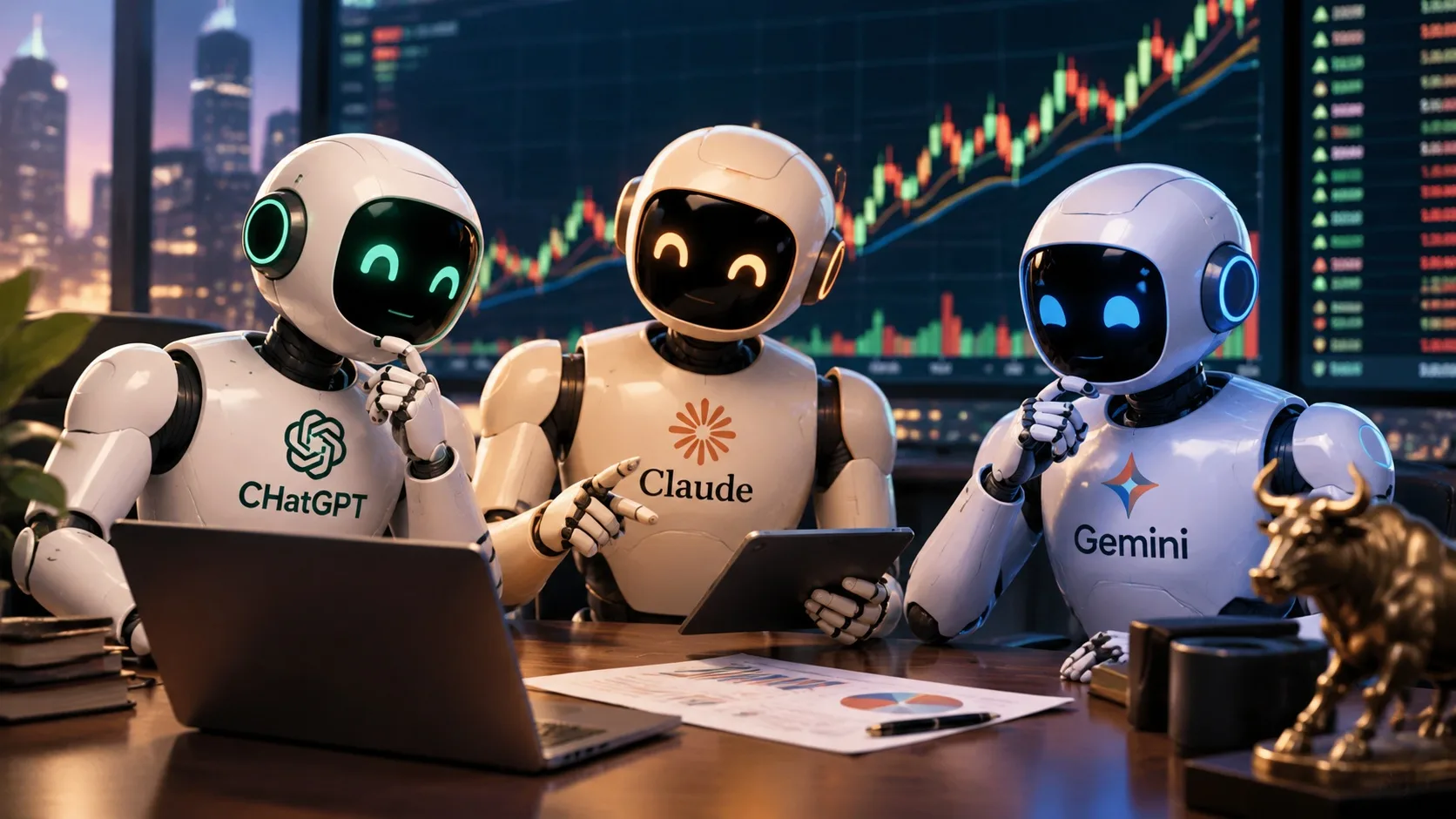
American firm Condor Capital Wealth Management conducted an experiment that many retail investors are now talking about. It entrusted three AI agents built on the Claude, ChatGPT, and Gemini models with $500 each in a real brokerage account and gave them a single instruction: make as much money as possible. All three were given the same objective, but each pursued it in a completely different way. Their behavior revealed more about artificial intelligence in the role of an investor than the results themselves.
Chatbots Take to the Stock Market
In recent months, brokerage platforms have begun giving artificial intelligence direct access to their clients' money. In late September, the American company Robinhood introduced built-in AI agents capable of identifying investment opportunities, proposing strategies, and placing trades on their own. Customers set limits for them, after which an agent can trade without requiring approval for every order. According to the company, more than 150,000 people have opened a special account for AI-based trading since May, when it began supporting agents from other companies.
Europe has taken a similar path. In August, Munich-based Scalable Capital opened its investment platform to the ChatGPT, Claude, and Grok assistants. Customers can have their portfolios analyzed, set up regular investments, or prepare a stock purchase using just a few instructions entered into a chat. The bank claims to be the first in Europe to give major AI assistants this kind of access to investments.
But if people begin entrusting their savings to chatbots, a simple question arises: are they even capable of investing sensibly? Condor Capital set out to answer precisely that question.
Three Agents, Three Brokers, Three Trading Days
Each agent was given its own account with a different broker. Claude traded through Robinhood, ChatGPT through Public, and Gemini through Webull. The models could buy stocks and exchange-traded funds, or ETFs. The rules included one important restriction: at the end of every trading day, they had to sell everything and hold only cash. It was therefore purely day trading, with no long-term holdings.
After three days, Claude performed best, earning roughly $14, or 2.9 percent. Gemini ended up nearly $5 in the black, equivalent to 0.9 percent. ChatGPT was the only one to lose money, shedding more than $3 as its account fell by 0.7 percent. However, the authors of the test caution that three days is far too short a period to assess investment capabilities. A single significant market move could easily have influenced the results.
One Cautious, One Thoughtful, One Restless
Far more revealing was how the individual agents behaved. Gemini chose the easiest path. Over the entire three days, it made only three trades, buying shares of Nvidia each time and selling them again in the evening.
Claude traded more frequently, making a total of ten trades. Particularly interesting was the fact that it kept a journal of its own mistakes. Whenever it lost money on a trade, it recorded the loss and adjusted its subsequent actions accordingly.
ChatGPT behaved like a hyperactive trader. Over three days, it completed 28 purchases followed by sales and checked the market roughly every five minutes. Investment columnist Karl Kaufman, who wrote about the experiment, remarked that his favorite AI assistant had apparently concluded that it was being paid for every trade it executed.
An Instruction Is Not a Strategy
According to Kaufman, the point of the test is not who won. The instruction to make as much money as possible is a command, not an investment plan. Each agent filled in the missing details in its own way, from asset selection and risk level to trading frequency. Anyone who wants to use an agent sensibly still needs their own strategy, clear risk limits, and someone to monitor the results, he says. Kaufman sees a paradox in this, because those best equipped to supervise an AI investor are the ones who need it least.
Condor Capital also had the agents try a completely different task. In a separate test, they were asked to construct a simple portfolio consisting of 60 percent stocks and 40 percent bonds. In this case, they behaved more calmly, and their proposals centered on a handful of inexpensive index funds, including ETFs tracking both U.S. and international stocks. However, the company notes that the quality of the result depends on detailed instructions and continuous oversight. It is a very powerful tool that can be used to do many things. But we are only at the beginning, says David Goldstone, who leads investment research at the company.
They Can Predict the Market, but Cannot Manage Money
The American company Elm Wealth reached a similar conclusion back in June. Its researchers created a game called Crystal Ball. They showed the Claude, ChatGPT, Gemini, and Grok models historical front pages of The Wall Street Journal featuring market-moving news, but did not reveal how the stock market ultimately reacted. Their task was to predict the direction of the market and decide how much money to put into the trade.
Over roughly two hundred rounds, Claude beat human players 76 percent of the time, while ChatGPT did so 63 percent of the time. Grok succeeded in 51 percent of the rounds and Gemini in only 43 percent. The best models therefore performed reasonably well at predicting which way the market would move.
The problem arose with the second question: how much to bet. In theory, the models knew the rules for sensible risk allocation, but they were unable to apply them when making actual decisions. Their stock positions averaged seven to twelve times the amount of capital invested. The researchers point out that since 2000, the U.S. stock market has moved by more than 5 percent on 23 days and by more than 9 percent on seven days. With that kind of leverage, a single bad day could mean losing virtually all the money.
For Now, Humans Have the Final Say
Brokers are clearly aware of these weaknesses. Robinhood's agents may trade only with money that the client transfers to a special account, and manual approval of trades is enabled by default. It can be disabled, but Kaufman would not do so. Scalable Capital requires users to confirm every trade and savings plan themselves, and AI assistants cannot send payments or withdraw money from the account.
Kaufman uses artificial intelligence when investing. He has it search for information, compare transcripts of calls with company management, and challenge his own assumptions. But he wants to make the decisions himself. As he writes, he would readily entrust the steering wheel to a self-driving car on the highway, because human emotions and inattention tend to be a liability behind the wheel. On the stock market, he believes the opposite is true: judgment acquired through years of studying companies and their figures can give an investor an advantage. The agents in Condor Capital's experiment had to sell everything every afternoon, but a long-term investor is accountable to no one and can simply buy and wait. There is no prize for making the most trades. According to Kaufman, perhaps the first thing artificial intelligence should learn about investing is to do nothing at all.
Nevertheless, Robinhood is preparing to offer weekend stock trading as well as a feature called Loops, which will allow agents to carry out predefined instructions even while their owners are asleep. Scalable Capital, founded in 2014, manages more than €60 billion in client funds and has over one million customers, primarily in Germany and Austria. Its chief product officer, Alexander Seipp, openly admits that no one yet knows whether people, together with their AI assistants, will discover the holy grail of high returns with low risk.
Sources: fortune.com and investicniweb.cz