Google Research presented three research projects in which AI agents run laboratory experiments or revise molecular designs using measured results. The VERID framework connects agents with liquid-handling robots; related prototypes for DNA aptamers and new proteins explore how experimental feedback can improve subsequent designs.
VERID tracks the physical state of a robotic lab
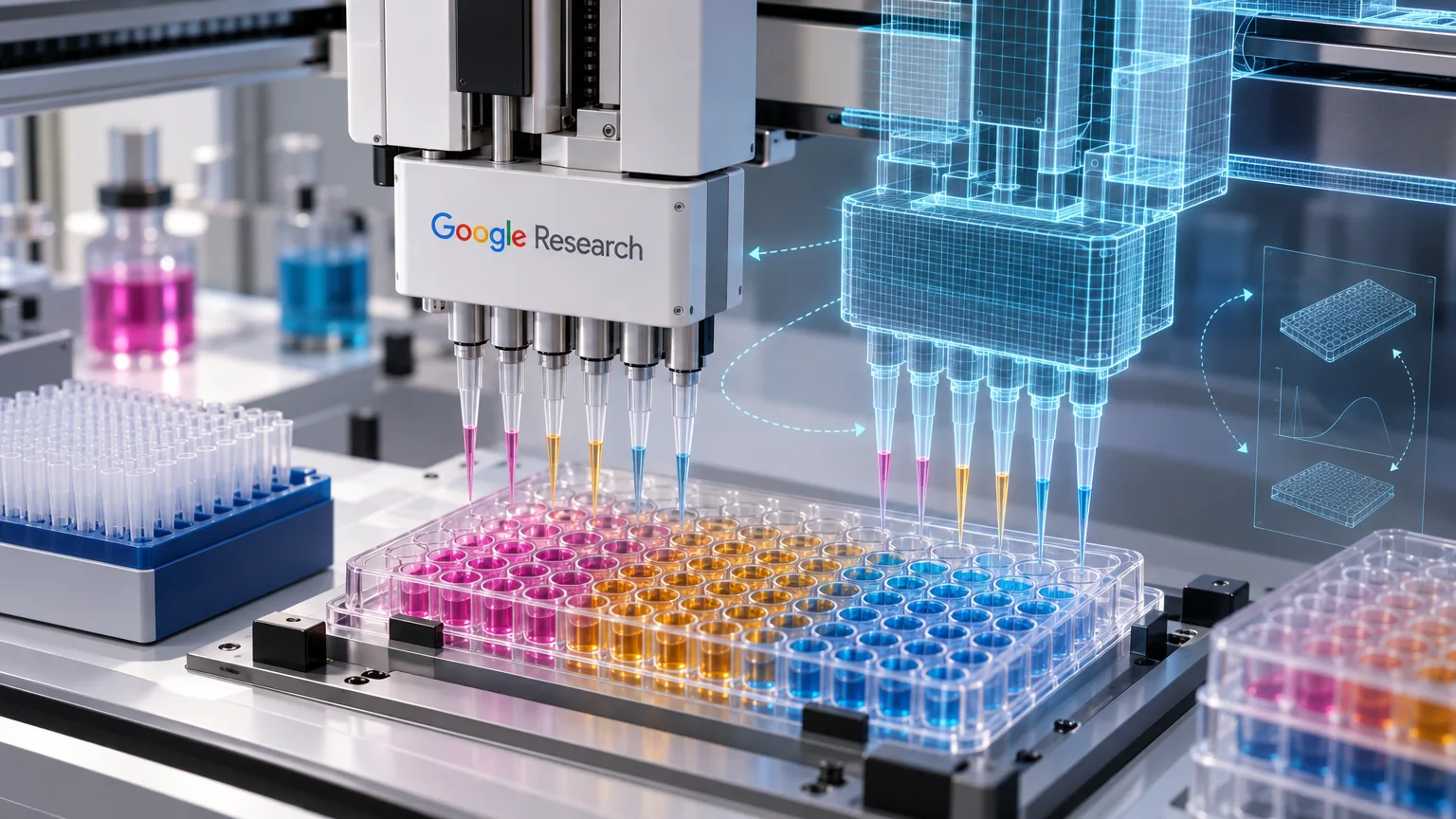
At VERID’s core is a continuously updated semantic digital twin of the laboratory, according to Google Research. It tracks the spatial layout and geometry of robotic arms, as well as liquid volumes in individual wells, reagent identities and available pipette tips. The researchers built it on the open-source PyLabRobot framework.
Agents use this environment to plan, simulate and execute liquid-handling protocols. Google Research says a virtual dry run can detect collisions or attempts to draw liquid from an empty well within seconds. Checks intercept invalid commands before they reach the robot, while synchronized camera footage and action logs preserve the experiment’s progress for later analysis.
Logs helped correct mixing and recover from equipment failure
In one case study, video combined with execution logs helped identify uneven dye layering. The researchers attributed it to dispensing too close to the bottom of a well, after which the agent adjusted its mixing strategy. During the same experimental campaign, the digital twin’s retained state allowed work to resume after a plate-reader failure without repeating the pipetting.
Another experiment tasked an agent with reconstructing dye mixtures of undisclosed composition from overhead camera images. It repeatedly designed and ran robotic experiments, looking between runs for optical and fluidic artifacts affecting its results. Google Research reports a more than fivefold improvement in accuracy on this specific task.
Three aptamer design rounds revealed progress and a wrong turn
For protein-binding DNA molecules called aptamers, the team tested three cycles of design, experimentation and revision. Each cycle takes 7–10 days, according to Google Research. Agents propose sequences, candidates are screened against target proteins on magnetic beads, and sequencing supplies quantitative results for the next round.
The first round of designs targeting α-thrombin produced no successful binders. Google Research attributes the failure to fixed primer overhangs that disrupted folding in 48% of sequences. Adding stabilizing flanking stems in the second round brought the hit rate to 26.0%; diversifying designs in the third raised it to 42.1%, with final specificity of 98.5%.
The myoglobin experiment, by contrast, showed how optimizing binding affinity alone could worsen results. According to the researchers, G-quadruplex motifs accounted for 63% of second-round designs, but most also bound to other proteins and the beads themselves. Specificity fell from 75.0% to 19.1%, while the hit rate corrected for bead binding dropped from 10.2% to 3.7%.
Using those measurements, the agents independently revised their design rules, Google Research says: they limited nonspecific motifs, subtracted bead binding and switched to structures without G-quadruplexes. In the third round, specificity reached 72.4% and the on-target hit rate reached 33.5%, which the researchers describe as a ninefold increase over the previous round.
Focusing on the local binding site accelerated protein structure prediction
The third project focuses on designing new protein binders. Google Research applied its workflow to fibroblast activation protein alpha (FAP), a receptor overexpressed in solid tumors. After a few experimental runs, the team says its best designs achieved single-digit nanomolar binding affinity.
The team adjusted the computational workflow to focus folding predictions on the local binding site. Google Research reports that this accelerated structure prediction 8.6-fold without reducing structural accuracy. The change targets the most computationally demanding part of designing protein complexes.
At equal compute, collaboration between a scientist and an agent nearly doubled the in-silico hit rate compared with a scientist working alone and found successful designs across a broader range of target sites, according to Google Research. The scientist set the overall strategy, while the agent handled tactical execution. To screen large libraries of variants in parallel in the lab, the team introduced yeast surface display and fluorescence-activated cell sorting (FACS).
Connecting VERID with protein discovery is the next step
Google Research says the experiments remain under direct human oversight: people authorize and review proposed sequences, verify laboratory protocols and supervise robot runs. Every sequence undergoes biosecurity screening, and every VERID protocol is simulated and checked against the digital twin before reagents are used.
As its next step, Google Research plans to combine VERID’s traceable automation with learning from repeated protein-discovery experiments. The aim is to let agents directly explore complex biological design possibilities in the laboratory.