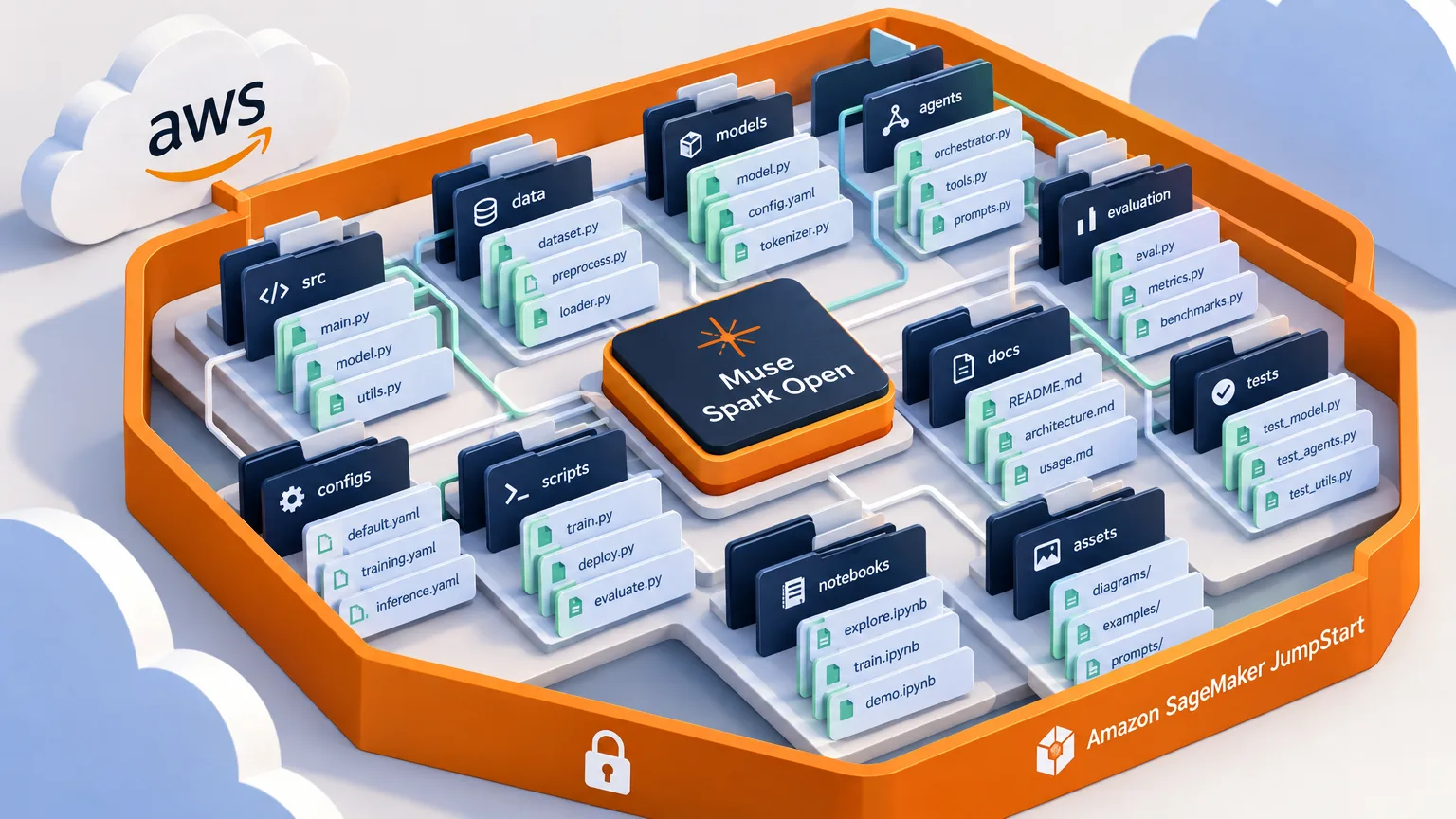
AWS has made Meta’s open-weight coding model Muse Spark Open available in Amazon SageMaker JumpStart. Developers can deploy it to an endpoint in their own AWS account; according to AWS, its 1 million-token context window can accommodate an entire project, including dependencies and thousands of files.
Training for refactoring and long-running agent tasks
According to AWS, Meta based the model’s training on developers’ work in real repositories. It covered code generation, debugging, refactoring across multiple files and tasks that take an extended period to complete. AWS says the context can also include legacy code, rather than just the parts of a project currently being edited.
Meta says the model handles long-running agent tasks by planning its approach, taking actions, observing their results and adjusting its next steps, rather than simply making individual tool calls.
AWS says training also covered web browsing, coordinating subagents and operating computers across desktop, mobile and browser environments. For deployment in SageMaker AI, however, the customer’s application or agent framework must supply the tools, browser and computer-use environment.
Bug-fix inputs can include images and audio
According to AWS, inputs extend beyond text to documents, images, audio and audiovisual material, while the model’s output is text. Among its proposed uses, AWS describes processing screenshots, design documents or a bug recording with audio and video to produce a plan for reproducing the problem or a draft fix.
Two variants with different memory requirements
According to AWS, Muse Spark Open uses a mixture-of-experts architecture with 816 billion parameters in total, of which 42 billion are active for each token. Serving it still requires enough GPU memory for all 816 billion parameters, so deployment requirements depend on more than the model’s active portion.
JumpStart offers the BF16 version as Muse-Spark-Open-816B-A42B and the quantized version as Muse-Spark-Open-816B-A42B-NVFP4. AWS says NVFP4 weights require roughly a quarter of the memory needed for BF16 weights. The NVFP4 variant runs on ml.p5e.48xlarge, while BF16 uses ml.p6-b300.48xlarge.
Deployment in your own account, with two launch regions
Deployment is available through SageMaker Studio or the SageMaker Python SDK, with either route creating a real-time inference endpoint. AWS says provisioning the instance and loading the weights typically takes 15–20 minutes. At launch, the model is available in US East (N. Virginia) and US East (Ohio).
Customers need a sufficient quota for the supported instance type. SDK deployment requires Python 3.10 or later and SageMaker Python SDK v3. The weights are governed by the Muse Model License, including the Muse Spark Usage Policy, and deployment requires acceptance of the EULA; SDK users provide that acceptance by setting accept_eula=True.
The endpoint can be connected to the customer’s own Amazon VPC, with storage encrypted using an AWS KMS key and network isolation enabled for the container. Customers also choose the instance type and scaling limits. A pinned model version changes only when the model is redeployed.
Customers pay for the endpoint for as long as it runs, even without incoming requests, so AWS recommends deleting it when it is no longer needed.
Chat API separates the answer from reasoning output
The endpoint accepts OpenAI-compatible chat requests containing a messages list. It returns the final answer in message.content and reasoning output in message.reasoning_content. The usage.reasoning_tokens field reports the number of tokens used for reasoning. The max_tokens limit must leave enough room for both reasoning and the final answer.
Tokens can also be streamed as they are generated. Applications enable this by adding "stream": true to the request body and calling endpoint.invoke_with_response_stream instead of invoke.