Researchers from the artificial intelligence laboratory at the Free University of Brussels and the University of Namur have shown that a group of independent programs can develop a functional, shared means of communication on their own. Ten computer agents, no dictionary, and a million short conversations. That was all the Belgian scientists needed for artificial intelligence to come up with its own language.
Why human speech is not enough for machines
Large language models such as ChatGPT learn a language that already exists. They have processed vast amounts of human-written text and learned to imitate it. The Belgian team tried a different approach. Its agents do not memorize anything. They invent words themselves and link them directly to what they detect with their sensors.
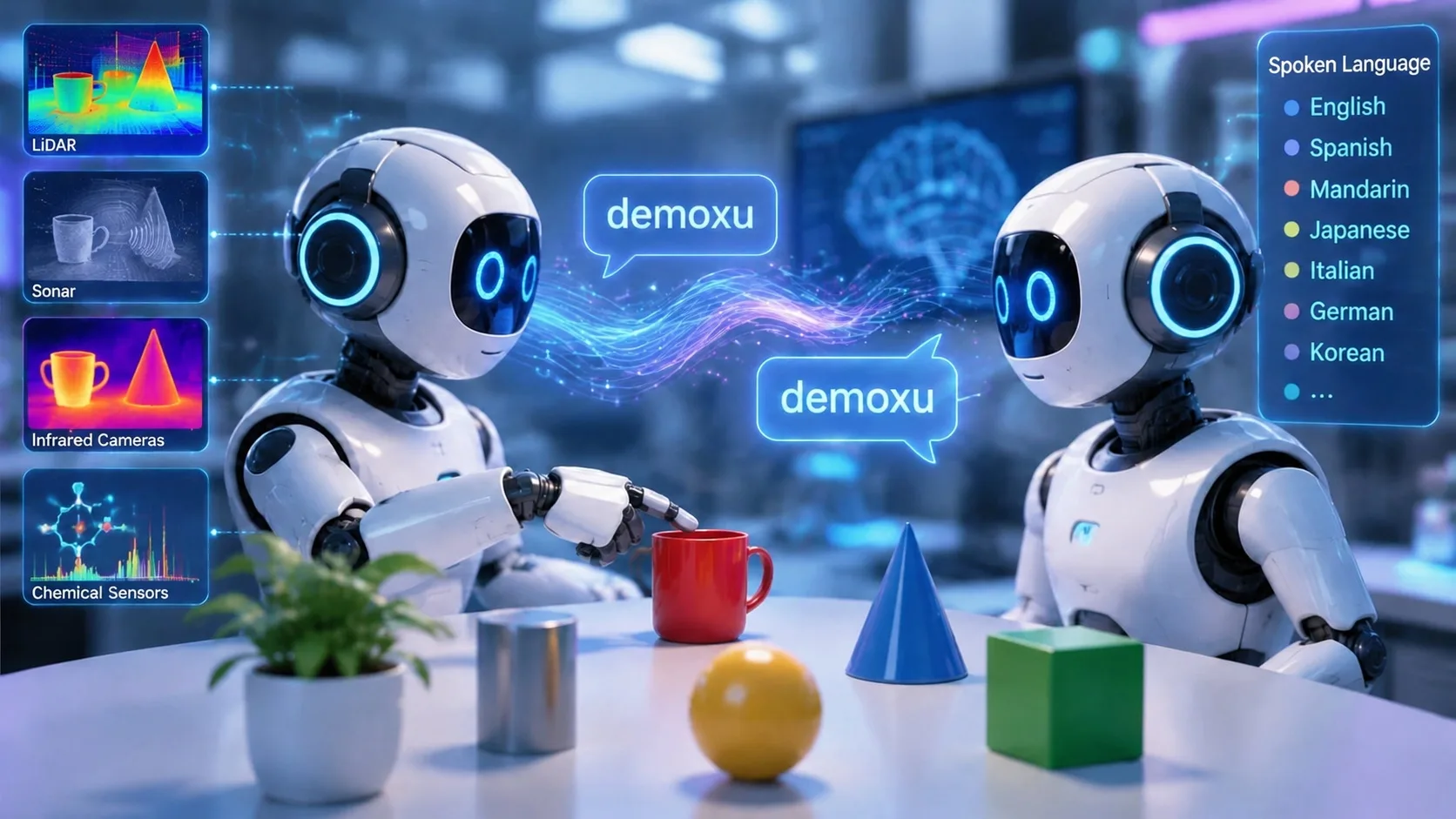
Why do they do that, you may ask? Human languages arose from human senses. We have words for colors, sounds, and tastes because we perceive them ourselves. Machines, however, use sensors for which humans have no equivalent, such as lidar, sonar, infrared cameras, or chemical analysis instruments. No human language has precise words for what they measure.
Doctoral student Jérôme Botoko Ekila, the lead author of the study, explains that instead of forcing machines to speak a human language that does not match their sensors, the team allowed them to create their own artificial natural language. The concepts the agents create in this way correspond precisely to what they perceive, even if a human could make no sense of the raw data.
Professor Paul Van Eecke adds another reason. Sensors on two robots or cars are never configured exactly the same way. Humans solve this problem through language. When someone says they are standing by a red car, another person can find them even though their eyes do not see exactly the same shade. Language thus forms a kind of layer above what each person perceives, and robots have now created precisely such a layer themselves.
A guessing game
The agents start with a blank slate. They know no words or categories and know nothing at all about the world. They perceive each object around them only as a series of numbers from their sensors. The scientists gave them only three basic abilities, which they believe also underpin the development of human languages. The agents can invent a new word, gradually refine its meaning, and learn from whether they successfully communicated with one another. The program selects two agents at random and shows them a scene containing ten objects. One is assigned the role of speaker and is told which object to draw the other agent's attention to. It says a word, and the listener guesses. If the guess is correct, both reinforce the word. If not, the speaker points out the correct object, and both adjust the word's meaning.
If the speaker does not have a suitable word available, it simply invents one. The words are random clusters of three syllables, such as demoxu or xipabu, and mean nothing in themselves. They acquire meaning only through the way the agents use them. A listener hearing a new word for the first time simply adds it to its own vocabulary.
There is no central computer setting the rules, says Professor Katrien Beuls of Namur. The agents always communicate only in pairs, and the shared language of the entire group emerges on its own from a vast number of brief conversations. According to her, the agents create exactly as many categories as they need for the task, without any unnecessary ones.
Chaos reigns at first. Each agent invents its own words, and the group's vocabulary rapidly expands. In a test using images of geometric solids, it grew to around 90 words. Then it begins to streamline. Words that work survive, while unsuccessful ones gradually disappear. After a million conversations, just under 50 words remained on average. Meanwhile, the communication success rate rose to around 96 percent after only 50,000 conversations and reached almost 100 percent by the end.
The authors identify three phases in this process. First, the agents invent and experiment; then they converge on rough but usable concepts; and finally, they merely fine-tune the details and fill in the gaps.
Wine, exoplanets, and birds
To rule out a lucky coincidence, the scientists tested the method on 37 different datasets. The agents discussed chemical analyses of wine, NASA data on planets outside the solar system, mushrooms, and photographs of birds and human faces. In seven cases described in detail, the success rate ranged from around 96 to almost 100 percent. The agents needed only 17 to 265 words, with just a few dozen of them doing most of the work.
Unlike many artificial intelligence systems whose inner workings are opaque, this system makes it possible to determine exactly what each word means. That is because every word is linked to specific sensor values. This is nicely illustrated by the word penatu, which emerged during conversations about exoplanets. The scientists found that the agents use it to refer to Earth-like planets with a radius about 81 percent that of Earth.
Broken sensors do not stop them
The team deliberately made life harder for the agents. They miscalibrated some agents' sensors and added noise to others' measurements. They also assembled groups in which each agent perceived the world through a different set of sensors. In another experiment, after 500,000 conversations they suddenly disabled one or even half of the sensors of every agent.
The language adapted each time. The agents agreed less often on which word to use for what because each one favored expressions that best matched its own senses. In most cases, however, they could still communicate successfully. For comparison, the scientists also tested a simpler approach in which each agent divides the world into fixed categories and only then are names found for them. It worked reasonably well as long as everyone perceived the world in the same way. Once their perceptions diverged, the success rate fell to between a fraction of a percent and around 43 percent.
The researchers also tested larger groups of up to one hundred agents. They took longer to reach agreement, but the resulting vocabulary was smaller. The authors explain that larger groups generate more ideas, making it easier to select the best ones. When the agents were allowed to string together up to five words, their vocabularies shrank to between 17 and 48 words, but learning took more than ten times longer. Even so, in 95 percent of cases the agents managed with a single word.
From the laboratory to machines
The authors see potential applications wherever machines need to communicate with one another. These include self-driving cars, robots, and industrial sensors, which will never be calibrated in exactly the same way. According to them, a language that machines develop themselves can handle precisely this kind of environment better than preprogrammed codes.
It is not computationally demanding, either. A standard server processor can handle a million conversations in six to eight hours, and the scientists have released the source code. In the study itself, they emphasize that they wrote it without the assistance of generative artificial intelligence. The research was funded by the Belgian scientific foundations FWO and FNRS as part of the joint WEAVE project.