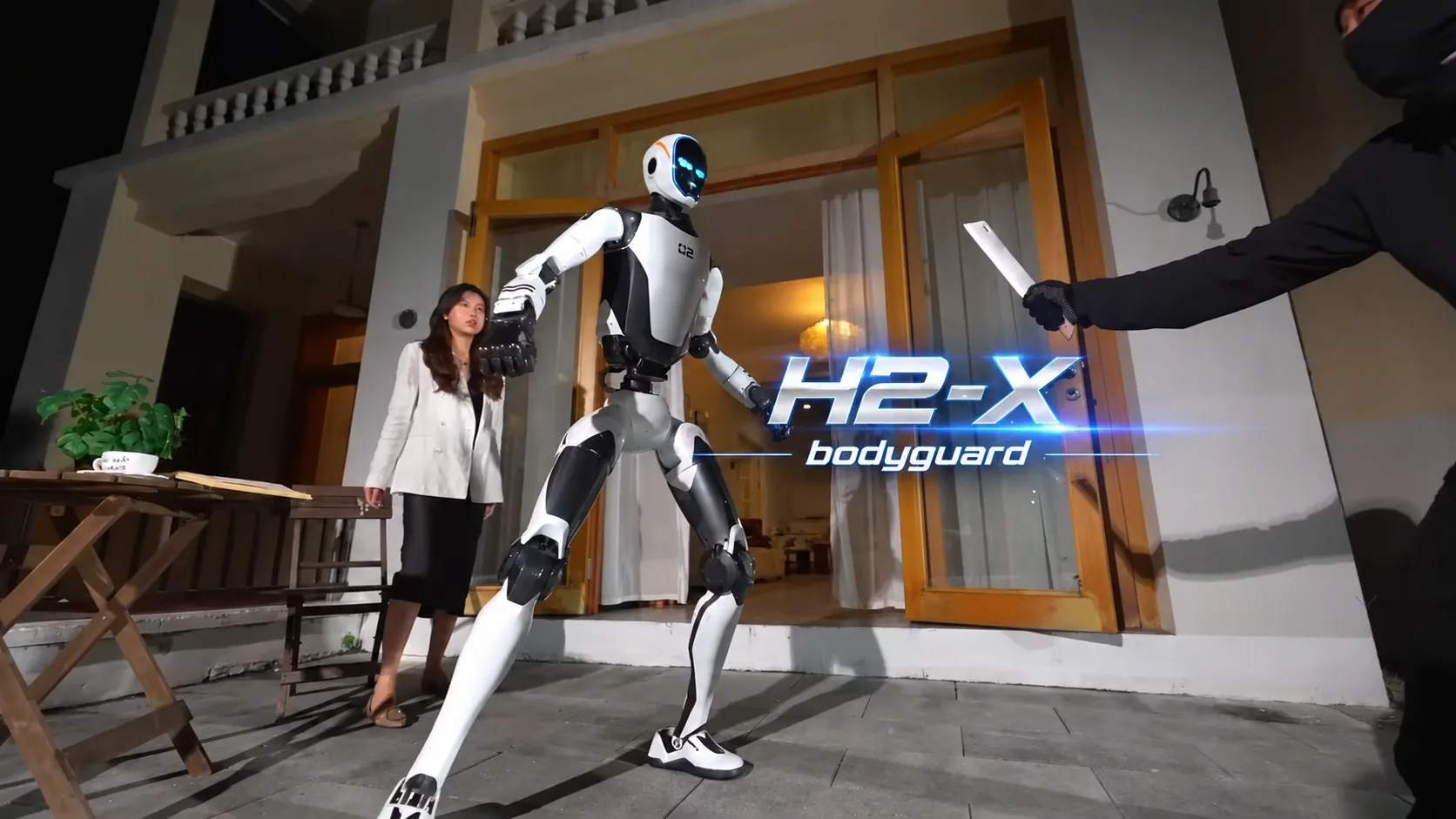
Chinese company Unitree, the world’s largest manufacturer of bipedal humanoid robots, has released a one-minute video of its new machine. It is called H2-X and is sold in China under the grandiose name Kung Fu Legend Guardian, which can be loosely translated as the Legend and Guardian of Kung Fu. In the video, the robot kicks parked cars, jumps down from high platforms, and lifts a vehicle with a trapped dummy underneath it. The manufacturer wants to turn it into a bodyguard and rescue assistant with a battery life of around eight hours. However, it has not yet disclosed the price, full technical specifications, or launch date.
At first glance, it is a slender, human-sized figure with two legs, two arms, and a head. The H2-X builds on the older H2 model, which Unitree introduced last October. Because the company has not published the specifications of the new version, the base H2 model remains the only reliable point of reference. It stands 182 centimeters tall and weighs around 70 kilograms, roughly the size of an adult man. Its body is made of aerospace-grade aluminum, titanium, and durable engineering plastics. It is cooled by fans rather than liquid, as some more powerful machines are, and communicates with its surroundings via Wi-Fi 6 and Bluetooth 5.2.
The manufacturer lists the robot as having 31 degrees of freedom. This technical term refers to the number of independent movements the robot can make with its joints. Each leg has six, each arm seven, the waist three, and the head two. The more degrees of freedom a machine has, the more naturally and skillfully it can move.
Another specification, torque, describes the force with which a joint can rotate a limb. It reaches up to 360 newton-meters in the legs and up to 120 newton-meters in the arms. By comparison, an ordinary mid-size passenger car has an engine with torque in the same range of hundreds of newton-meters. Thanks to this strength, the robot can perform jumps and kicks and withstand landings from a height. Its arms can carry around 15 kilograms for short periods and approximately seven kilograms over longer periods.
Control is handled by an onboard computer, which in the most powerful H2 version offers computing performance of up to 2,070 TOPS, meaning trillions of operations per second. The robot needs this level of performance to run artificial intelligence directly onboard, simultaneously monitoring its surroundings with cameras, understanding instructions, and controlling movement. Buyers can pay extra for an Nvidia Jetson AGX Thor chip, but the company has not said whether the H2-X received the same equipment.
Battery life raises the most questions. The base H2 lasts about three hours on a replaceable battery with a capacity of just under one kilowatt-hour. For the H2-X, Unitree promises around eight hours, equivalent to a full work shift. However, captions in the video reveal that this figure applies only to standing still, not walking, performing combat routines, or carrying out strenuous rescue work. The company has not explained how it nearly tripled the battery life, nor has it published the testing conditions. Yet this is a significant distinction for prospective customers. Security agencies and fire departments buy equipment for full shifts, and a robot that needs to recharge halfway through the day will struggle to compete with a human guard carrying a flashlight and radio.
Kicking Cars and Rescuing Dummies
The footage begins in a junkyard. The robot jumps onto the roof of a car, flips back to the ground, and uses a series of kicks and elbow strikes to dent a door, shatter a window, and damage a mirror. It then jumps down from a shipping container and from a platform about four meters high, rolls to absorb the impact, and smoothly rises to its feet. Unitree claims that it did not speed up the footage in any way.
The second part of the video shows the robot in the role of a guard. It intervenes against a knife-wielding intruder threatening a woman, lifts the front of a car so a passerby can pull out a trapped dummy, and pushes a child dummy out of the path of an approaching vehicle, which then runs over the robot itself. At the end, the company asks viewers to use the robot safely and in a friendly manner.
Unitree Introducing: H2-X Kung Fu Legend Guardian🤖 Powerful performance to serve and guard you, with a maximum endurance of approximately 8 hours. Please use the robot safely and in a friendly manner. https://t.co/5RU5kDzSUK
— Unitree (@UnitreeRobotics) October 21, 2026
A Guard You Must Not Approach
The captions contain another warning. People should keep a distance of at least two to three meters from the robot. A bodyguard you are not allowed to approach sounds rather impractical. A similar warning can also be found on the base H2 model’s website, where the company openly states that it is a powerful machine and that buyers should understand the limitations of today’s humanoids.
Unitree has not revealed how many of the movements in the video the robot performed independently, how many were controlled remotely by a human, and how many were preprogrammed. Remote control, which experts call teleoperation, still predominates in similar tasks. In September, the company unveiled its own artificial intelligence system, UnifoLM-X2-1.0, a so-called world-action model. This software predicts how the robot’s surroundings will develop and chooses its next step accordingly. At the time, Unitree claimed that a robot using it was able to spar entirely on its own, without an operator or a rehearsed routine. It makes no such claim about the new video.
Experts point out that identifying a genuine threat in a crowd and responding proportionately is far more difficult than kicking a door. A 70-kilogram machine capable of deforming sheet metal with a single kick would be moving among people, and no one has yet publicly said who would bear responsibility if the robot misinterpreted a passerby’s raised hand. According to TechRadar’s editorial team, the H2-X would have great difficulty obtaining the certifications required to be sold to the general public as a bodyguard. It is more likely that some version of it will find use in industry or the military.
The price of the H2-X is not yet known. The base H2 model sells in China for around 200,000 yuan, or just under $30,000, while prices from overseas retailers climb to $41,000. In the Czech Republic, the H2 Basic version is available for almost 864,000 Czech korunas.
Meanwhile, its competitors are heading in a different direction. Boston Dynamics is preparing its Atlas robot for Hyundai’s factory in Georgia, Figure is focusing on manufacturing and warehouses, and China’s UBTECH supplies Walker robots for assembly lines. Unitree is sending its new robot into the street—the least predictable environment it could have chosen.
The video was released around two months after Unitree listed on Shanghai’s STAR Market. Shortly after trading began, the company was valued at nearly $62 billion, but roughly half of that disappeared within a week, with the shares falling 55 percent from their peak. By July, it had manufactured around 18,000 humanoids, yet the day before the video premiered, it warned investors that sales of humanoid robots were still in their infancy and that slower demand could affect its revenue. According to Reuters, the plunge in Unitree’s shares prompted Beijing to slow the wave of further stock market listings, with around six Chinese robotics companies waiting in line.
Sources: scmp.com, techradar.com and robots-daily.com