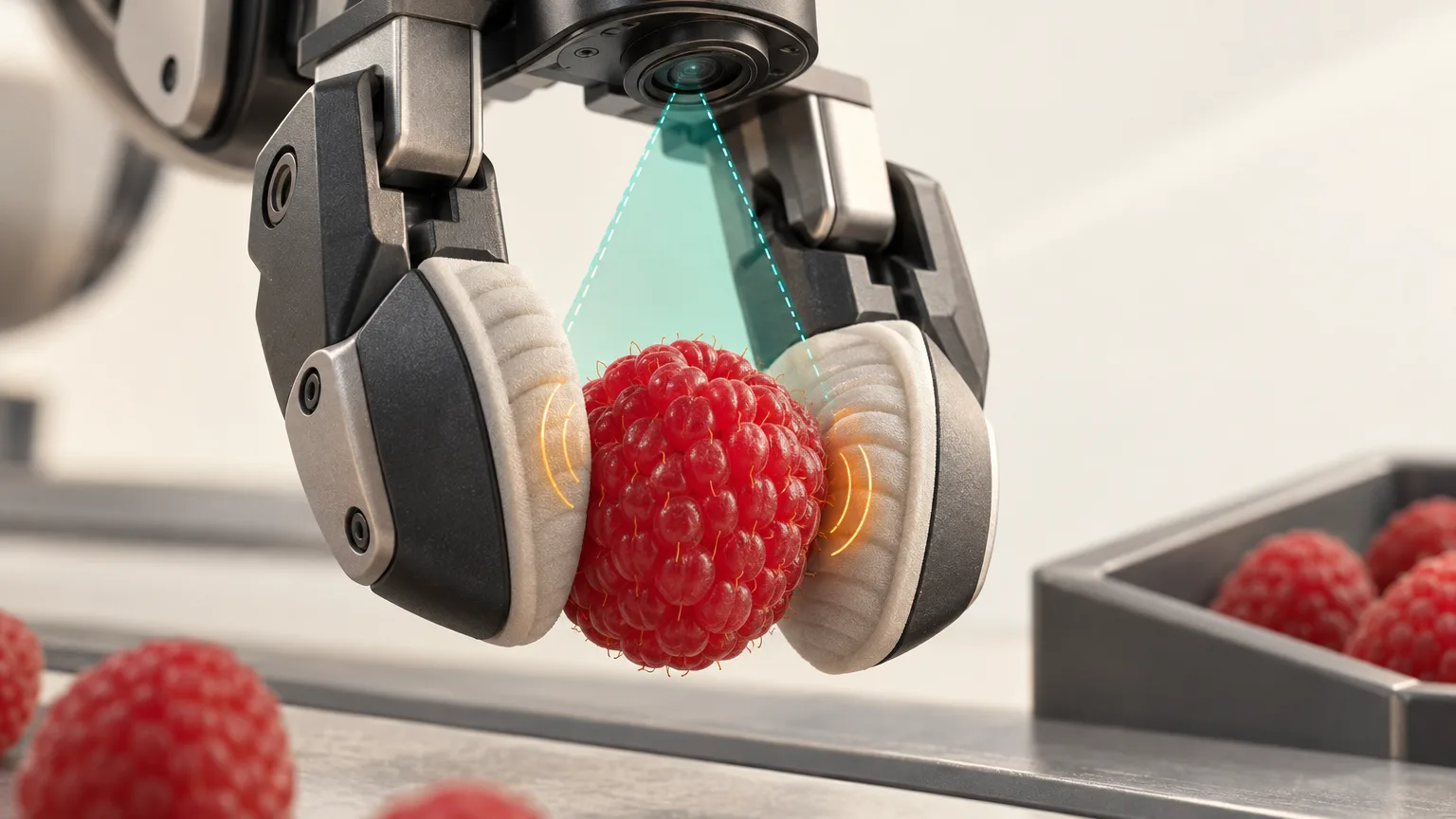
Eka Robotics has developed a robotic manipulation architecture that pairs a vision-force-action deep-learning model with a force-sensitive gripper. Alongside visual input, it uses information about physical contact: co-founder Pulkit Agrawal says force feedback guides the hand as it searches for contact with an object and grasps it.
Vision locates the object, force feedback guides the grasp
Agrawal describes a division of responsibilities between the two inputs. Vision provides an approximate location and orientation for the object, while the grasp itself relies on force feedback.
The robotic hand was designed around that approach. Eka made it more flexible than traditional grippers and equipped it with more force sensors. In a demonstration described by TechCrunch, its response to contact allowed it to grasp a raspberry without crushing it.
Training in a physics simulation
Training relies on a physics simulator that models the forces encountered during attempts to grasp objects. This provides an environment for reinforcement learning at scale.
The founders say they can generate thousands of hours of simulated robot experience in just a few minutes.
Picking speed and adaptation to different objects
TechCrunch reports that the robot can pick up approximately 1,500 objects weighing up to 1 kg per hour, compared with about 600 for a human. Eka says its grasping success rate exceeds 95%.
Kris Hauser, a professor at the University of Illinois Urbana-Champaign, observed during a demonstration that the robot could handle a wide variety of objects without retraining. When its first attempt failed, it tried to grasp the object again.
Industrial pilots and the durability challenge
Eka is working with several industrial customers in private pilot projects. These focus on pick-and-place tasks and wire manipulation.
Hauser identifies operation on real assembly lines, where the system would need to run for an entire year without breaking down, as a further challenge. He also questions how well the method will transfer to other tasks; he has personally seen only pick-and-place work.
According to Agrawal, the current gripper is rated for 5 million duty cycles. The company aims to reach 20 million cycles, the standard for industrial arms.
The startup raised $150 million in a Series A round led by a16z and F-Prime. The funding brought its post-money valuation to $1.45 billion.