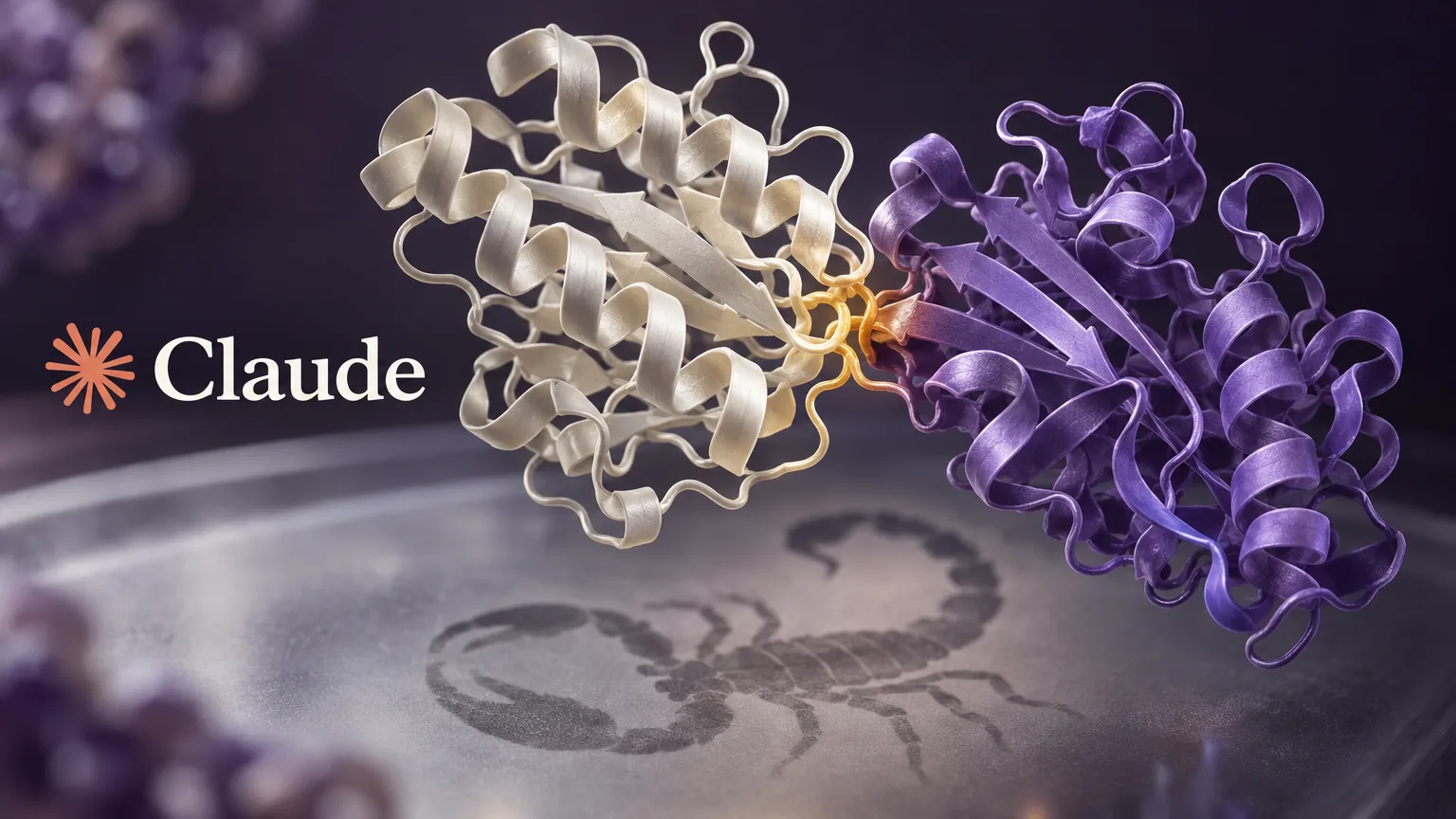
Anthropic presented a research experiment in which an internal Claude model designed small proteins intended to bind scorpion neurotoxins. According to the company, 17 of 211 tested designs met its laboratory criteria, each binding to one of four toxins dangerous to humans. The model generated candidates and helped decide which to advance for testing.
Five toxins and an attempt to target several at once
Anthropic’s researchers chose Cn2 from Mexico and Ts1 from Brazil. They also selected AaH I and AaH II from North Africa, and LqhIII from the Middle East. The designs were intended to target the sites where these toxins attach to sodium channels. According to the company, Claude searched the Protein Data Bank and AlphaFold database for suitable structures, then selected five specific amino acid positions on each toxin for the new proteins to bind.
The assignment covered four types of design. Alongside proteins targeting individual toxins, Claude was asked to design binders targeting Ts1 and Cn2 together, the three toxins AaH II, AaH I and LqhIII, or all five at once. The researchers see this multitoxin approach as a possible way to reduce the number of components needed in a future universal antivenom.
Claude managed tools and candidate selection
According to Anthropic, the internal model worked largely autonomously within Claude Science for 64 hours. Researchers developed the initial prompt and four follow-up instructions with investment research firm Citrini Research. Under their supervision, Claude also analyzed the research data, produced figures and drafted the final report.
The initial instructions specified the targets, available tools and rules for novelty, scoring and filtering. Within that framework, Anthropic says Claude managed the computational workflow: it set quality thresholds, decided how to divide work among the tools and developed strategies for proteins intended to bind multiple toxins.
The company reports that Claude used 12 design tools to generate 318,484 candidates, filtering out those resembling a toxin or a known protein. It then predicted joint structures and screened 553,052 design–toxin pairs. The computational work required on the order of 10,000 GPU hours.
Claude selected 180 designs for laboratory testing, and the team added another 31 with its help. According to Anthropic, the final set contained 60 candidates targeting individual toxins, 30 targeting the two β-family toxins and another 30 targeting the three α-family toxins. The largest group consisted of 91 designs intended to bind all five toxins.
Binding had to meet the criteria at both laboratories
Anthropic says Adaptyv Bio and Twist Bioscience carried out the laboratory work, using different methods to produce the proteins. Adaptyv Bio used a cell-free system with protein-making machinery extracted from bacteria. Twist Bioscience used human kidney cells to produce proteins joined to the Fc portion of an antibody. Both laboratories used surface plasmon resonance to measure binding between the designs and their target toxins.
Anthropic counted a design as successful only if it showed binding in every repeated test at both laboratories. Every measured dissociation constant, KD—a measure of binding strength—had to be no greater than 1 µM. The protein also had to show no binding signal against CLEC12A, an unrelated human protein used to check for unwanted binding.
Strongest binders targeted Cn2; multitoxin designs fell short
Anthropic recorded seven successful designs against Cn2, four against AaH II, four against AaH I and two against LqhIII. None of the proteins designed to target multiple toxins met the criteria for more than one target. Among the 60 single-toxin designs, 11 succeeded, a rate of 18%. The company describes that rate as consistent with typical protein-design campaigns, including its previous work.
According to the company, the strongest candidates were Cn2-B1 and Cn2-B2, which target Cn2 from the Mexican scorpion Centruroides noxius. Both laboratories measured KD values in the single-digit nanomolar range for these proteins; lower values indicate tighter binding.
Anthropic says competition binding experiments suggest its Cn2 binders attach at or near the same site as an antibody called LR. That antibody has been reported to neutralize Cn2 in mice. The site occupied by LR overlaps the region where the toxin attaches to a sodium channel.
Data for further research, not a finished antivenom
Anthropic emphasizes that the experiment demonstrated binding only to recombinant toxins produced in a laboratory. No design was tested for toxin neutralization in cell experiments or for efficacy in living animals, so the company does not describe the result as a developed antivenom.
To support further research, Anthropic is releasing all 211 designs, together with their predicted structures, scores and experimental data.