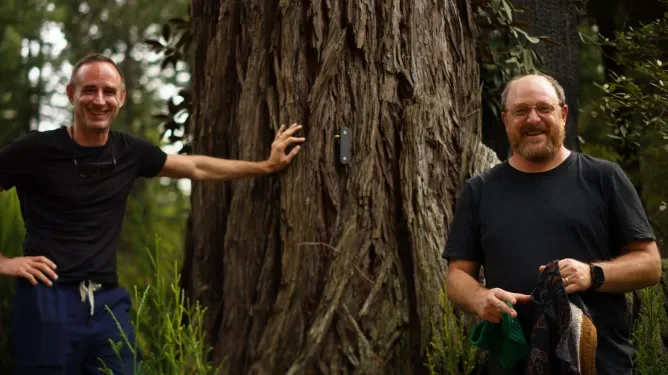
American startup Electric Plant has unveiled an artificial intelligence model called Bombadil that reads a plant’s health directly from its own electrical activity. It does not infer it from the soil, weather, or what the eye can see. The company built it around inexpensive sensors that are screwed into tree bark or inserted into a stem. The data is then sent to the cloud, where the model translates it into a form growers can understand. Based on the results, they can decide when to water or fertilize.
It all started with a plant on wheels
Co-founder and CEO Justin Mast came across the topic by chance. While reading scientific literature, he found research in which scientists connected a houseplant to a motorized platform. When the plant wanted more light, electrical signals flowed through its living tissues. A control board detected the current and moved the plant closer to the light source.
Mast then contacted neuroscientist Lee von Kraus, who had worked with the US military agency DARPA. Together, they founded Electric Plant and spent three years collecting the data that gave rise to Bombadil. The model’s name refers to a character from Tolkien’s The Lord of the Rings, an eccentric who lives in the forest and understands trees.
Plants send each other electrical messages
The idea that plants use electricity is nothing new. The authors of the scientific study on the model explain that plants generate electrical signals in response to environmental stimuli, and these signals travel from the site of the stimulus to distant parts of the body. Scientists distinguish three main types. An action potential is fast, lasts about a second, and is triggered when a stimulus crosses a certain threshold. A variation potential is slower and longer and usually occurs after injury. A system potential is a traveling, short-term change in voltage in the opposite direction. Scientists refer to the sum of all these signals as the plant electrome.
Reading these messages is not easy, however. The signals are weak and easily drowned out by electrical noise. A plant that has previously experienced stress responds differently to the same stimulus. The shape of the signal also varies by species, so what works for one plant often fails for another. Existing machine learning models have therefore always specialized in a single task. They were usually trained on one species in one environment, and every new crop or condition required new data and a new model.
A smartphone-sized sensor
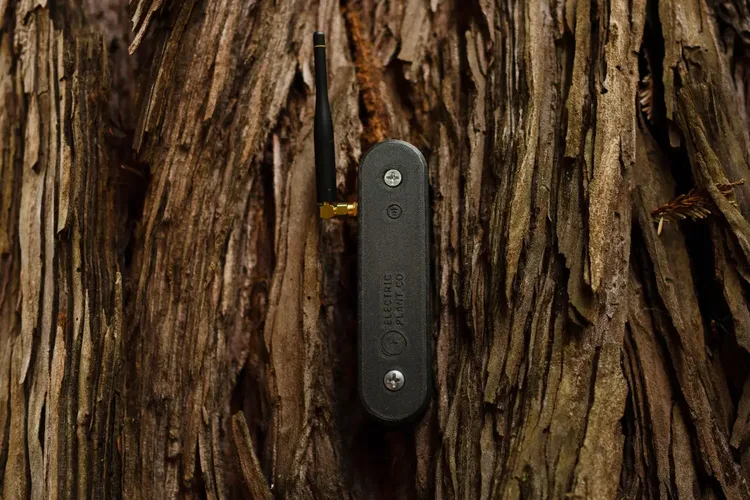
Electric Plant developed its own hardware. The outdoor sensor, called Bud, is about the size of a standard iPhone folded in half lengthwise and is attached to the plant using stainless steel screws. The screws must penetrate the cambium, the layer of living tissue just beneath the bark, to detect voltage changes on the order of microvolts. The company connects plants with soft stems using a thin wire.
Bud takes a measurement once per second, sends data wirelessly, and runs on a battery. For laboratories and greenhouses, the company offers a more powerful device called Stem, which monitors eight pairs of electrodes and measures 120 times per second. According to Mast, only a few sensors are needed per acre of land.
Price is the deciding factor. Current devices usually cost thousands of dollars, while Electric Plant’s sensor costs tens of dollars, according to Mast.
How Bombadil learned
The model is based on the same type of architecture as language models such as ChatGPT, known as a transformer. Instead of words, however, it reads segments of electrical recordings. It divides continuous recordings into 16-minute segments, so one day is covered by 90 segments.
The first phase of training took place without human guidance. The model’s developers hid a large portion of the segments in the recording and had it guess what was missing from the gaps. At each step, it saw only 40 percent of the data and had to fill in the remaining 60 percent. Language models learn in a similar way when people conceal part of a sentence. Bombadil thus gradually learned what the electrical life of a plant looks like.
To do this, it needed an enormous amount of data. The study reports more than 4 million hours of recordings from over 1,400 plants representing 100 species, collected at ten locations from November 2024 to July 2026. These include laboratories, greenhouses, commercial orchards, and natural forests. The company has since expanded the dataset, and when presenting the model, Mast spoke of more than 7 million hours from 125 species. The diversity is truly extensive: the model is familiar with ferns, redwoods, tomatoes, and dahlias.
Seven vital signs from a single signal
In the second phase, the model learned what the signals actually mean. The developers took a smaller subset of the data, roughly one million hours from more than 400 plants and 35 species, and paired it with over 41,000 measurements from a handheld MultispeQ device. It measures how efficiently a leaf processes light and monitors its temperature.
Bombadil then uses the electrical signal to estimate seven indicators that the developers compare to vital signs. Five of them describe photosynthesis, or how well the plant uses light. Two monitor leaf temperature and water stress. When a plant lacks water, it closes its stomata, stops cooling itself through evaporation, and the leaf becomes warmer relative to the surrounding air. Most of the training therefore took place on plants whose watering was deliberately restricted by scientists.
The results are promising but not perfect. The model was able to track changes in all seven indicators, but its accuracy varies considerably by species. It performed best on Norway spruce, while it was unable to extract any useful information from the data for croton. The authors attribute this to the small number of plants tested. A second sensor on the same plant also helps, improving the result for almost every plant.
More importantly, Bombadil can also read species it never encountered during training. Scientists also tested it on forms of stress it had not been trained on at all. African nettle plants were exposed to salinity and the herbicide glyphosate, and the model’s estimates shifted in exactly the direction predicted by scientific literature. According to the authors, this suggests that the model is genuinely reading the plant’s condition rather than merely applying a learned pattern for drought.
Less water, higher yields
The main goal is practical. According to Mast, growers, gardeners, and foresters have so far relied on crude tools. Soil probes, handheld spectroscopes, and satellite images work, but they offer little insight into the inside of a plant and lag behind its actual needs. Bombadil is intended to provide an inside view. Mast claims the system can increase yields while reducing water consumption by 20 percent or more. In his words, agriculture and forestry consume the most freshwater on Earth, yet we care for plants from the outside.
The developers expect to add more capabilities to the model over time. According to them, a new task does not require a new model, only an additional layer. Their plans also include having Bombadil control irrigation on its own one day. The founders dream of an even bolder step: a tool that would allow people to talk with plants. For now, however, Mast tempers this vision by saying that they are listening more than speaking, but listening is the first step.
Sources: techcrunch.com and arxiv.org