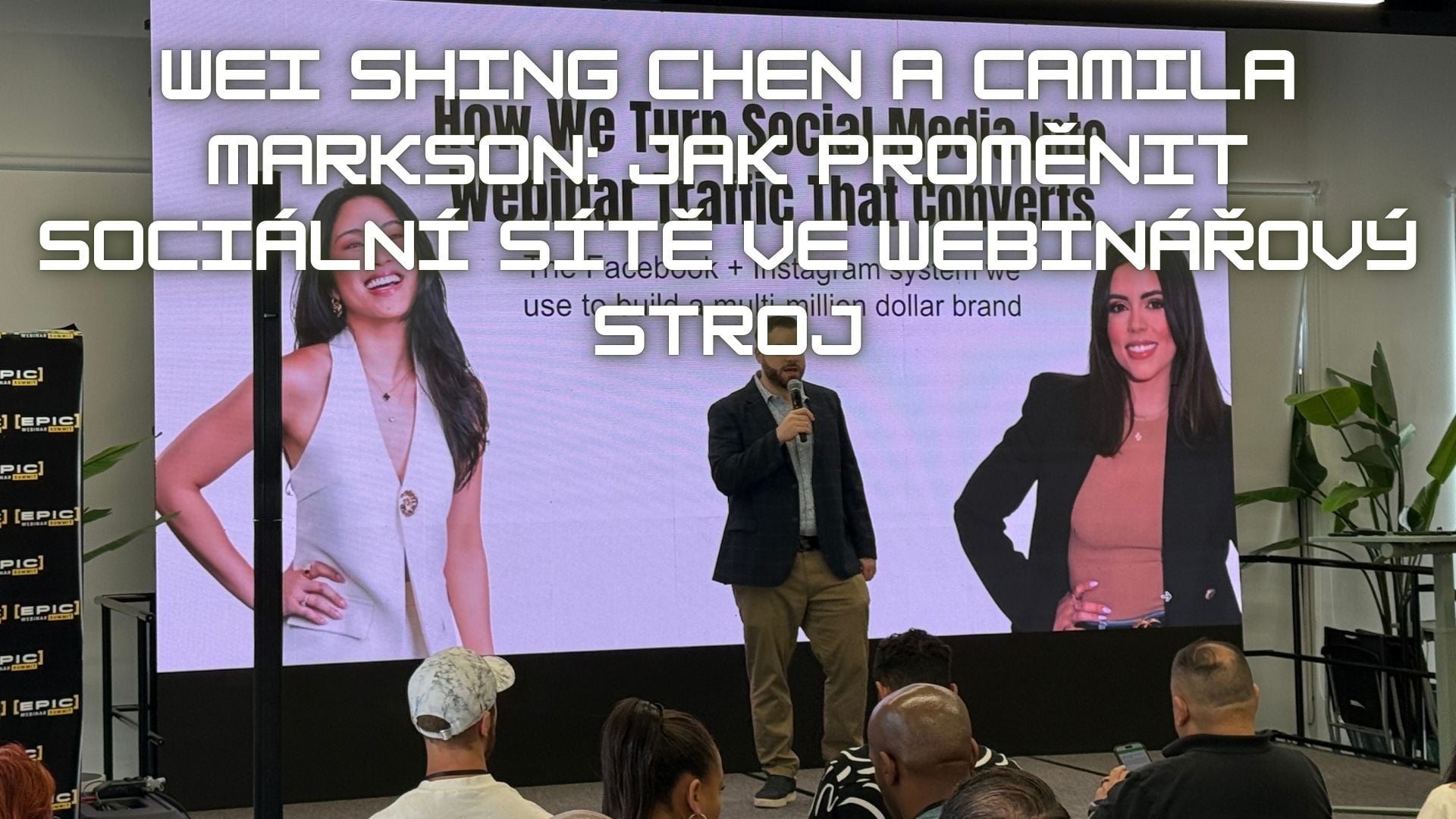
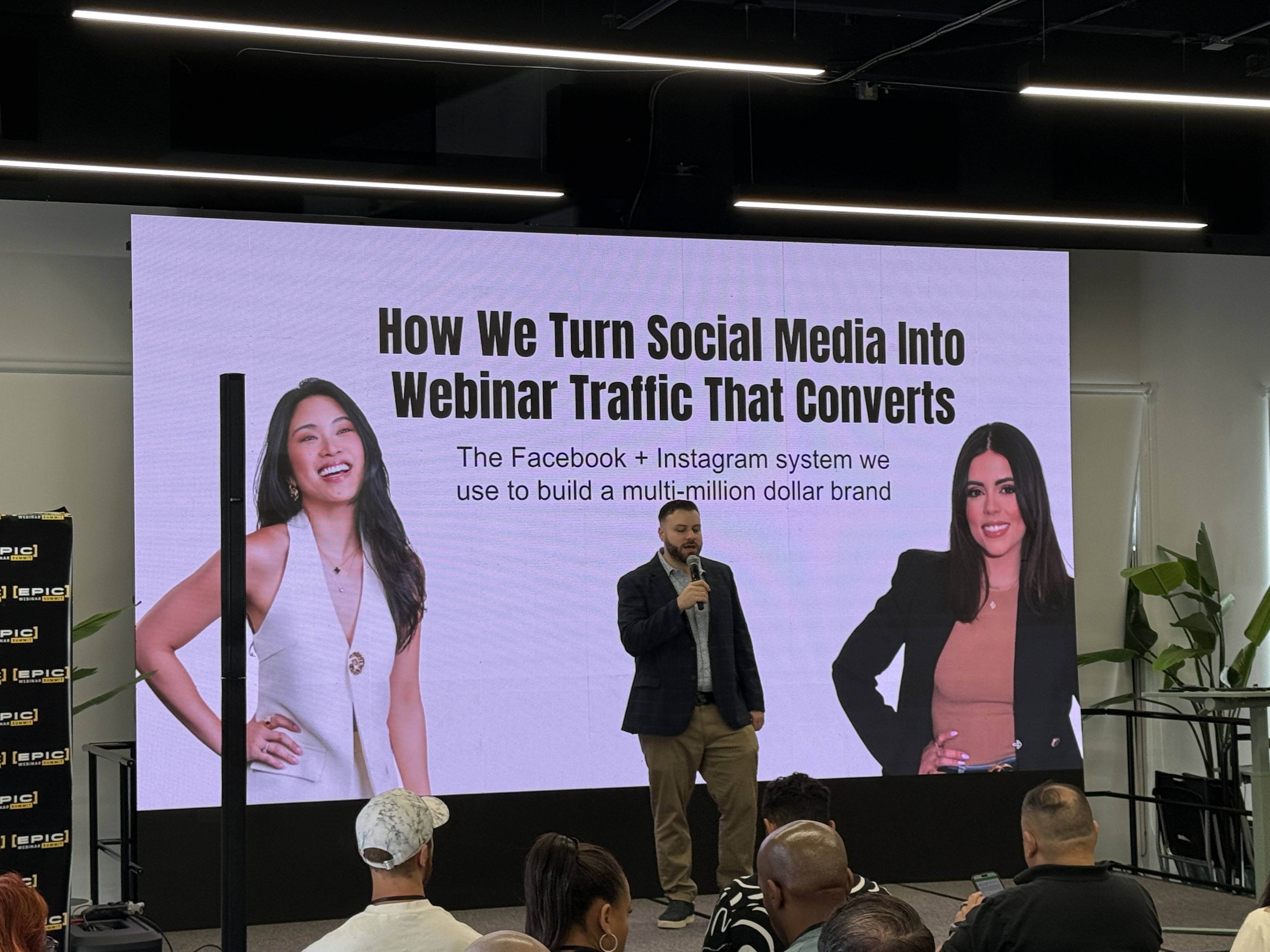
I recently attended the Epic Webinar Summit, where two speakers – Wei Shing Chen and Camila Markson – gave a talk on how to turn Instagram and Facebook into tools that consistently fill your webinars with attendees. And because they shared so many practical insights, I decided to write it all up so that those who weren't there can benefit from it too.
Both of them have come a long way, and they certainly didn't start at the top. Steffi lived off her savings for a year and a half, and at one point she had less than a thousand dollars in her account – and her first online sale? 70 cents. Not even a dollar. Today, she runs a multimillion-dollar business, travels the world with her husband, and they recently bought their dream home. Mila came to the US from Brazil with eleven thousand dollars in her pocket, unable to speak English, slept on a couch, and worked as an assistant for $60 a day. Today, she has more than a million followers, and her business generates seven-figure revenue. They both say the same thing – it all took off thanks to social media.
And that was exactly what their entire talk was about.
Instagram: how to approach your bio, content, and trust in 2025
Steffi started with the absolute basics – optimizing your Instagram profile. And although it may sound obvious, many people get it wrong and lose potential leads as a result.
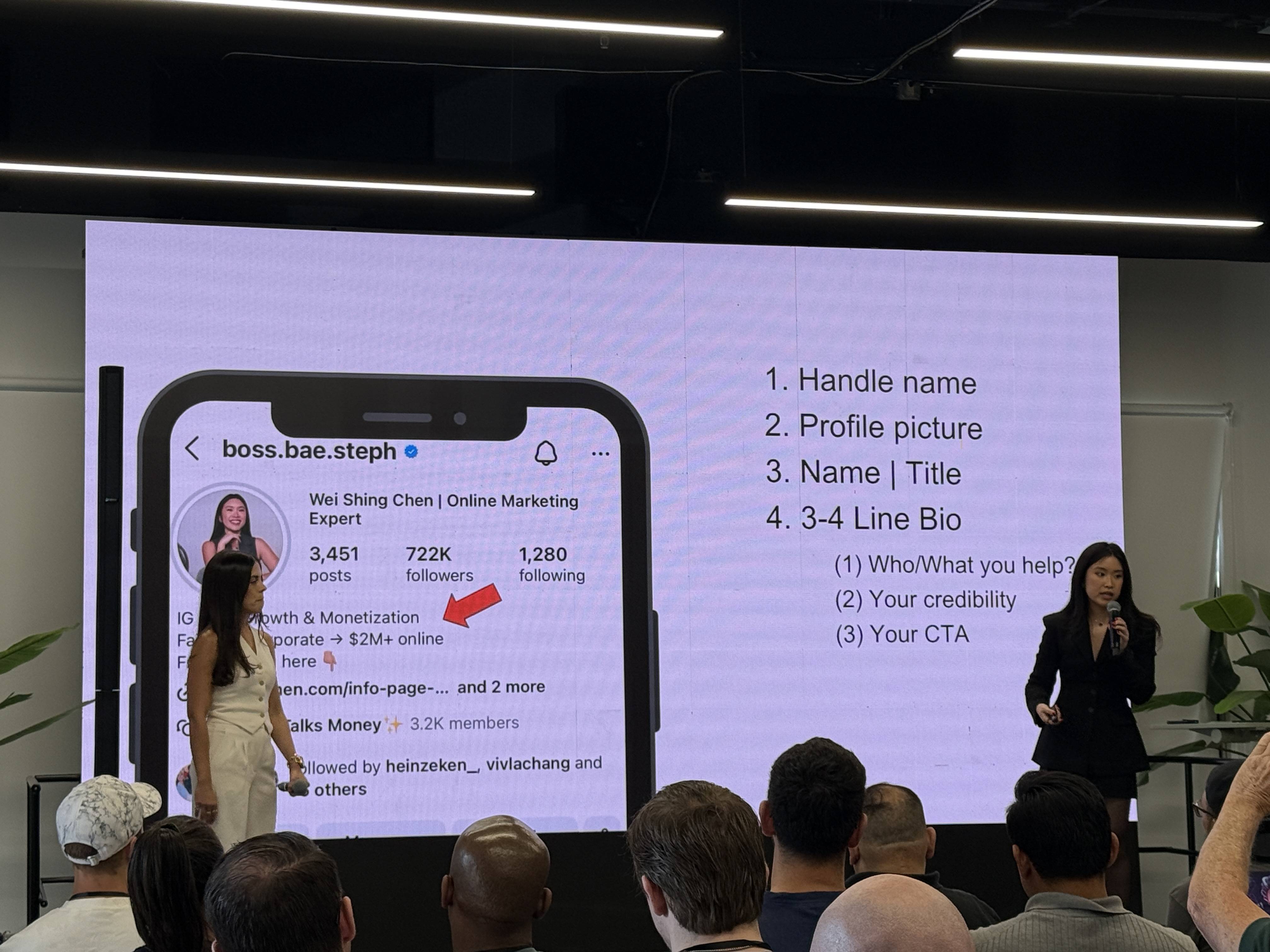
Your bio is your elevator pitch
Ideally, your handle should reference your niche. Steffi's handle is “boss.bae.steph" and she teaches people how to run an online business – so it fits. If you don't know how to combine your name with your topic, she recommends simply entering a prompt into ChatGPT and having it generate some suggestions.
Your profile photo should show you from the waist up and be sharp and professional. Steffi mentioned the website Peerspace.com, where you can find a local photography studio and an affordable photographer. But if you're just starting out, a phone photo is more than enough – she used one herself for two years.
The bio itself should be three to four lines long and have a clear structure: who you help, what you help them with, what gives you credibility, and finally a call to action (CTA). Steffi recommends adding a hand or downward-pointing arrow emoji – because people scroll through social media on autopilot and sometimes simply need a clear visual cue to click.
Link in bio: less is more
This point was emphasized strongly. Many people have twenty different links in their bio. The result? Decision paralysis. Someone who was interested suddenly doesn't know where to click and leaves. Steffi recommends no more than two to four links – the first to a lead magnet, the second to webinar registration. That's all.
Story highlights you need to have
The essential categories according to Steffi are: About Me, Testimonials, Q&A, and Lifestyle. These are the first things a new visitor will click through, and this is where they form their first impression and begin building trust.
What type of content works on Instagram today
This was probably the most interesting part of the entire talk. Steffi introduced a simple framework called SHARE that you can use to create content people actually share with others.
S – Simple
Content that delivers value quickly. “3 steps to replace your income." “5 ways to get started online." People want to feel like they've just learned something – and the simpler and easier to digest it is, the better.
H – Hook
People supposedly have shorter attention spans than goldfish. So the first few seconds determine everything. Steffi recommends having a strong hook right at the beginning and ideally a second hook within seven to ten seconds. An interesting tip: use negative words. She mentioned the example of a friend who runs a faceless account – she records videos in which she blurs her face. That “negative connotation" paradoxically attracts attention because the brain responds with, “I shouldn't be watching this, so I have to see it." The result? From zero to more than $350,000 in revenue.
A – Authenticity
So-called “yapping content" – spontaneous, honest talking to the camera. It works extremely well on TikTok, especially in a FaceTime-call style that makes it seem as though an older sibling is sharing a secret with you. And one more interesting observation: videos filmed in a car perform exceptionally well. Why? Natural light and a subconscious sense of urgency – what's so important that you can't wait until you get home to say it?
R – Relatability
Content people can relate to. Steffi showed an example in which she filmed a trend where, when it was time to pay at a restaurant, she pulled out a lipstick as though she were contributing to the bill. But instead of the usual punchline, her husband took it and started applying it. The video was shared more than 56,000 times and brought her over 1,700 new followers from a single reel.
E – Entertaining
People primarily look for entertainment on social media. They scroll during their lunch break, in traffic jams, and before going to bed. Steffi shared a video of herself trying to sing a Sam Smith song – it was shared more than 170,000 times and gained her 3,000 followers.
Piggybacking: take advantage of what already works
Another strategy Steffi strongly emphasized is piggybacking on viral content. It's not about copying, but about creating so-called “stitch" content – taking a format that works and adding your own twist. She recommended two web apps for this: snapinsta.net and snaptick.app, which allow you to download viral content from TikTok or Instagram and use it as a foundation.
As an example, she mentioned her student Judy, who used this exact method to grow from 6,000 to 150,000 followers in eight months – while generating four- to five-figure monthly income.
She also mentioned another student, Annie, who reacted to Bad Bunny's Super Bowl performance with a simple post along the lines of, “Did you see what that woman said during his performance?" – and that post brought her more than 3.4 million views and over a thousand new followers in a single day.
Facebook: like TikTok in 2020
Mila took over the second part of the talk and focused on Facebook. Her main point? Facebook has more than 3 billion monthly active users and is currently in a similar phase to TikTok in 2020 – it's relatively easy to achieve viral numbers, and the platform actively rewards creators for their content.
Mila herself gained more than 260,000 followers on Facebook in just six months. And here's the key statistic: 88% of her reach comes from people who don't follow her. That means enormous potential for reaching new audiences.
Formats that work on Facebook
Mila showed several types of posts that consistently deliver results for her.
The first is a graphic post created in Canva – a simple visual with a bold hook, information in the background, and a prompt to click into the comments (a yellow downward-pointing hand emoji). She then puts all the valuable content in the comments, adding a CTA at the end – for example, “comment the keyword for a recommendation." Why put it in the comments? Because Facebook's algorithm organizes comments poorly, so people have to scroll and search, generating engagement that the algorithm rewards.
The second format is a breaking news style – a visual with an AI-generated image, a bold yellow caption, and a strong hook. Again, with the information in the comments.
The third is a Twitter-style post with her own photo in the background, which also builds her personal brand.
Three-step framework: Research → Recreate → Reshare
This is the core of Mila's strategy, and she made it perfectly clear – 80% of success on social media is research.
Step 1 – Research: Browse Facebook, Twitter, and TikTok and look for content with high engagement in your industry as well as others. Save everything in folders. This allows you to gradually build a library of proven content that you can model.
Step 2 – Recreate: Use AI (ChatGPT, Manus AI) to break down the structure and framework of successful content and recreate it in your own words for your industry. If you repost something, don't forget to tag the original creator – it builds credibility. Mila mentioned that Manus AI even created a seven-day content plan for her based on an analysis of her profile and most successful posts.
Step 3 – Reshare: Share your best posts in relevant Facebook groups and in your stories. Most importantly, repost your top content repeatedly. You're the only one who feels like you're posting it over and over again. Everyone else is seeing it for the first time.
One piece of content, multiple formats
When you find a post that works, transform it into other formats – video, short-form content, a text post, or campaign-style graphics. Mila showed how she transformed the exact same concept into four different styles, each of which had excellent engagement. Same message, different packaging.
Frequency: the more, the better
Then came a number that may surprise you – Mila recommends posting on Facebook at least 10 to 15 posts a day. She posts twenty herself. She plans and schedules everything in advance. And in the future, she recommends outsourcing this task.
Another hack: create a group of creators in your industry and share each other's content, follow one another, and invite your followers to follow the others. Growing together works faster.
Bonus: make use of your haters
This caught my attention. Mila doesn't block haters – instead, she saves their comments in a folder and turns them into content. She takes a screenshot of a negative comment, adds her response, and people love it because it feels authentic while also generating engagement.
And one final practical tip: on Facebook, you can add a clickable link to your bio. When someone opens your profile, your website or landing page is just one click away.
Key takeaways
The entire talk could be summarized in one sentence that both speakers quoted at the end: find a growing industry, follow proven frameworks, and have a strong “why" that will keep you going through difficult times.
From a practical perspective, these are the main points I would take away from the entire talk:
Your Instagram profile is your business card – and most people clutter it with unnecessary things. Fewer links, a clear CTA, and a specific bio. Content that people share has a clear structure – it's either simple, hook-driven, authentic, relatable, or entertaining (ideally a combination). You don't have to reinvent the wheel – find what already works and recreate it in your own way. Facebook is currently a huge opportunity for organic reach and webinar leads. And perhaps most importantly – consistency and volume. Post more, share more, test more. Algorithms reward those who show up.
If you're just starting an online business or looking for a way to make your organic marketing more effective, this is a solid foundation to build on.