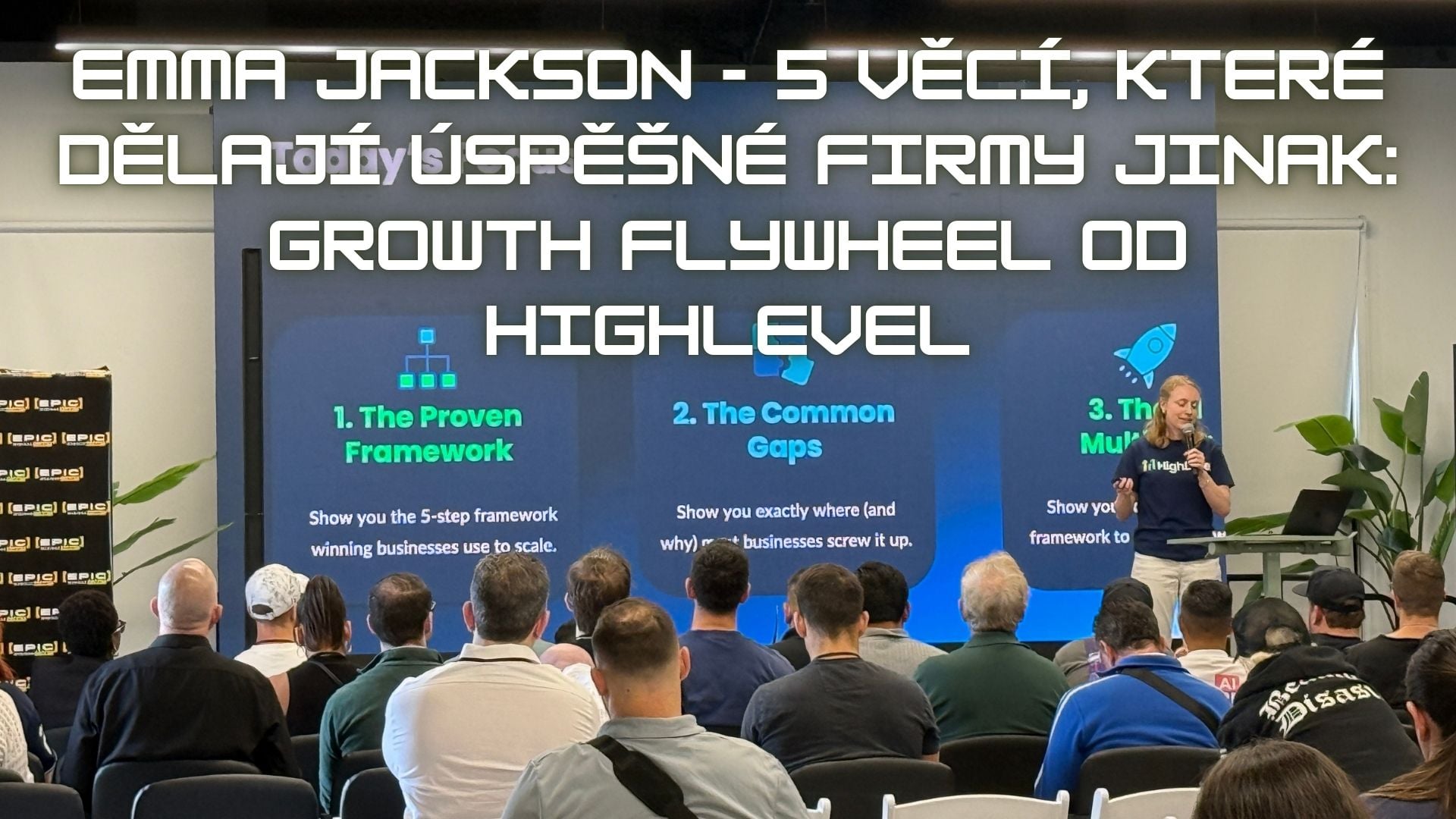
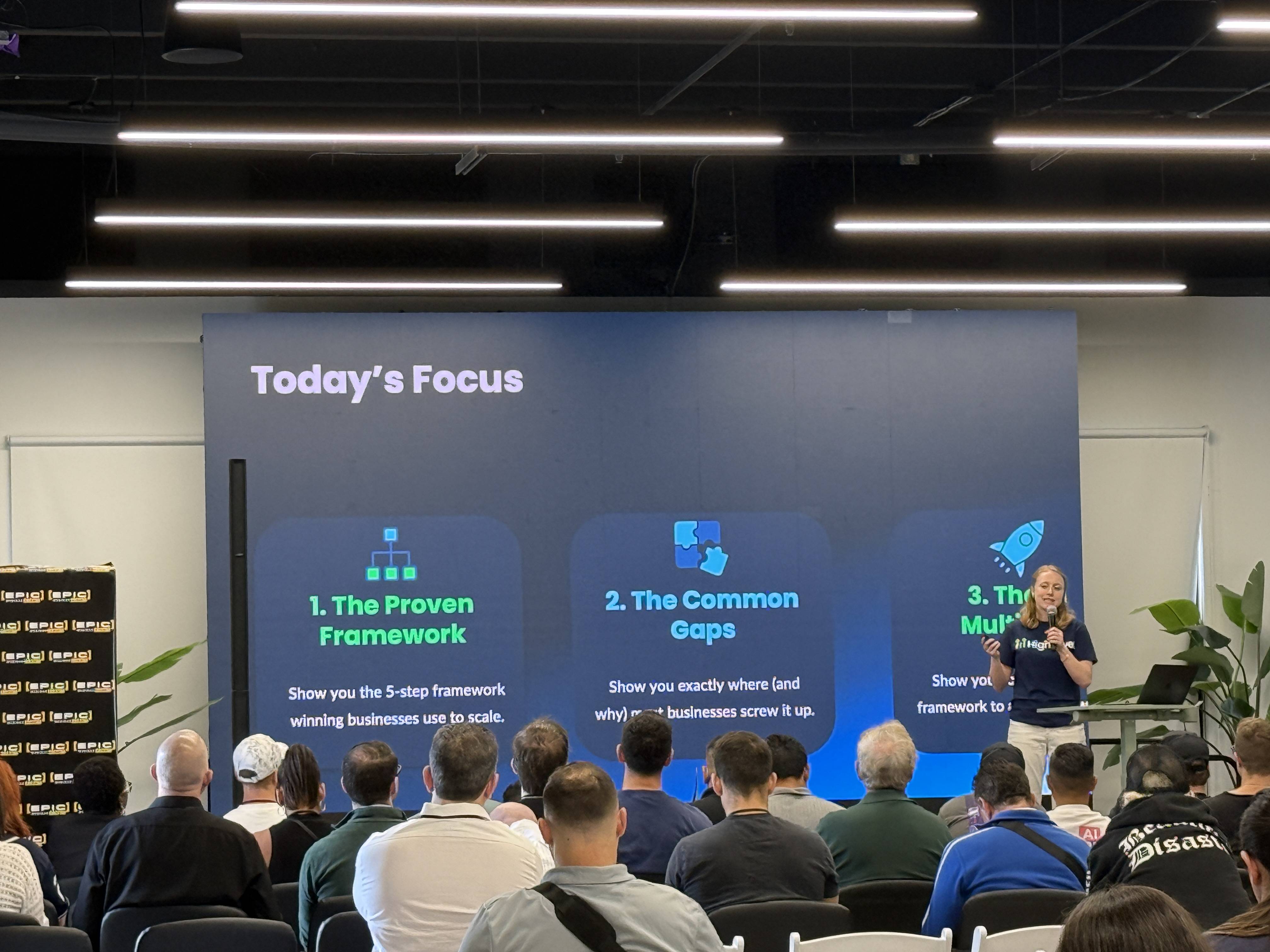
At the Epic Webinar Summit, a speaker from HighLevel took the stage—representing one of the world’s most widely used marketing tools, which ranked first globally in the marketing automation category last summer. And although most people in the room had already heard of HighLevel, the main point of the talk was not to sell software. It was about what separates companies that grow from those that stagnate.
Every day, HighLevel analyzes data from millions of companies around the world. And the pattern that repeatedly emerges among successful ones is surprisingly simple. They call it the Growth Flywheel—a five-step growth engine that works like a flywheel. The more steps you have in motion, the faster the entire system spins. But if even one step fails, the momentum stops.
Here is a summary of what was covered in the talk—and, more importantly, what you can apply to your own business.
1. Capture—capture leads (and create a compelling offer)
The first step is simply getting a potential customer’s contact information. And this is where most companies fail right from the start, because they do not have a genuine offer. A typical website has a “Book a consultation” button—and that is it. But that is not an offer; it is merely a call to action with no incentive whatsoever.
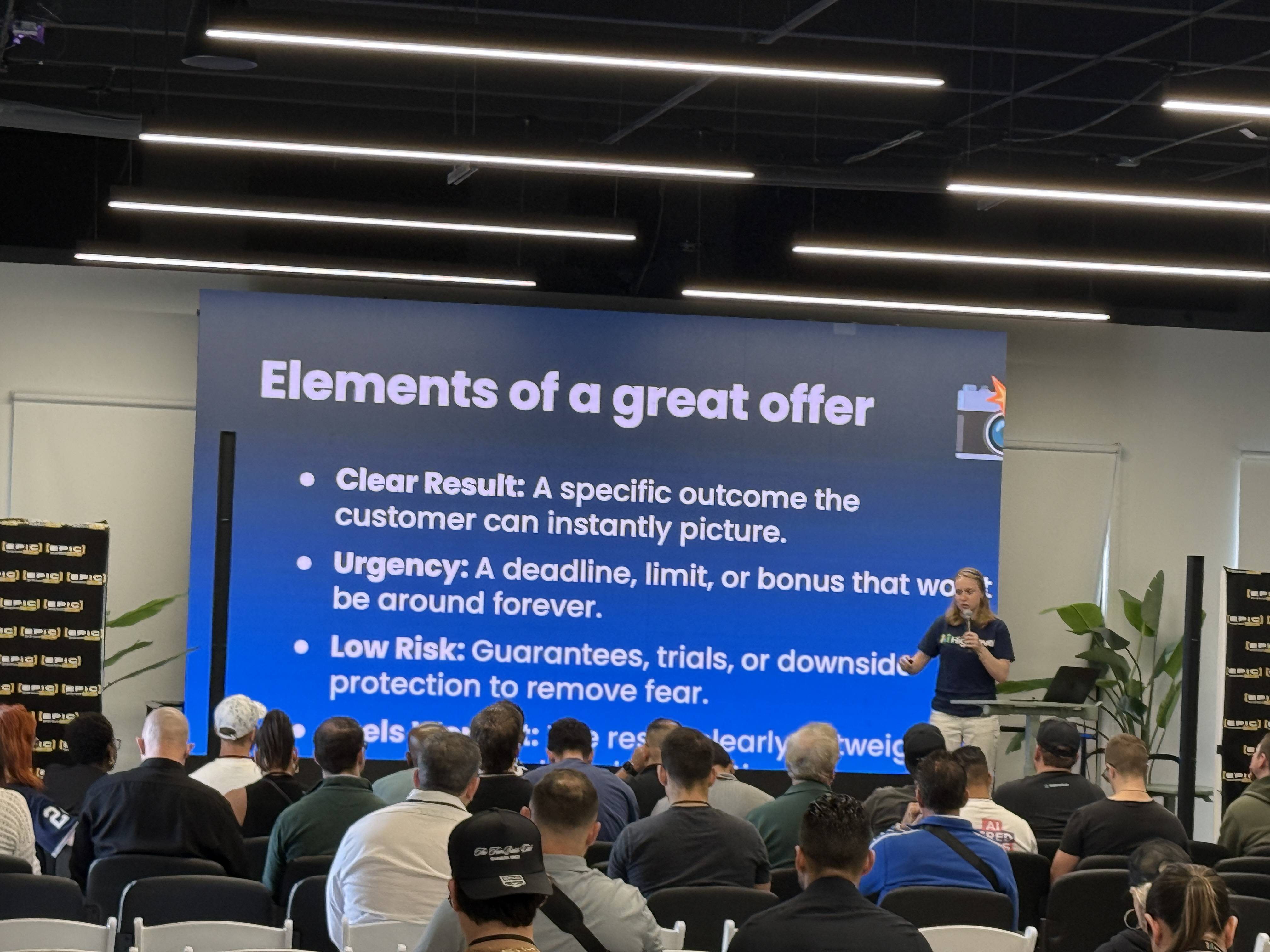
A good offer has four essential qualities. First, it must communicate a clear result—a specific outcome that the customer can immediately envision. Second, you need urgency—the offer cannot be evergreen; it needs a deadline or limitation. Third, it must be low risk—especially with expensive services, no one will pull out their wallet overnight, so a guarantee, trial, or another form of protection is crucial. And fourth, the whole thing must be worth it from the customer’s perspective, not yours.
As entrepreneurs, we tend to see the value of our own product from the inside. But customers see it completely differently, and you have to clearly demonstrate that value to them.
The second part of capturing leads is about where you store them. It is astonishing how many multimillion-dollar companies still run on an Excel spreadsheet. Without a CRM system and a visualized pipeline, you have no chance of seeing where leads are slipping away. When you break your sales process down into stages—new lead, appointment booked, appointment attended, contract signed—you can immediately see where the problem lies. You may discover that people are booking calls but not showing up. And that is a completely different problem to solve than not having enough leads.
What is more, there are now so many channels that leads can come from—Instagram, Facebook, WhatsApp, LinkedIn, YouTube, in-person events, ads—that small teams are completely overwhelmed. That is precisely why successful companies deploy AI chatbots that operate 24/7 across all channels, answer questions, collect contact details, and even book appointments directly.
2. Nurture—nurture leads (and do it quickly)
This is the speaker’s personal favorite, and honestly, rightly so. Because this is where success or failure is decided.
You know the classic scenario: the marketing team brings in leads, and the salespeople say, “These leads are terrible; there’s no way to work with them.” It is an endless dispute. But the data shows that the problem is usually not lead quality, but the speed and consistency of follow-up.
An MIT study examined how quickly you need to respond to a new lead. And the answer is—within five minutes. After five minutes, the probability of conversion drops dramatically. In the meantime, the lead finds a solution elsewhere or simply loses interest.
Now ask yourself: is it realistic for you or your team to respond to every lead within five minutes, every day, all year round? Of course not. Moreover, the data shows that 48% of leads arrive outside business hours—in the evenings and on weekends. So either you have no personal life, or you are losing money.
The solution is automation and AI. But be careful—not in the form of an automated email containing a calendar link. That is not a conversation; it is a dead end. The average email open rate is around 31%. For SMS and WhatsApp messages, it is 98%. That is an enormous difference.
Instead, you should automatically send an SMS or WhatsApp message that asks a question—something that prompts the lead to respond and engage in a conversation. That is where genuine nurturing begins.
3. Close—remove friction from payments
The third step is where you get to the money. But even here, many companies make the process unnecessarily complicated.
Beyond the sales call itself, there is a lot of time-consuming administration—sending proposals, invoices, follow-ups, and repeated reminders. How much time do you spend chasing people who have not responded to your proposal?
Successful companies solve this with automated workflows. Reminders for unsigned proposals, reminders for unpaid invoices, automated onboarding sequences after payment—all of this can run on its own. Your sales team can then focus on what it does best: building relationships and having conversations.
Another topic mentioned was voice AI—voice-based artificial intelligence that can receive (and in some cases initiate) calls 24/7. HighLevel reports more than one million calls per month through its voice AI and tens of thousands of automatically booked appointments. That represents enormous time savings.
Then there are the seemingly small details that actually make the difference. Can your customer sign a contract on a mobile device? Can they pay via Apple Pay or Google Pay? If not, you are adding unnecessary friction. And every point of friction is an opportunity for the customer to leave.
4. Evangelize—turn customers into ambassadors
Most entrepreneurs stop working the moment they get paid. And that is a huge mistake.
How many times have you had a delighted customer, thought, “Great, that’s nice”—and never asked them for a review, referral, or testimonial? Exactly. During the talk, the audience was asked who had received a five-star review within the previous seven days. Out of hundreds of people, only three or four raised their hands.
Yet the solution is simple: an automated system that asks the customer for a review once the service has been completed. And the second part is responding to reviews. Google loves it when you respond to reviews, and it improves your organic SEO. With today’s AI tools, you can automatically respond to both positive and negative reviews, each in a different tone and style.
Reviews and referrals are the first things potential customers look for when they hear about you. And if they find nothing, or only outdated reviews with no response, their trust immediately declines.
5. Reactivate—do not discard your database
And here is the “hidden” fifth step—the one discussed least often, but potentially the most profitable.
Your contact database is the most valuable asset you own. You have already paid for every contact—with energy, time, or actual advertising spend. And yet many entrepreneurs leave those contacts sitting idle while chasing new leads.
People who have already bought from you trust you. Why would they not buy from you again? Reactivation campaigns are essentially sales on demand.
What matters, however, is how you handle reactivation. Do not just send offers. Send conversation starters—news, interesting information, and updates about what you are doing. The best entrepreneurs keep their community informed and bring them along on the journey. And again—do it via SMS and WhatsApp, not just email.
The talk also demonstrated how AI built directly into the platform helps create reactivation campaigns—from image generation and copywriting to topic suggestions.
Why it matters: the flywheel effect
The entire Growth Flywheel concept is based on one idea—all five steps reinforce one another. More conversations lead to more sales, more sales lead to more reviews, more reviews generate more leads, and the entire cycle accelerates.
But if even one step does not work, momentum is lost. If you focus too much on closing and forget about nurturing, your leads will slip away. If you do not evangelize, you have no social proof. If you do not reactivate your database, you are unnecessarily paying for new contacts you already had once before.
Key takeaways
At the end, the speaker summarized it in three points that make sense.
Scale through systems, not hard work. Stop chasing individual deals and build a functioning engine. That is the essence of the Growth Flywheel.
Hire AI employees. The technology exists. You do not have to implement everything at once—choose one thing, one step in the flywheel where you know you have a weakness, and start there.
Start with one thing. If, while reading this article, you thought, “I could do this better”—that is exactly where you should start. The rest will come gradually.
AI does not change the fundamentals of business. You still need to capture leads, nurture them, close deals, build your reputation, and reactivate contacts. But now you can do it faster, more cheaply, and more consistently.
And that is the real competitive advantage—not working more, but having better systems.