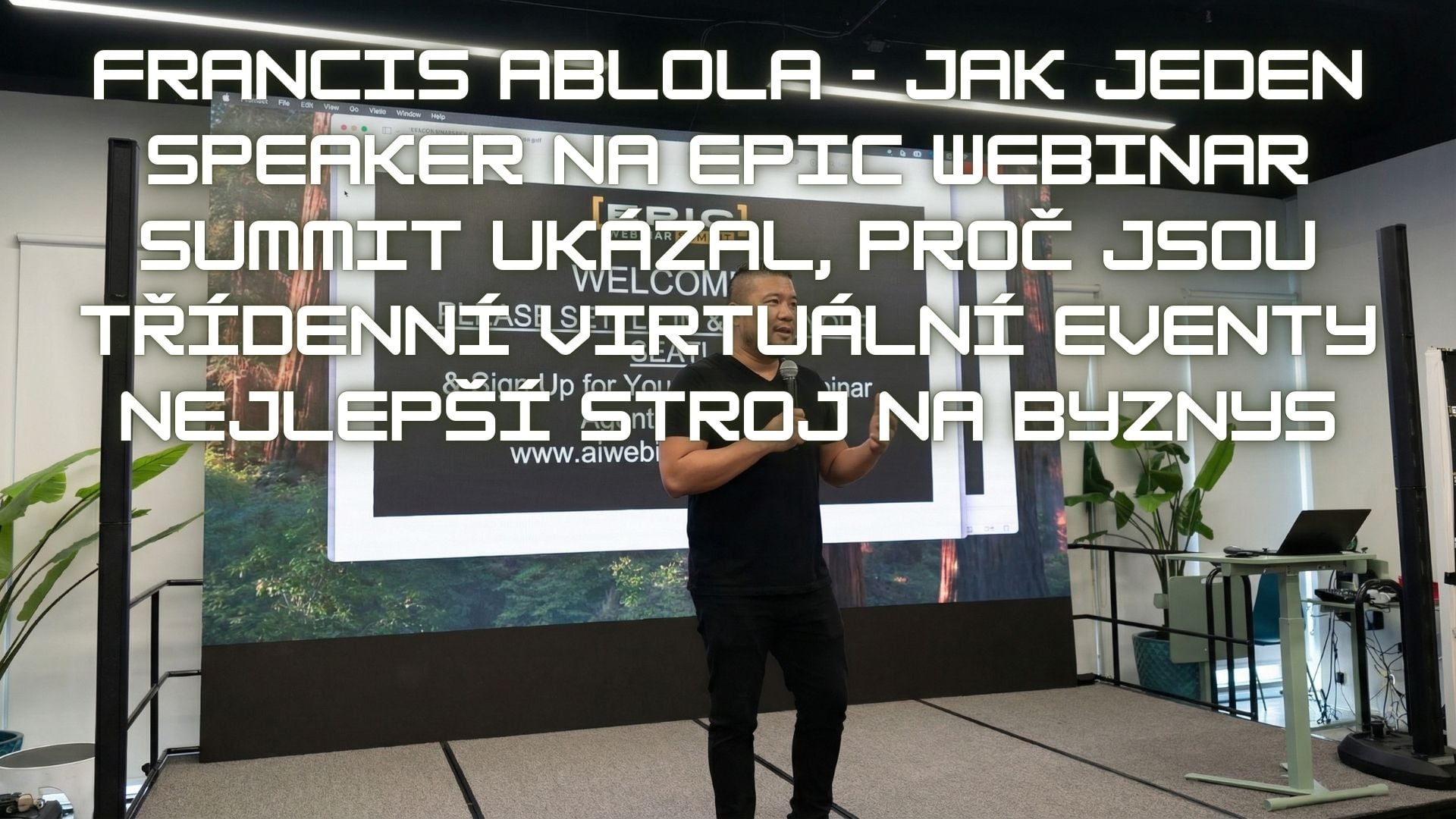
At the Epic Webinar Summit, a speaker took the stage who has spent the last 20 years immersed in the world of live events—and the last five years proving that three-day virtual events can be even more powerful than in-person ones. I had the opportunity to listen to his presentation, and honestly, it was packed with value from the first minute to the last.
Here are the most important takeaways.
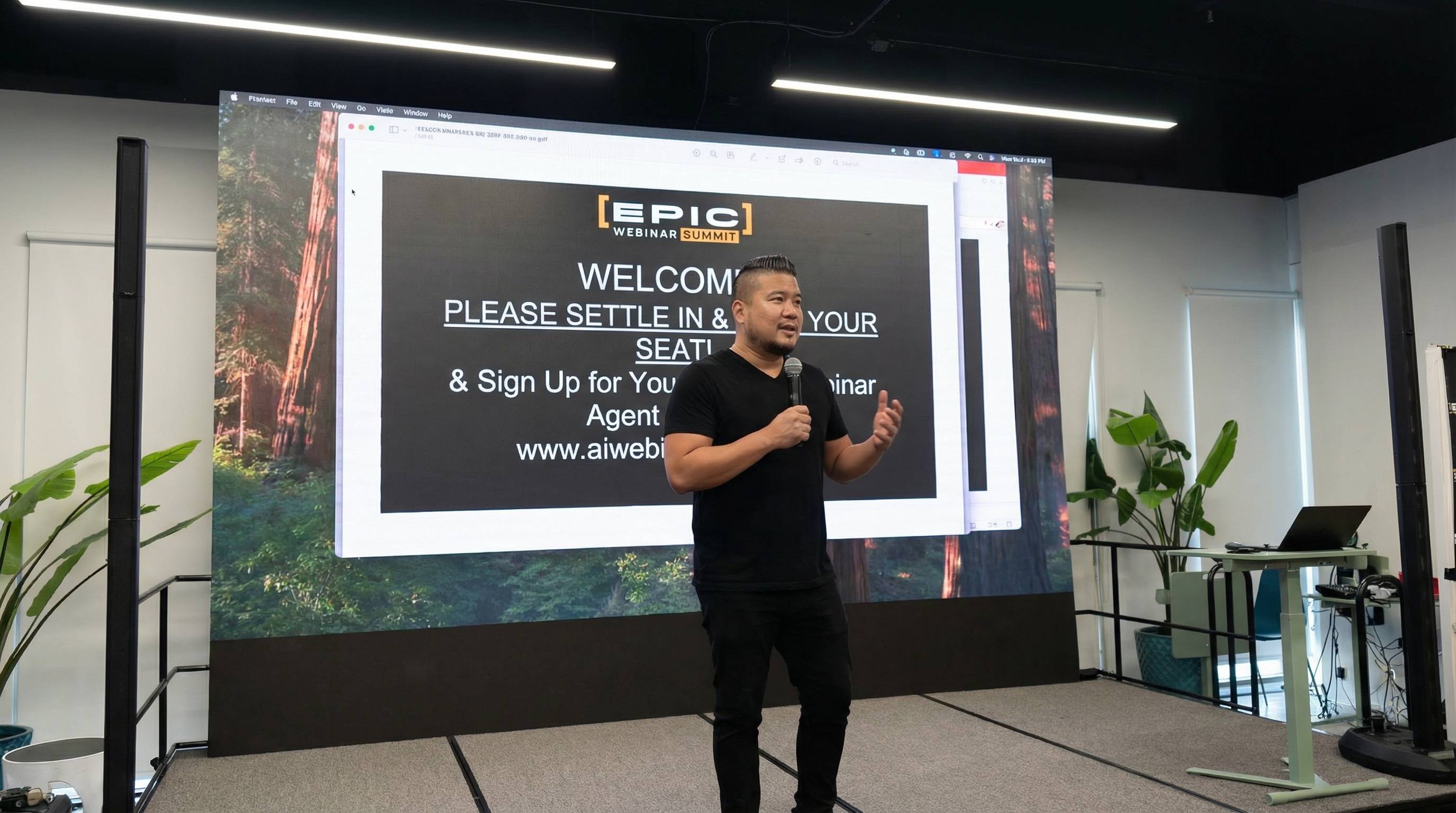
From $5,000-a-seat live events to total collapse
The speaker began by describing how his company used to run premium live events—200 to 500 people in the room, tickets priced at $5,000 per person, twice a month. Business was going so well that the company made the Inc. 5000 list of the fastest-growing companies in the U.S. four years in a row, including a ranking of No. 80.
Then December 2019 arrived. His business partner left overnight, and the seven-million-dollar company fell apart. In February 2020, Facebook blocked all their advertising accounts—even though they were spending $10,000 to $15,000 a day and had a 30-person sales team that suddenly had no leads at all. Then COVID hit and buried live events completely.
As he put it, quoting Mike Tyson: “Everyone has a plan until they get punched in the face.”
Why three-day virtual events?
After a month of grieving, he began looking for a way forward. The answer was three-day virtual events—a format his company now runs practically nonstop, several times a month and sometimes even simultaneously.
Why this particular format? Here are the main reasons he discussed:
They work exceptionally well with cold traffic. People who do not know you at all attend a three-day event and, over 12 hours of content, develop a level of trust in you that would otherwise take months to build.
Opt-in page conversion rates are incredible. The speaker mentioned a 40–50% conversion rate on the registration page, which is an absolutely exceptional figure for cold traffic.
Unlimited global reach. People join the events from Dubai, Singapore, Malaysia, Hong Kong, Australia, and New Zealand—people who would never fly to an in-person event.
Speed of implementation. While filling a room for a live event takes months, they can fill a virtual event in 10 days. And they run several of them every month.
The fastest return on investment of any format they have ever tested.
Community building. According to him, no other format can accelerate the process of building trust and relationships with an audience so effectively.
The key strategy: don’t sell, build relationships
This was probably the biggest takeaway from the entire presentation—and something that goes strongly against the grain of what is commonly done in online marketing.
At the very beginning of each event, the speaker tells the audience: “We have 12 hours of content spread over three days. We’re not going to sell you anything. The only thing we have to offer will be mentioned during the break and at the end of the day—and it’s entirely up to you whether you stay.” And then they actually stick to it. Consistently.
Why does it work? Because people are extremely skeptical online today. Anyone who has ever attended a summit with 12 speakers knows that each of them is usually selling something. This approach is the exact opposite—and that is precisely why it stands out.
At the end of each day, they ask: “Who believes we kept the promise we made at the beginning—that we wouldn’t pitch?” And reportedly, the chat explodes with positive reactions every time. In three years of running these events regularly, they have only had to disable the chat once—because of a single troll.
As he summarized it: “People love to buy, but they hate feeling manipulated.”
How they use the principles from the book Influence
The speaker mentioned that he had recently shared the stage with Robert Cialdini, author of the iconic book Influence, and broke down his entire event strategy through Cialdini’s seven principles. Here is how they apply them in practice:
Reciprocity – They provide enormous value for free—12 hours over three days—while explicitly saying that they do not want anything in return. This is the exact opposite of what most people do, which is precisely why it works so well.
Scarcity – The event takes place on a specific date, and if you miss it, it is gone. Even if the next one is in 10 days, FOMO still works because each event may be slightly different.
Authority – The content is packed with case studies, and in the beginning, when they had not yet established their own authority, they invited guests they could “borrow” it from. Today, they work with people such as Les Brown and Jack Canfield.
Social proof – Thousands of people live in the chat, responding in real time. During breaks, they play testimonial videos from real clients.
Liking – The three-day format creates room for storytelling and personal moments. The speaker does not begin with a 15-minute story about himself; instead, he organically weaves small personal details throughout the event—about his children, how he feels, and what is currently happening in his life.
Commitment and consistency – The participants’ time is an investment. Even though the event is free, the fact that someone devotes 12 hours of their time creates a strong commitment.
Unity – Returning attendees who come back for a second or third time—some as many as fifteen times—create a sense of community. They also invite members of their paid program to join and naturally share their positive experiences.
Tactical tip: create “heroes” in the chat
One thing that caught my attention was that, during the three-day event, they notice people who respond in the chat exactly the way they want them to. They publicly praise these people and turn them into the “heroes” of the chat. And what happens? Others begin doing the same thing. This creates a self-regulating community where positive behavior naturally prevails.
The pre-event webinar: a brilliant move
Before every three-day event, they hold a preparation call—a webinar about the event itself. Hundreds of people join to learn what to expect, get to know the speaker, understand the agenda, and find out how the event will be run.
The result? When the event begins, it is not a room full of complete strangers. People already know what to expect and feel like they are part of something. That is a huge difference compared to someone arriving at a webinar completely alone and not knowing what they are getting into.
An AI chatbot doubled the show-up rate
Of all the practical tips, what caught my attention most was their use of an AI chatbot—specifically CloseBot. After deploying it, their show-up rate doubled from 15% to 30%. The chatbot holds individual conversations with registered attendees, answers questions, reminds them about the event, and even converts them into customers for their paid products after the event ends.
And here comes the interesting part—they tested the chatbot’s results against a live sales team. The chatbot won. An experienced sales team lost to an AI bot in terms of conversion.
The entire business model: from a free event to $25,000
The speaker openly revealed the entire structure of his funnel. It begins with a free three-day event, where they try to cover their traffic costs through small upsells—$27 for VIP access to recordings and bonus content, another $27 as an order bump, and $67 on the OTO page.
But all of that is only the entry point. The real business model looks like this: a software subscription for $97 per month—or $997 per year—online courses ranging from $2,000 to $5,000, and $25,000 high-ticket programs with hundreds of participants.
And why does it all work? Because by the time someone is deciding whether to invest $25,000, they have already spent dozens of hours with them at virtual events, may have attended an in-person event, have built a relationship with them, and know exactly what they will get. According to him, the sale then happens completely naturally.
Virtual events as a gateway to in-person events
This is really the point of the entire model—and it is quite elegant. Virtual events are a mass-market tool for building an audience and trust. Participants are then recruited from them for smaller in-person events—currently 100 people once a month—where conversion into high-ticket programs is much easier because the attendees are no longer strangers.
As the speaker described it, when you walk into a room with 500 existing clients who have never met you in person but have seen you at three virtual events, “it’s like coming home to family.” The dynamics in the room are completely different, and sales happen naturally through the relationship rather than through pressure.
A Facebook group as a flywheel
Another clever element is that, after registering for the event, people are directed to a Facebook group with 56,000 members. After the event, they are encouraged to share their impressions there. This organically increases the group’s engagement, so Facebook shows it to more people, who then join and see invitations to future events. This creates a self-sustaining cycle that generates registrations completely free of charge.
AI prompts for understanding the audience
At the end, the speaker showed how he uses AI to work with data from customer surveys. They collect thousands of responses from actual buyers and then run them through specific prompts—to create a detailed avatar, identify positive patterns and audience aspirations, uncover objections and negative emotions, and ultimately develop offers that precisely match what the audience wants.
What should you take away from this?
If I had to summarize the entire presentation in one sentence, it would probably be this: stop trying to sell and start building relationships at scale. According to this speaker, three-day virtual events are the perfect tool for doing so—scalable, repeatable, and with a proven return on investment.
It is a model that does not require a huge team, can be launched relatively quickly, and—if you do things right—creates a community of people who keep coming back on their own and voluntarily recommend you to others.
And if you take only one thing away from this presentation, let it be this: transparency sells better than any pitch.