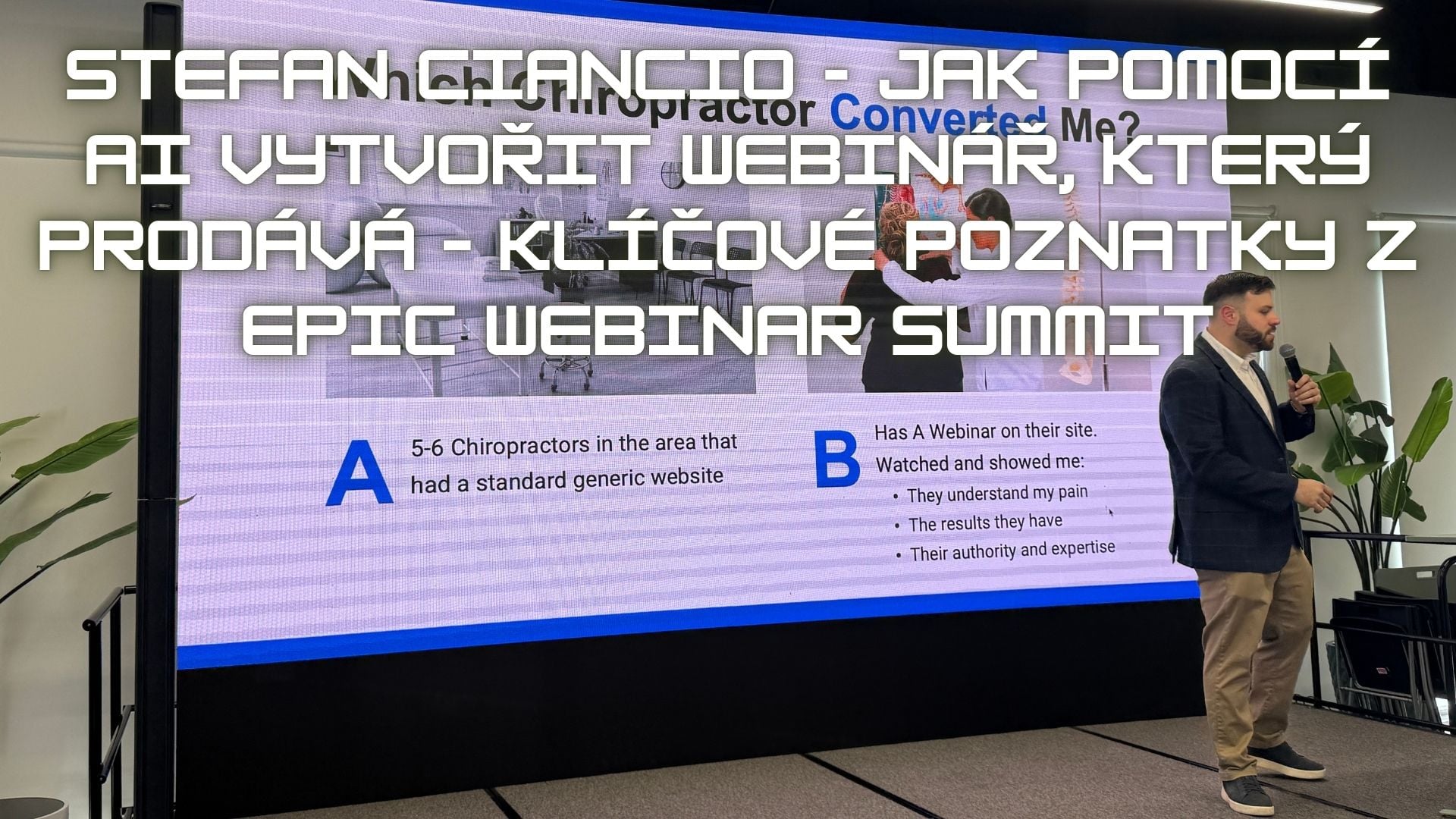
I recently attended the Epic Webinar Summit, where Stefan, the founder of Webinar Kit, gave a talk on how to use AI today to create a sales presentation that actually converts—in just a few minutes.
I have to admit, the talk really grabbed me. Not because it presented some revolutionary concept, but because the whole thing was highly practical, with a live demonstration right on stage. And most importantly—it made sense.
Here is a summary of the most important points.
Why webinars?
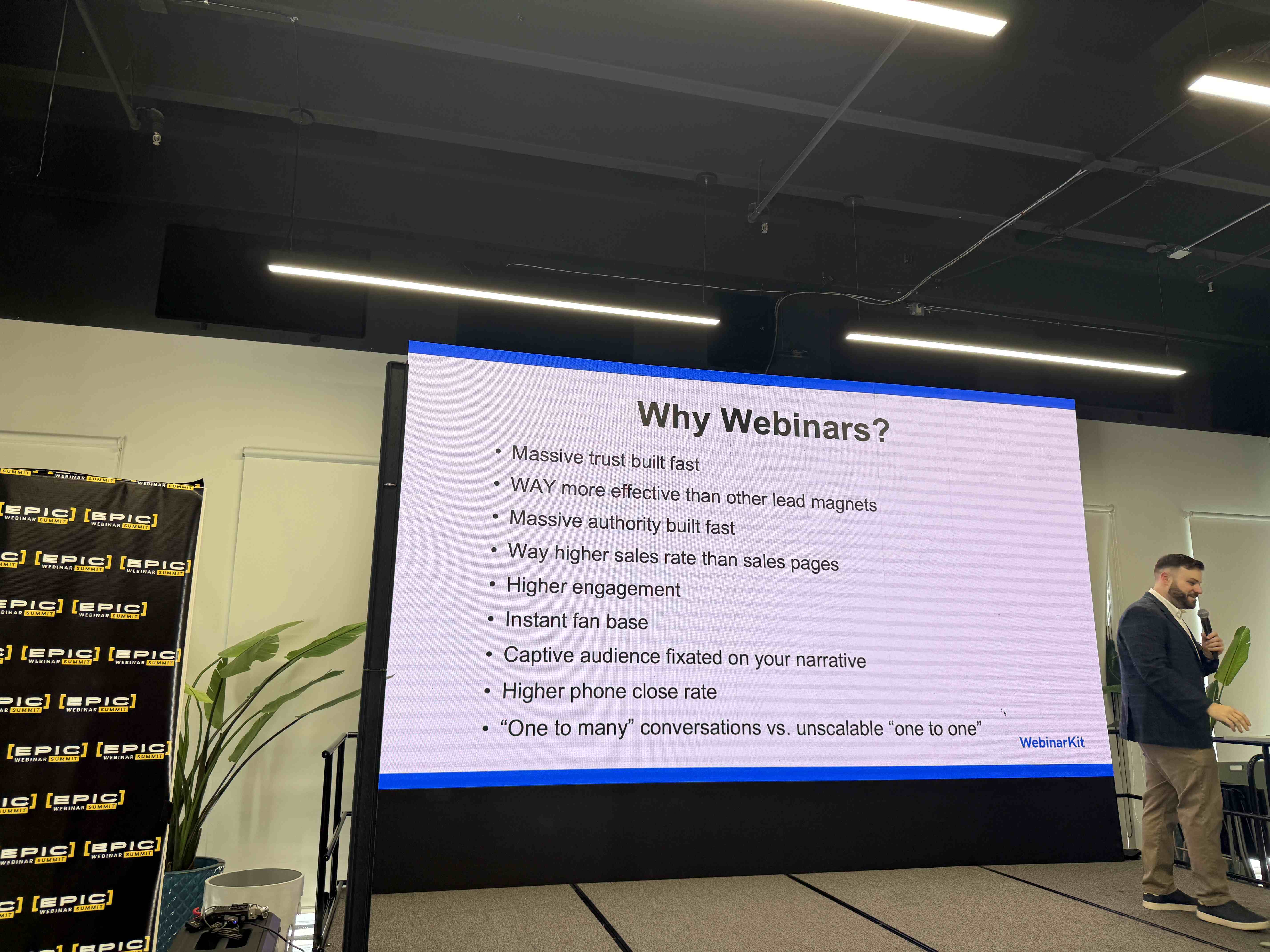
Stefan began with what is essentially the foundation of his entire philosophy: selling without sales calls and without endlessly posting on social media. And according to him, webinars are the tool that makes this possible.
The concept is simple—instead of having the same conversation over and over with a single prospect, you can have that same conversation with dozens, hundreds, or thousands of people at once. It is the “one-to-many” principle, which Stefan compared to a potential thousandfold increase in productivity.
At first glance, this may seem obvious, but the reality is that a huge number of companies do not use webinars at all. And this is despite the data Stefan presented, which showed that webinars are the second most effective tool in B2B marketing—right after in-person events.
The chiropractor story that caught my attention
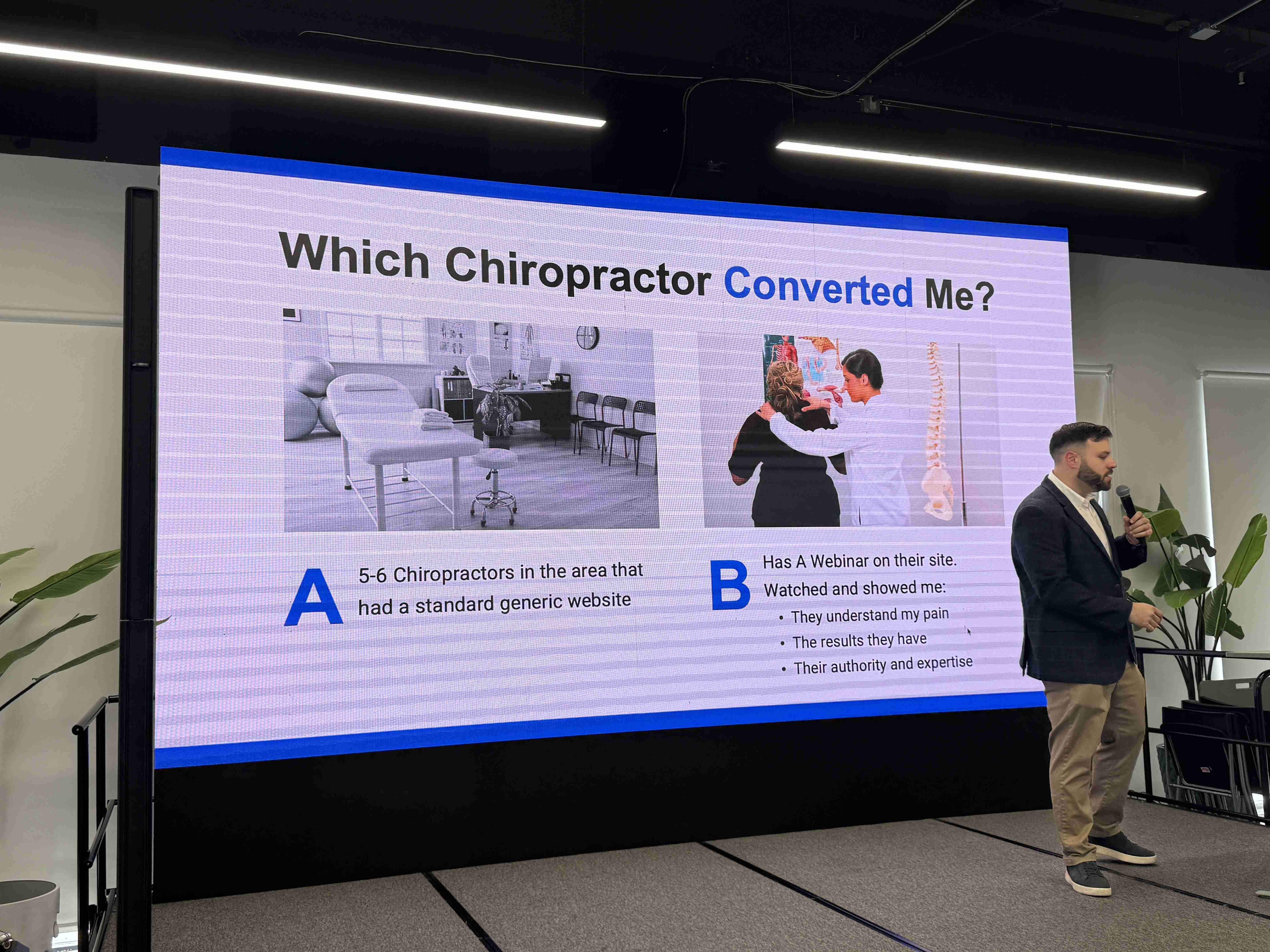
One of the best parts of the talk was a personal story. Ten years ago, Stefan was having back problems and was looking for a chiropractor in Philadelphia. He found five practices with the same reviews and the same cookie-cutter websites. They all looked exactly alike.
Except for one.
One of those websites featured an unoptimized, poorly placed recorded video—essentially a webinar. The topic was something along the lines of “How to Actually Relieve Chronic Back Pain.” And that one thing made the difference. Stefan chose this chiropractor, who was also booked weeks in advance, while the others had appointments available immediately.
The point? Even a poorly executed webinar on your website can be what sets you apart from the competition. Through it, the chiropractor demonstrated three key things: that he understood the patient’s problem, that he got results, and that he was an authority in his field. And that was enough.
The old way vs. the new way of creating webinars
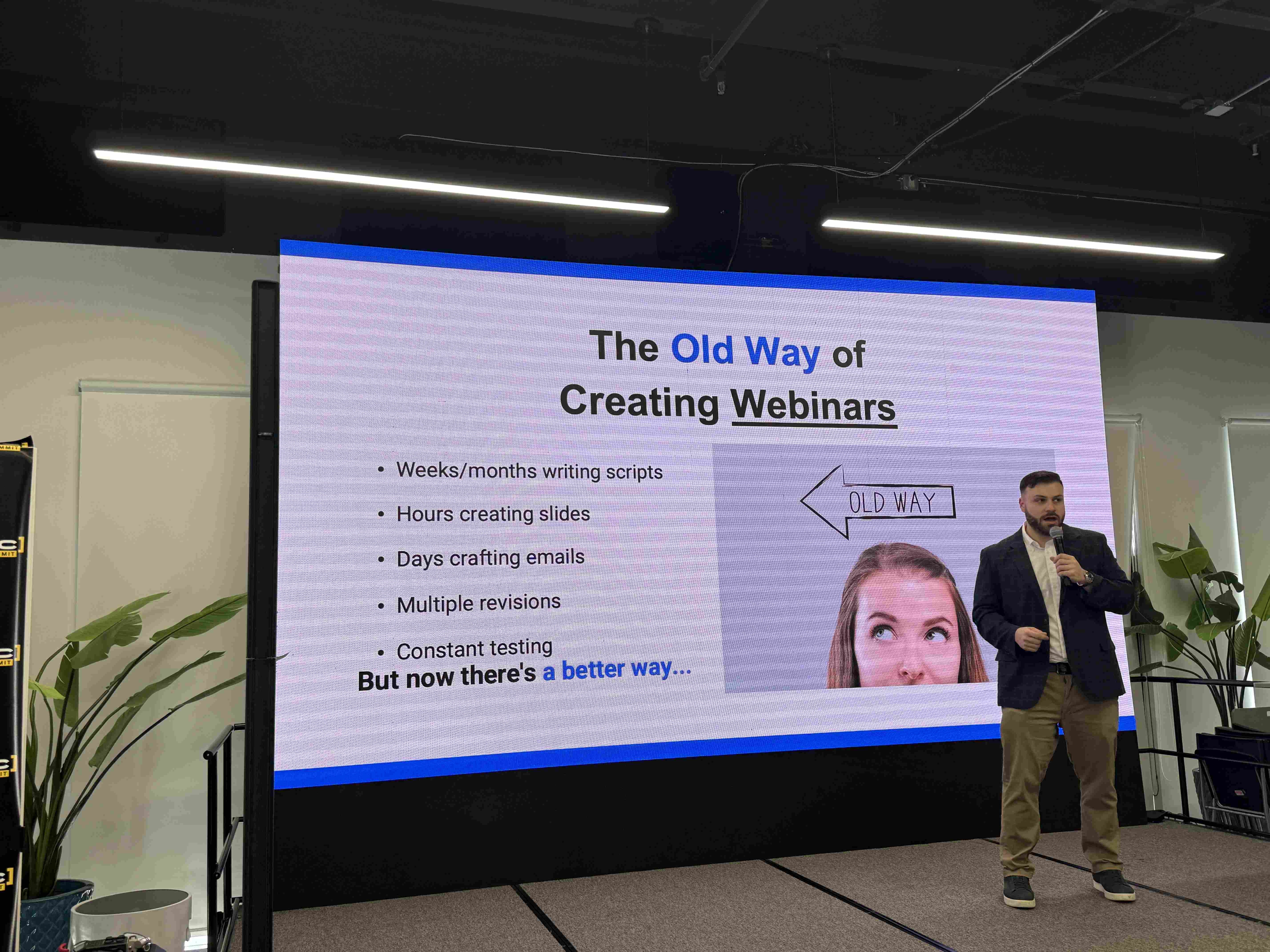
This was probably the most practical part of the entire talk. Stefan openly described what creating webinars used to look like—weeks of writing scripts, hours spent on slides, days spent on emails, and endless revisions and testing. Simply a painful process.
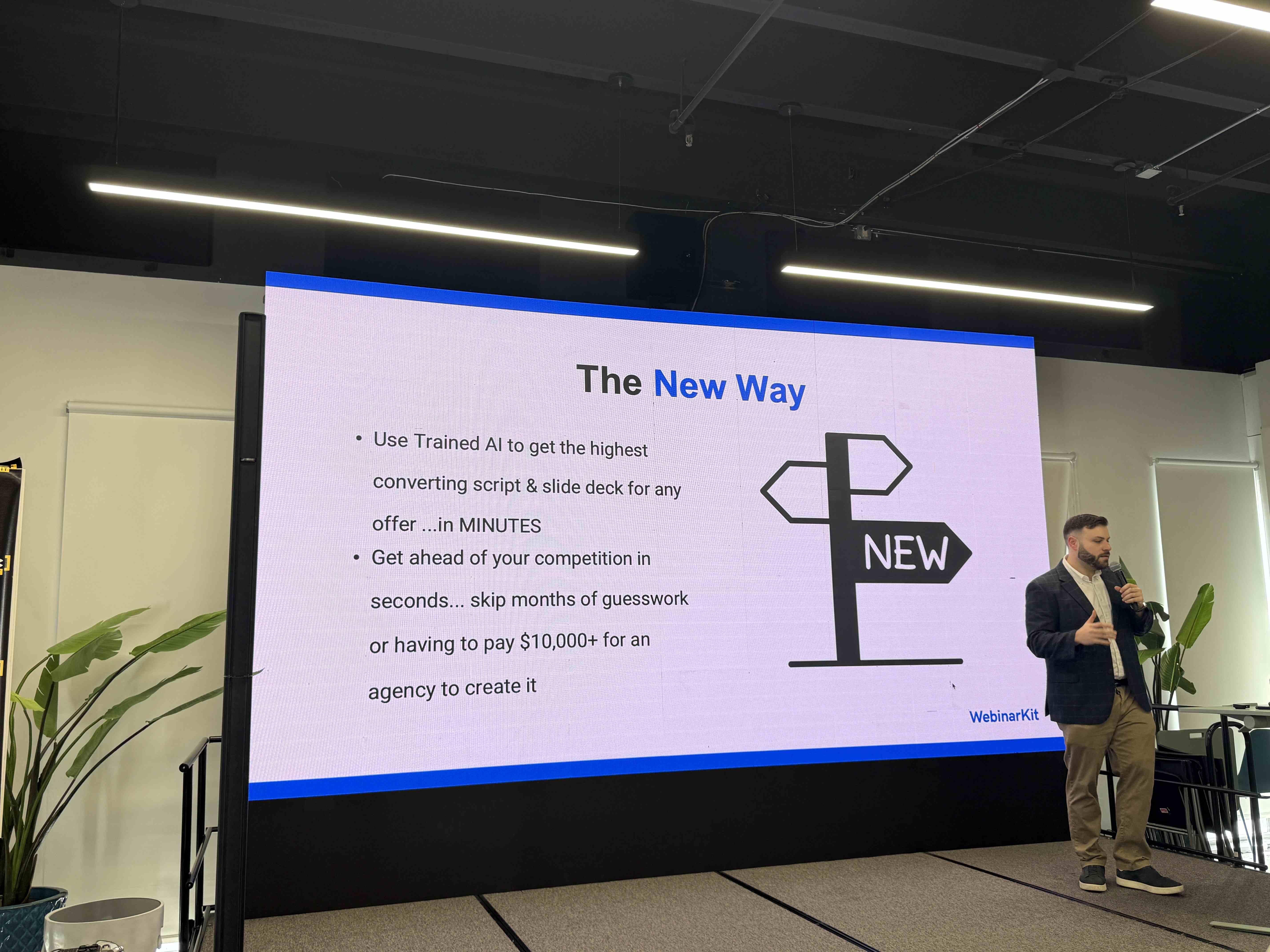
The new approach? Using AI trained specifically on sales data and proven frameworks. However, Stefan strongly emphasized one crucial distinction—this is not about going to ChatGPT and typing “create a webinar for me”. According to him, output from generic AI is too general and does not convert.
The key is that the AI must be trained on real sales data, proven webinar structures, and conversion mechanisms. Stefan specifically mentioned that their tool (AI Webinar Agent) draws on data from more than 20,000 customers and combines frameworks from well-known names in the industry—such as Russell Brunson’s “three secrets” structure, along with other elements from other experts.
Live demonstration on stage
The most interesting part of the talk was the live demonstration. Stefan took the sales page of one audience member (MJ Worthmore, operator of forexuniversity.com) and generated a complete webinar from it right there on the spot.
The process was straightforward:
First, he pasted the text from MJ’s sales page into the tool. The AI automatically extracted the event title, main promise, target audience, pain points, customer desires, and false beliefs—in other words, all the key elements that a high-quality sales webinar needs. Everything was editable, of course, so if the AI did not get something exactly right, it could be corrected in just a few clicks.
Then Stefan clicked “Generate Script,” and within a few minutes he had a complete script for the entire webinar. He then used that script to generate a complete slide deck—including AI-generated images.
What surprised me was when MJ himself admitted that the presentation included things that were not on his sales page at all—for example, the topic of “marketing in theory,” which he discusses on his YouTube channel. The AI had apparently done its own research and added relevant information from other sources.
The results it delivers
Stefan mentioned several specific cases. For example, influencer Jeff Hunter used AI Webinar Agent and achieved a 15% conversion rate on his first webinar—meaning 15% of attendees purchased the product being offered. Another user, Daniel Chung, generated his first webinar and made $22,000 from it.
Of course, these figures should be taken with a grain of salt, and they depend on many other factors (the offer, target audience, and product price). Even so, they show that AI-generated webinars can genuinely work as a sales tool.
An AI avatar instead of a camera
At the end, Stefan demonstrated one more feature—the option to have the webinar presented by an AI avatar. So if you do not want to be on camera, you do not have to be. The AI avatar will deliver the presentation for you in various accents and styles (American English, British, Australian—and apparently even Santa Claus).
The quality is not perfect yet, but as Stefan himself noted, it will only improve. And for someone who does not have the time or inclination to record a video, it is quite an interesting alternative.
What should you take away from this?
If I had to summarize the main ideas from Stefan’s talk in a few points, they would be these:
Webinars are still one of the most powerful sales tools, especially in B2B. And yet surprisingly few companies actively use them.
You do not need a perfect webinar to get started. Even an imperfect webinar on your website will set you apart from competitors who do not have one. The chiropractor is proof of that.
AI dramatically reduces the time needed to create a webinar. What used to take weeks can now be done in an afternoon. But be careful—it is not enough to go to ChatGPT and ask for a “webinar.” You need AI that understands sales frameworks and conversion mechanisms.
Getting started is more important than having everything perfect. Stefan repeatedly emphasized that you can edit and improve an AI-created presentation at any time. AI gets you 80–90% of the way there, and the rest is up to you. But that first step—simply launching it—is the most important thing.
Iteration is key. Every webinar you launch will provide you with data and feedback. And with each subsequent iteration, you will improve. You do not have to be the best on your first attempt.
Personally, I think this is the direction in which the sale of online products and services will increasingly move. AI tools for creating presentations and webinars are still in their infancy, but they can already save enormous amounts of time and money. And those who understand this sooner will have an advantage.