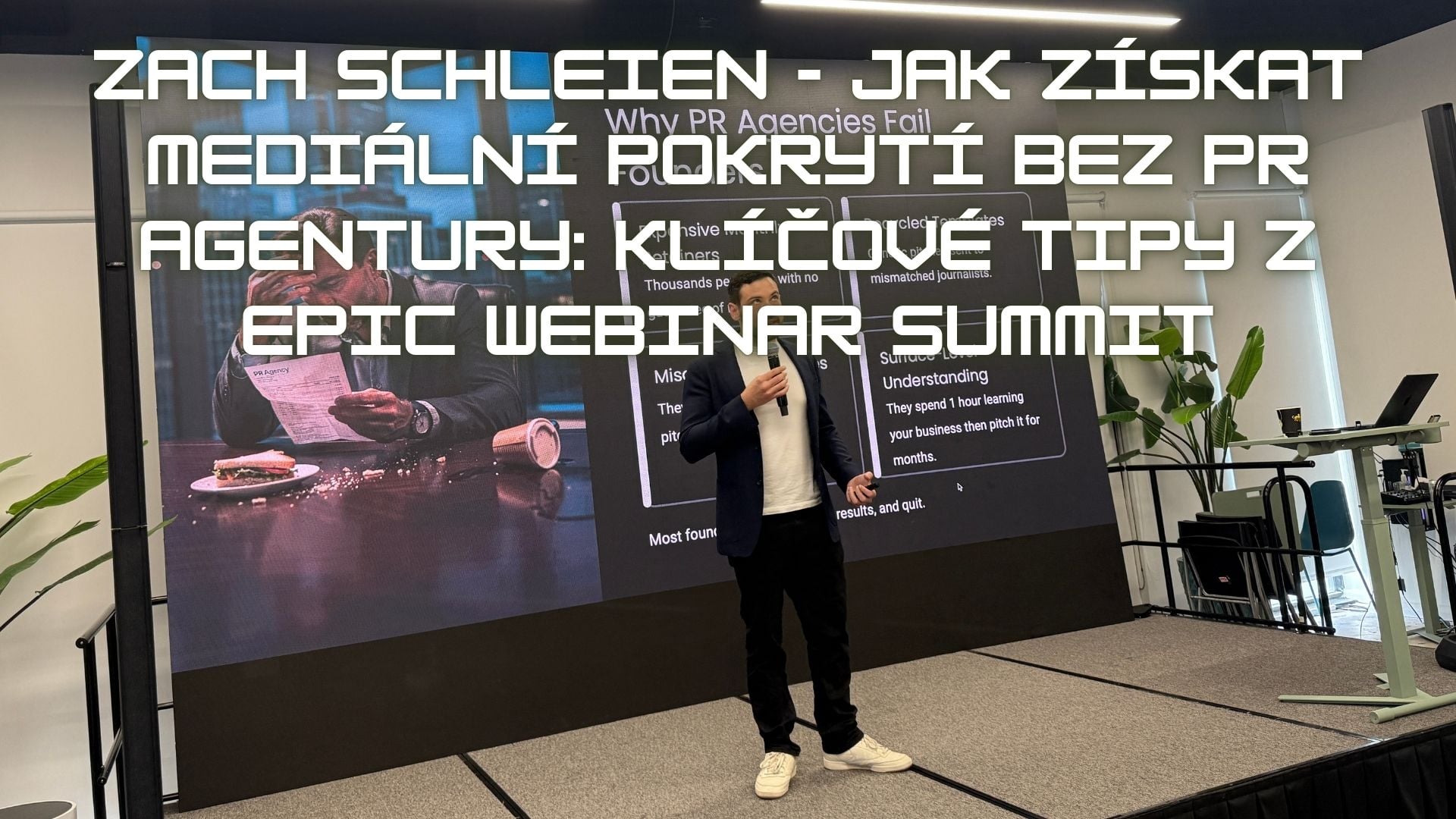
At the Epic Webinar Summit, a speaker shared something most startup founders would never even consider handling on their own – how to get media coverage without a PR agency, without a big budget, and without any previous public relations experience.
And honestly? What he said made perfect sense.
From zero to the New York Times
The speaker has no PR background. He has never worked with an agency and has never worked professionally in PR. Yet he managed to get featured in more than 200 media outlets across 26 countries – including the New York Times, Forbes, BBC, Bloomberg, and Vice. More importantly, that media coverage ultimately helped him secure $2.5 million in funding.
How? In a simple but labor-intensive way. He sent hundreds of pitches, tracked what worked and what did not, and gradually iterated and refined his approach. He wrote every pitch himself and researched every journalist manually, one by one.
No magic, no shortcut – just a system, data, and repetition.
Why PR agencies often fail
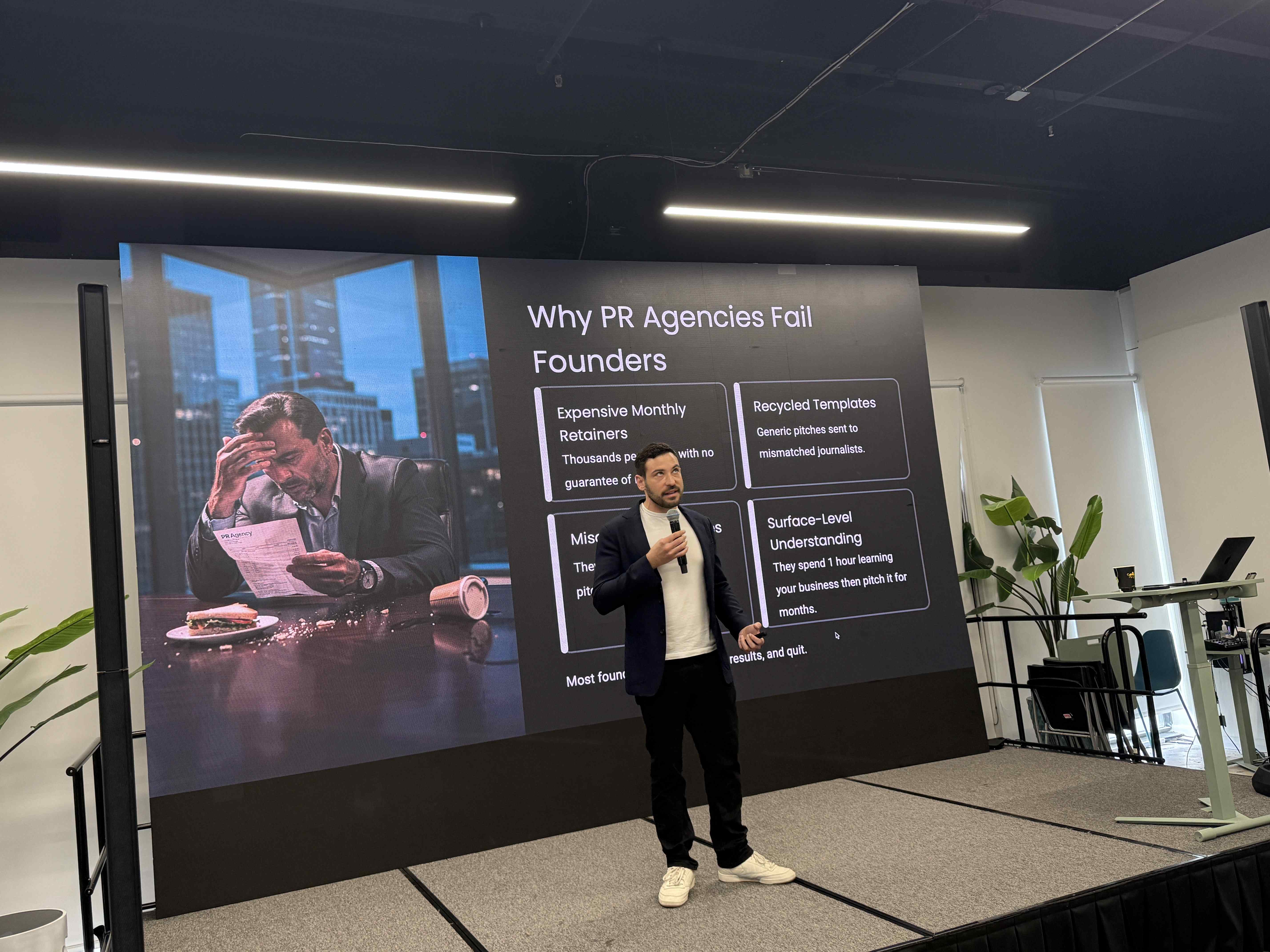
This was one of the most interesting points of the entire talk. Many founders consider hiring a PR agency. And why not – it sounds logical: you pay professionals, and they secure media coverage for you. But the reality is often different.
PR agencies commonly charge retainers of $7,000 to $15,000 per month. For that money, you get something the speaker compared to a “black box” – the agency learns something about you, starts pitching, and you have no real idea what exactly is happening. You ask how it is going, and the answer is: “We’re pitching you.” And that is all.
The problem is that you are one of many clients. The agency tries one angle, and if it does not work, it is not always motivated to look for another. What is more, no one knows your business as well as you do – and unfortunately, that shows in the quality of the pitches. A superficial understanding of your product leads to superficial pitches that fail to interest journalists.
The key mindset: you are not pitching your product, you are pitching value to the journalist
This was the most crucial point of the entire talk and something most founders get wrong.
The typical approach looks something like this: “I have a new AI marketing tool, it’s great, write about us.” And what happens? Forbes replies with something along the lines of: “Thanks, we’ll refer you to our sales department, where you can purchase advertising.”
Why? Because a pitch framed this way is essentially an ad, not a story. And journalists do not write ads – they write stories that interest their readers.
The key is to think from the journalist’s perspective. They have their beat, their area of expertise, and their readers. They need to produce content that people read, or they will lose their job. So when pitching them, you need to ask yourself: “Is this genuinely useful to this journalist and their readers, or only to me?”
Four types of angles that work
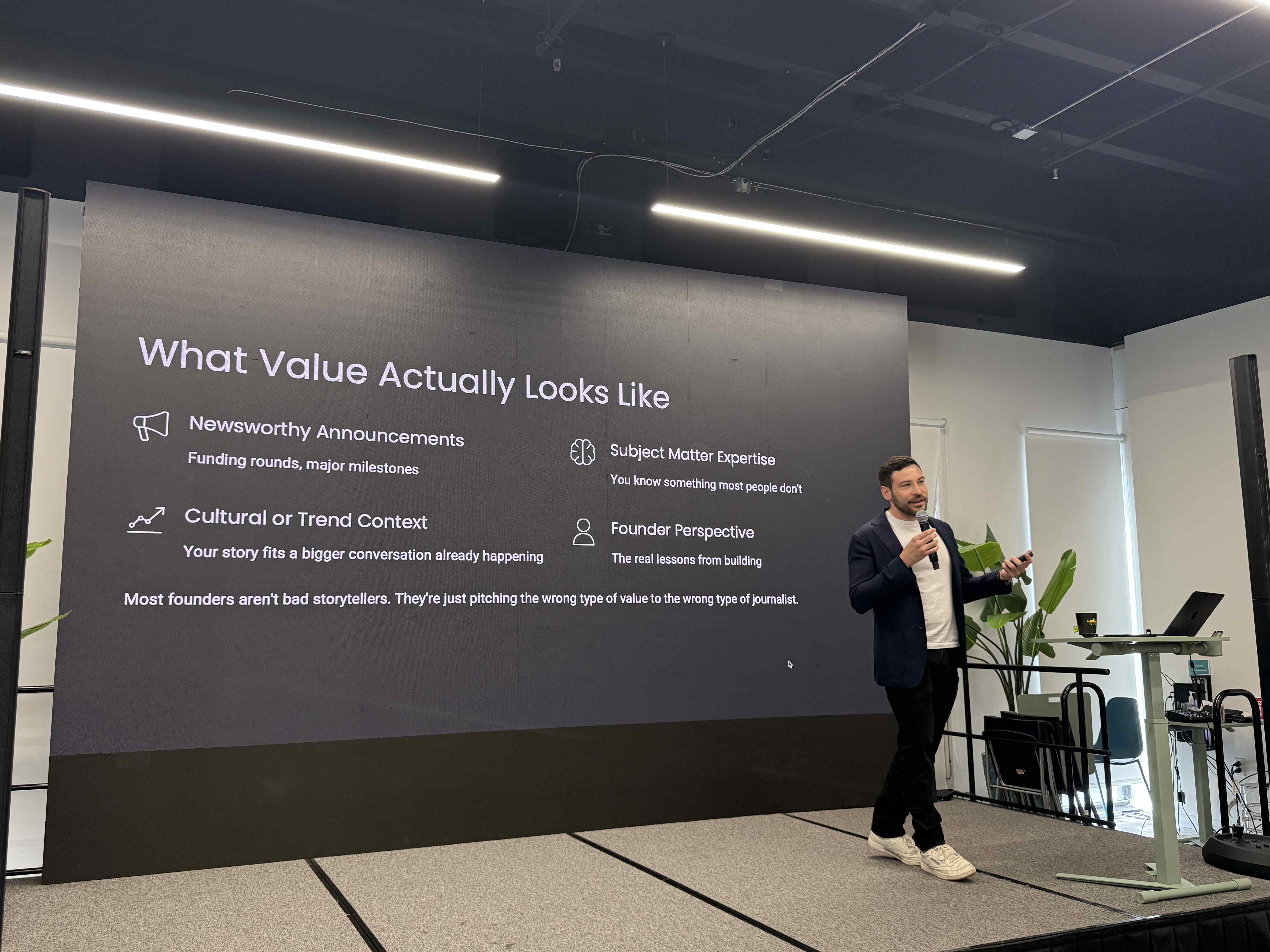
The speaker introduced four main categories that can be used to frame a pitch. They are not the only possibilities, but they cover most situations.
Newsworthy announcement – this typically includes things such as closing a funding round or reaching a major milestone. But be careful: not every announcement is newsworthy. If you have closed a $300,000 seed round, that alone will not interest journalists. But if Bill Gates gave you that $300,000 – that is a story. The significance of the news is not in the number, but in the context surrounding it.
Cultural or trend context – this is about placing your story within a broader social conversation that is already taking place. The speaker mentioned the example of a colleague whose startup focuses on AI in the context of privacy and security. Many people are afraid of AI, so someone who can clearly explain AI’s impact on private data is a valuable source for journalists. It is not about pitching the startup – it is about pitching expertise.
Subject matter expertise – if you understand something the average person does not, you have something to offer. Journalists are constantly looking for experts who can help them put a topic into context. If you know more about something than most people, that is your ticket into the media.
Founder perspective – real-life experience from building a company. Lessons you have learned. Mistakes you have made. This is the kind of content readers enjoy and journalists like to cover.
Newsjacking: ride a wave that is already moving
One of the most practical tips from the entire talk concerned so-called newsjacking – the ability to respond quickly to a current event and offer journalists relevant commentary or a story.
The speaker illustrated this with his own example. During COVID, he ran a video speed dating app. People were stuck at home and wanted to meet others. At the time, every journalist was looking for COVID stories. So instead of pitching his app as a product, he framed it as a story about how he was helping people date safely during the pandemic. The result? The New York Times and BBC.
Notice the shift – he did not say, “I have a great dating app, write about it.” He said, “I’m helping people solve a real problem in the context of the current situation.” And that is the crucial difference.
Why ChatGPT or Claude is not enough
The speaker also addressed whether using a standard AI tool to write a pitch is enough. And his answer was quite straightforward – you can, but it probably will not produce results.
Standard LLMs are trained on general internet data. They can write text that looks good on paper, but they lack an understanding of the psychology behind a successful pitch. They do not know exactly what a journalist needs to hear, how to structure a pitch so that it does not feel like an advertisement, or what tone to use to get a journalist to respond.
Based on his experience, he therefore created a tool called PressPitch AI, which is trained on hundreds of his real pitches – the ones that led to coverage in top media outlets. In his words, it is the difference between a general-purpose tool and a tool that knows what works in practice.
Key takeaways
If I had to summarize the entire talk in a few practical points, it would be this:
Stop thinking about PR as “getting your product noticed.” Instead, ask what value you can provide to journalists and their readers. Find your angle – whether it is your expertise, a current trend, or a unique story from building your company. Pitch manually, strategically, and to relevant journalists. And most importantly – test. Just like with Facebook ads, your first attempts probably will not work. But with every pitch, you will learn something new.
Media coverage is not only about prestige. As the speaker mentioned, those media logos on your website build trust with customers, help with fundraising, and open doors that would otherwise remain closed.
And you do not need a PR agency charging $15,000 per month to achieve that. You need a system, patience, and the right mindset.