Fort Worth had always been racially divided, but sharp and uncompromising boundaries between people emerged with the advent of so-called Jim Crow toward the end of the 19th century. The term “Jim Crow” refers to a whole tangle of laws and ordinances intended to separate the races in everyday life, despite constitutional guarantees meant to ensure equality. Local customs proved capable of maintaining segregated facilities just as effectively as written laws. In Fort Worth, for example, the more fashionable district had the White Elephant Saloon, while the neighborhood known as Hell’s Half Acre had the Black Elephant Saloon, and their names said everything that needed to be said.
Strict racial boundaries were drawn in all public places. In theaters, for example, it was not a matter of Black people being allowed to sit in the balcony or at the back; they were not allowed inside at all. In February 1911, a riot broke out at the Dixie Theater in the 1100 block of Main Street after the owner decided to begin serving Black customers when attendance by white patrons declined. On February 27, 1911, a crowd of white men and boys who disliked the new policy gathered outside the theater to express their displeasure. After smashing the windows and sending employees fleeing for their lives, they turned their anger against the nearby Black neighborhood centered around E. Ninth Street and rampaged there for hours. White police officers did not intervene.
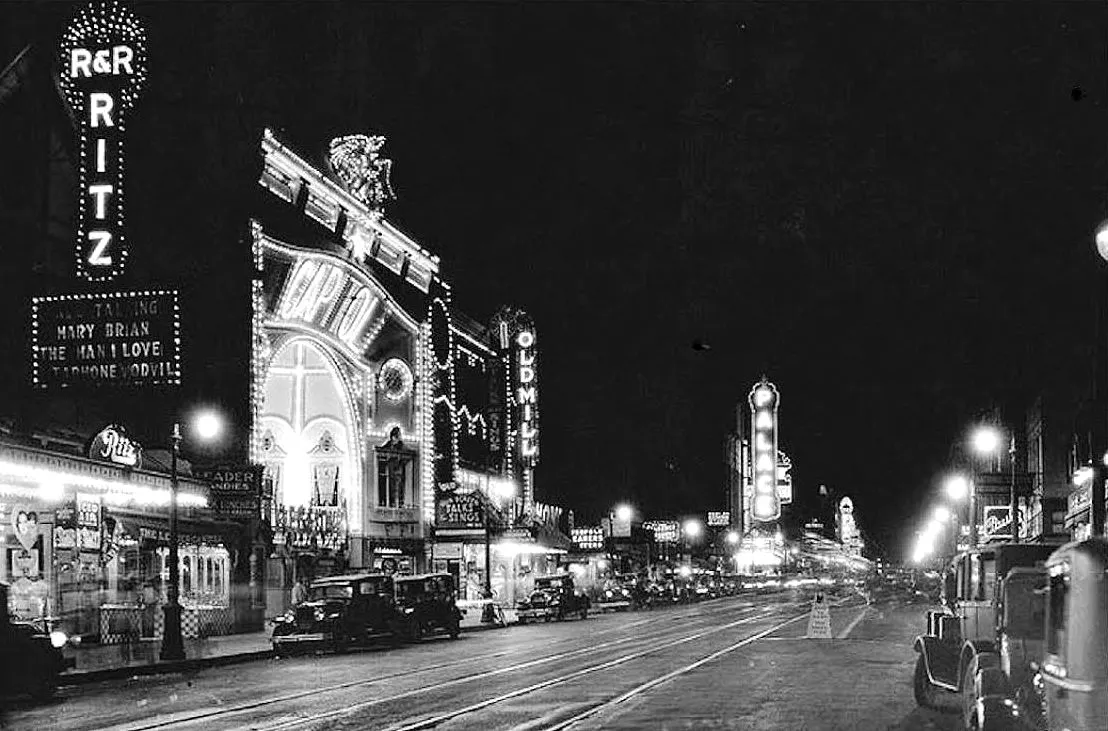
Black and white theaters remained segregated even in the 1920s, when a wave of new theaters arrived, offering both vaudeville and silent films. One of the most popular names for these new theaters was “Ritz,” because the name evoked an air of luxury. Ritz theaters opened throughout Texas, including in Dallas, Houston, Corpus Christi, Amarillo, and San Angelo, to name the most prominent.
The name Ritz first appeared in Fort Worth in 1924 as a vaudeville theater, whose opening attraction from September 3 to 6 consisted of musical performances by the University Club. It was followed on September 7 by a production of “Adam and Eva” performed by the Ritz Stock Company, which ran for two weeks. The theater stood at the corner of Tenth and Commerce Streets, which the Star-Telegram described as the “heart of the city’s theater district,” because seven vaudeville theaters and movie houses were located within a radius of roughly a block and a half. Ironically, this very area had once been the center of Hell’s Half Acre and even then formed the western edge of the neighborhood known as “Little Africa.”
The three-story building was constructed of brick over a steel frame, cost $150,000, and boasted that it was the “most modern amusement house in the city, with every comfort and amenity, including a pipe organ.” It was also the largest, with a capacity of 1,561 seats divided among the orchestra level, family circle, and balcony, with a spacious ten inches between individual seats. Its manager was Sam Bullmann, who had been lured away from a Dallas theater to bring his “wealth of experience” to the new venue. A program of plays for the coming season was published, including both touring Broadway productions and popular classics.
Everything about the place was first class, which meant that Black people were not allowed inside. The only Black man in the building was “Negro porter” Henry Bragg, who would have remained nameless forever had he not been badly burned in a boiler room explosion two months after the Ritz opened. The damage was slight, and the performance resumed an hour and a half later, but Henry was not so fortunate. Because he had no insurance of his own and the theater was uninsured as well, he lost his job.
The Ritz never lived up to expectations because of declining interest in vaudeville and the high cost of maintaining a permanent company of actors, compounded by the expense of booking major touring productions. Less than two years after the Ritz opened, both Sam Bullmann and the Ritz Players gave up on Fort Worth and headed to Dallas, where they went their separate ways. The Ritz Players found a home at the Circle Theater, while Bullmann found another employer, though not the New Ritz Theater, which opened in October 1928 as a second-run movie theater on Elm St.
In Fort Worth, the name “Ritz” was briefly adopted by the Chamber of Commerce for its auditorium in 1926 before once again fading into obscurity. Meanwhile, Tenth St. between Main and Commerce remained a popular location for theaters, including the Pantages Theater (102 E. Tenth), which opened in 1921 and presented both vaudeville and films for the rest of the decade. In 1929, RKO purchased the chain of theaters bearing the Pantages name, and Fort Worth’s Pantages Theater was renamed the New Liberty Theater. As the surrounding area declined, so did the nearby theaters, coinciding with a shift in their patrons toward people who were not welcome in the elegant movie palaces in the better part of town.
The name “Ritz” was rescued from obscurity in 1940 for a Black movie theater at 911 Calhoun. Legally, this was not a problem, because no one had copyrighted the name and the Ritz theaters had never formed a chain; it was simply a popular name for theaters. The surrounding neighborhood had changed. What had once been the “heart of the theater district” was now the heart of the city’s Black business district. White people rarely ventured into the area anymore. Immediately next door to the new Ritz, at 915 Calhoun, stood the Gilton Building, named after its owner, Robert Gilton, a Black dentist. While white moviegoers went to the trio of first-run theaters on Seventh St.—the Hollywood, Worth, or Palace—to see Hollywood blockbusters such as Gone with the Wind, Black patrons went to the Ritz Theater to see low-budget Black films such as Marching On, Hi De Ho, and Stormy Weather. And if white children did not want to go downtown to one of the three major movie theaters, they could visit one of the neighborhood theaters, such as the Tower, Parkway, or Isis. Black residents of Fort Worth had no such option. The Ritz on Calhoun St. did not advertise in either of the city’s two daily newspapers. It relied on the Como neighborhood newspaper and word of mouth. This second Ritz Theater closed in 1968, only to reopen in subsequent years as the Finne Arts Theater, a pornographic movie house that never attracted a large audience because of its selection of films exploiting human nudity and its dubious location.
Unofficially, Black moviegoers could sit upstairs in the Hollywood, Worth, Palace, and Majestic theaters, but they were not truly welcome there either. The Majestic Theater (at the corner of Tenth and Commerce Streets), the last respectable venue in the old district, was in such a dilapidated state by 1958 that management rented out the entire space for an appearance by Martin Luther King Jr. (his only visit to Fort Worth). By the mid-1970s, all the downtown theaters had closed. Ironically, the last to close, the Hollywood, had survived in its final years only by catering to Black audiences and screening so-called “blaxploitation” films such as Blacula, Super Fly, and Foxy Brown.
The transformation of the name “Ritz” from one promising first-class entertainment into one synonymous with cheap movies, ordinary audiences, and decaying surroundings was Jim Crow in a nutshell. In its first incarnation, the Ritz did not let Black people inside. In its second incarnation, white people avoided it like the plague. The name on the marquee did not change; only its meaning did.