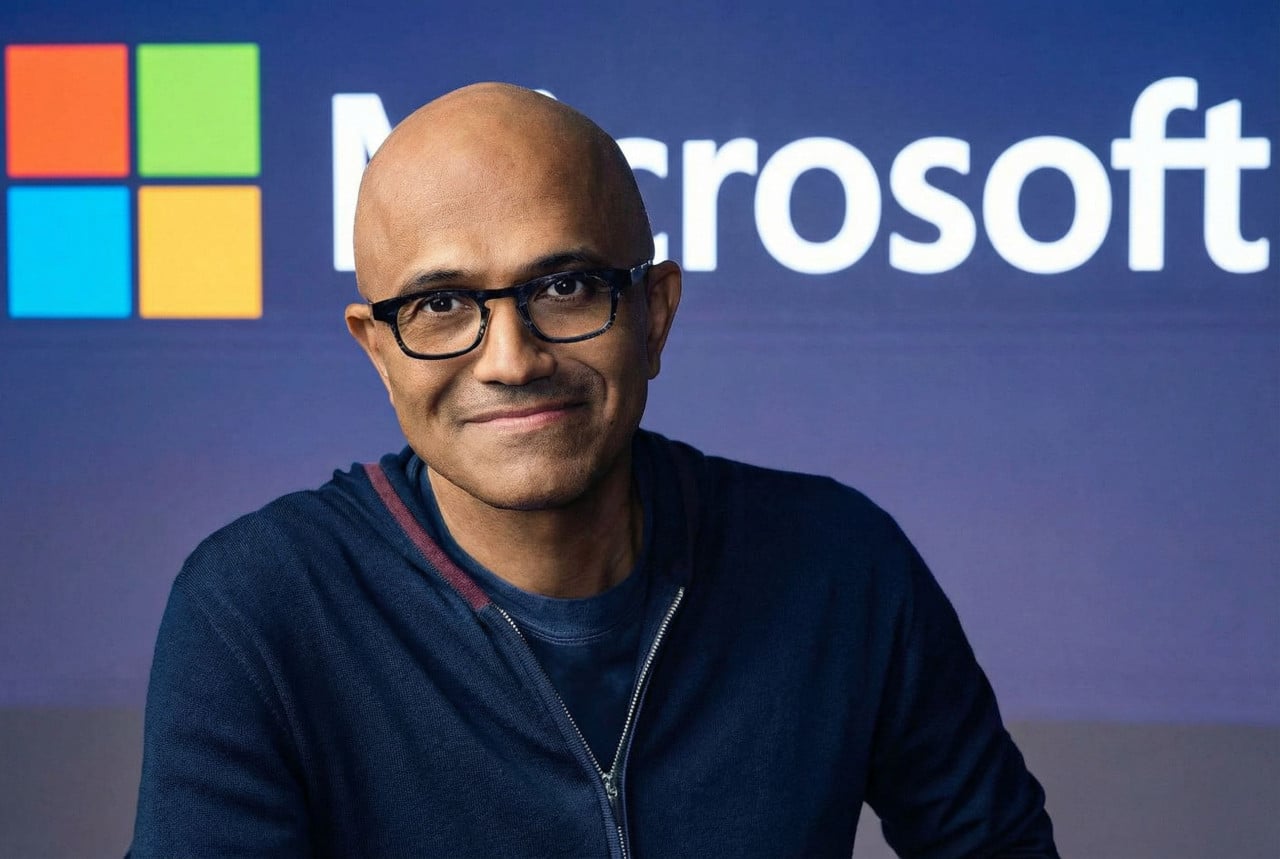
What happens when a handful of companies control all the world’s knowledge? That is exactly what Microsoft CEO Satya Nadella is warning about. In an article he published on X, he described a future in which a handful of artificial intelligence providers capture most of the value, while entire industries lose control over their own knowledge. And he does not like it.
“The last thing any of us should want is a world where every company in every industry hands over its value to a few models that absorb everything they encounter,” Nadella wrote. “There is no social license for an AI-driven future that hollows out entire industries.”
Nadella drew on a comparison that many remember. He recalled the first wave of globalization, when entire industrial regions were emptied out as manufacturing moved to lower-cost countries. “Think about what happened in the first phase of globalization, where entire industrial economies were hollowed out by the offshoring of manufacturing,” he explained. “The GDP numbers looked good, but that displacement was real, and we are still feeling its effects today.”
And this is where his warning comes in. He does not want us to repeat the same mistake with artificial intelligence—letting a handful of systems collect all the economic gains while the rest of the industries discover that someone has reduced the value of their knowledge to zero right under their noses.
This change is unlike any that came before
Why should this concern us more than previous technological disruptions? Nadella argues that the current transformation is fundamentally different from anything before it. “In the past, we used digital systems to augment human capabilities. This is the first time we can create a genuine cognitive loop between people and digital systems,” he said. “It is mind-bending because it also changes how we think about work within a company in the first place.”
He is getting to the heart of the matter. In his view, the risk is not the loss of some tool or software program. What is at stake is how organizations continue to learn, how they build their know-how, how they differentiate themselves, and how they survive at all in a world where artificial intelligence models continuously absorb the expertise of people and companies and turn it into a commodity.
An entire ecosystem rather than a single model
Nadella is therefore proposing a change in priorities rather than slowing down development. “I believe our priority must be to build a frontier ecosystem, not just a frontier model, so that value flows broadly across every company, every industry, and every country,” he said. “One where every organization can own the learning loop that encodes its institutional knowledge and compounds both its human and token capital.”
In his view, companies should retain control over their learning systems and their own expertise while also benefiting from the innovations brought by artificial intelligence. Feel free to leave tasks or work to machines, Nadella says, but never your learning. He favors an approach in which businesses build independently operating systems that improve over time while the company retains control over its intellectual property.
And take note of one point he likes to emphasize. According to him, human capital does not lose value as the machine component grows. Quite the opposite. “Human capital does not become less valuable as token capital grows. It only becomes more valuable!” wrote Nadella, who once studied electrical engineering in Manipal. “I believe human agency will drive the growth of token capital. People will set ambitious goals, connect insights across disciplines, build relationships, and recognize the patterns that matter most. Without human direction, all you have is computing power going around in circles.”
So who does he think should slow down?
Although Nadella did not name anyone directly, the target of his remarks was clear. In an interview with the Wall Street Journal, he took aim at companies such as OpenAI and Anthropic, which he believes are trying to dominate the entire field and are demanding enormous resources to fuel their unchecked expansion. “You cannot say: look, all the office jobs are gone and this could also be a weapon, and we are going to use all the energy to build data centers,” Nadella told the newspaper. In his view, the public will not tolerate a situation in which a handful of models and companies “do all the learning for the entire world.”
Microsoft is considering hosting a version of the inexpensive Chinese DeepSeek model to drive down the cost of using artificial intelligence. Anthropic and OpenAI both accuse DeepSeek of copying or outright stealing their leading models. At the same time, Microsoft has already launched a suite of inexpensive models for customers trying to keep rising artificial intelligence bills under control. Meanwhile, OpenAI and Anthropic are locked in a close race for the lead and face the prospect of a prolonged price war.
Nadella is not the only one with similar concerns
Similar concerns are being voiced elsewhere as well. Snowflme CEO Sridhar Ramaswamy warned in a February podcast that the largest software companies risk being reduced to mere data sources. “The major model developers want to create a world in which all the data from every company is easily accessible to them,” Ramaswamy said. “Everything else, the entire world, is just a dumb data pipe feeding into that big brain.” According to him, Snowflake must operate with the “fear” that people will stop using its tools and instead want a single universal assistant with everyone’s data.
Box CEO Aaron Levie struck a similar note. In a January post on LinkedIn, he wrote that artificial intelligence models will be able to perform demanding intellectual work in almost every profession, from law and strategy to scientific research. “The question we will have to grapple with is: in a world where everyone has access to the same expert intelligence, how does a company differentiate itself?”
Concerns about too much power being concentrated in a handful of models have also been raised by Canadian Prime Minister Mark Carney, Zoho founder Sridhar Vembu, and Infosys co-founder Mohandas Pai. All of this comes against the backdrop of the U.S. government forcing Anthropic to withdraw two of its most capable models, Mythos 5 and Fable 5.
The effects are already being felt in India
Nadella’s words resonate particularly strongly in India. The country’s technology industry is undergoing an artificial intelligence-driven transformation while also trying to build its own capabilities in the field.
Like the rest of the world, India has experienced a wave of layoffs in recent months. In April 2026, Oracle reportedly laid off around 12,000 people in India as part of its shift toward artificial intelligence. Domestic giants are not standing on the sidelines either. Tata Consultancy Services reduced its workforce by more than 12,000 positions during the 2026 financial year, moving away from the traditional mass-hiring model that had characterized the industry for decades.
Companies such as Cognizant, Freshworks, and SuperOps are now restructuring their operations around smaller, leaner teams. India remains a minor player in cutting-edge artificial intelligence development, with only a few startups venturing into it. One of them is Sarvam AI, which released open-source models this year and is pursuing a dual-track strategy. It is building its own original models from the ground up while also layering hybrid models on top of open architectures from companies such as France’s Mistral AI and America’s Meta.
Sources: businessinsider.com, finance.yahoo.com and ndtv.com