When Steve Jobs showed the world the iPhone in 2007, he did not start with what his phone could do. He started with what all the other phones were doing wrong. The startup Genesis AI is now trying something similar. Its first robot is called Eno, and at first glance, it looks different from the competition. It has no head. It has no face. Instead of legs, it moves on wheels and hides all its mechanics beneath a smooth shell. And yet—or perhaps precisely because of that—the entire industry is talking about it.
A machine deliberately designed not to look human
Most of today's humanoids look similar. Exposed joints, hard, glossy metal surfaces, with motors, gears, or cables peeking out here and there. Robot manufacturers are trying to bring their machines into hotels, hospitals, warehouses, and even living rooms. Genesis AI founder Zhou Xian asked himself: do you want a metal monster in the corner of your bedroom?
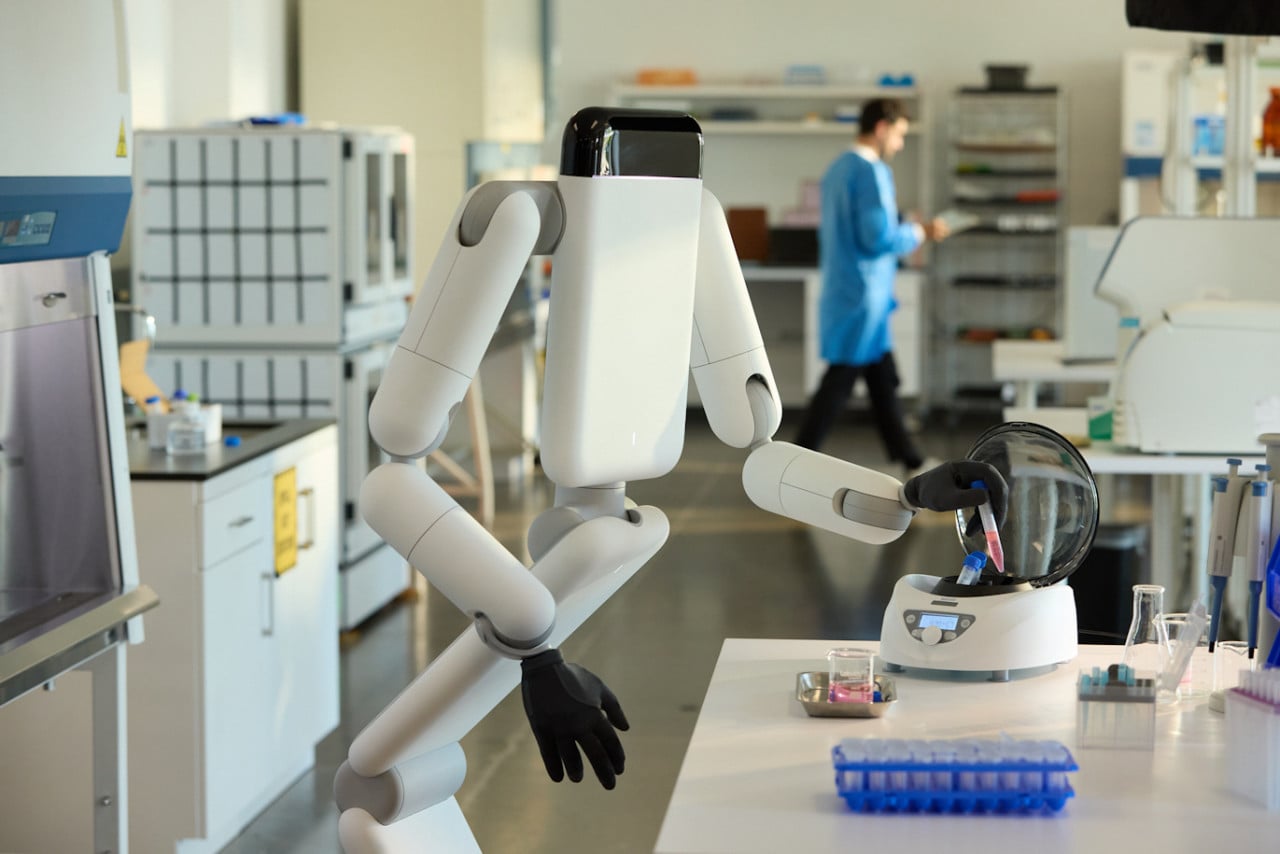
Eno is his answer. A slender tower made of articulated panels rises from a wheeled base, allowing it to adjust its height and reach in real time and fold compactly when the job is done. The motors, gears, and hinges are all hidden inside. There are no protruding cables or exposed actuators anywhere. Designers also appreciate the detail that you will not even find any screw holes on Eno.
“No unnecessary extra details,” says the Genesis AI team. “Every single part serves a purpose.” Its appearance is more reminiscent of Scandinavian furniture than a scene from science fiction. Calm, quiet, and designed to be lived and worked with, not stared at. The decision to leave out the head captures the entire idea best. “Why should robots have a head?” asks Zhou. “There is no brain in there. Fine, it is a place to put cameras, but that is all.”
Eno is not cute either. No big eyes, no animal-like features, none of the things some companies use to turn their robots into pets. Eno is a tool, and it makes that perfectly clear.
Eno's strengths
But there is one feature I have not seen elsewhere. Genesis will offer an optional screen on Eno's chest. It is not a face. It is a window into the robot's reasoning. Eno will use it to show what it is about to do before it does it. “When you only talk to a robot, the information density is extremely low,” Zhou explains. “We need a visual window into its mind.” We have seen robots with faces, eyes, and voices many times before. A robot that shows you how it thinks in order to earn your trust is something new.
Attractive design is pointless if the machine cannot handle real work. And Eno's hands are precisely what impresses most. Each one has twenty actively controlled degrees of freedom. Unlike conventional robots, which have four identical fingers and a thumb, Eno's fingers are all different lengths, just like a human hand. The fingers are backdrivable and contain a camera as well as touch sensors. This means the robot not only sees what it is touching, but also feels it.
And it can do quite a lot. In one demonstration, two hands worked together to tie a bundle of wires and wrap it in electrical tape. It sounds simple, but it is an extremely difficult task because the tape is sticky, floppy, and ends up differently every time. When the robot made a mistake, it recovered and tried again. In another demonstration, it handled laboratory work with millimeter precision: it transferred liquid between two arms, sealed a test tube, and inserted it into a centrifuge. None of the laboratory equipment had been modified for the robot, the team claims.
Eno is 170 centimeters tall and weighs 120 kilograms. It can carry a load of around twelve kilograms, work for approximately four to six hours on a single charge, and move at speeds of up to six kilometers per hour. To give an idea of where it is expected to be used: sorting goods in a warehouse, but also loading and unloading a dishwasher or folding laundry at home.
Everything in one package
All of this is powered by GENE, Genesis AI's robotic artificial intelligence model. Eno and GENE were developed simultaneously, so the body and brain are fine-tuned as a single unit.
And that was exactly the point. Genesis AI is what is known as a full-stack company. It builds everything itself, from the artificial intelligence model down to the last joint in the hand. While a conventional robot follows individual commands, the company says GENE can do something different. You give Eno a goal, and it understands the context, remembers it, adapts to changing conditions, and plans for itself how to complete a multi-step task.
In practical terms, this means Eno handles not just a single movement, but entire workflows. For example, it can keep a production line supplied or prepare an operation for the next shift. It communicates with surrounding systems, prioritizes tasks, and coordinates with people and machines.
The competition is not standing still
None of this means that Genesis AI has already won. The humanoid robot industry is crowded and advancing at a dizzying pace. Forbes tracks more than a thousand robots from over four hundred manufacturers worldwide. From the United States, there are Tesla, Figure, Agility, and 1X; from China, Unitree, AgiBot, and UBTech.
And Eno is still only an early prototype. When Forbes saw it, the version with the screen had been assembled for the first time just a few weeks earlier, and specifications such as payload capacity and battery life were still being fine-tuned. Genesis plans its first deployments for the end of 2026. It will begin with industrial customers—in manufacturing, logistics, and laboratories—followed by service sectors such as hotels and hospitals. Eno will not make its way into homes until much later.
The startup has substantial financial backing. Last year, Genesis AI secured an investment of 105 million dollars, and its investors include former Google CEO Eric Schmidt and French telecommunications billionaire Xavier Niel. The company is based in San Carlos, California, and says Eno is only the beginning. More robots are reportedly already in development.