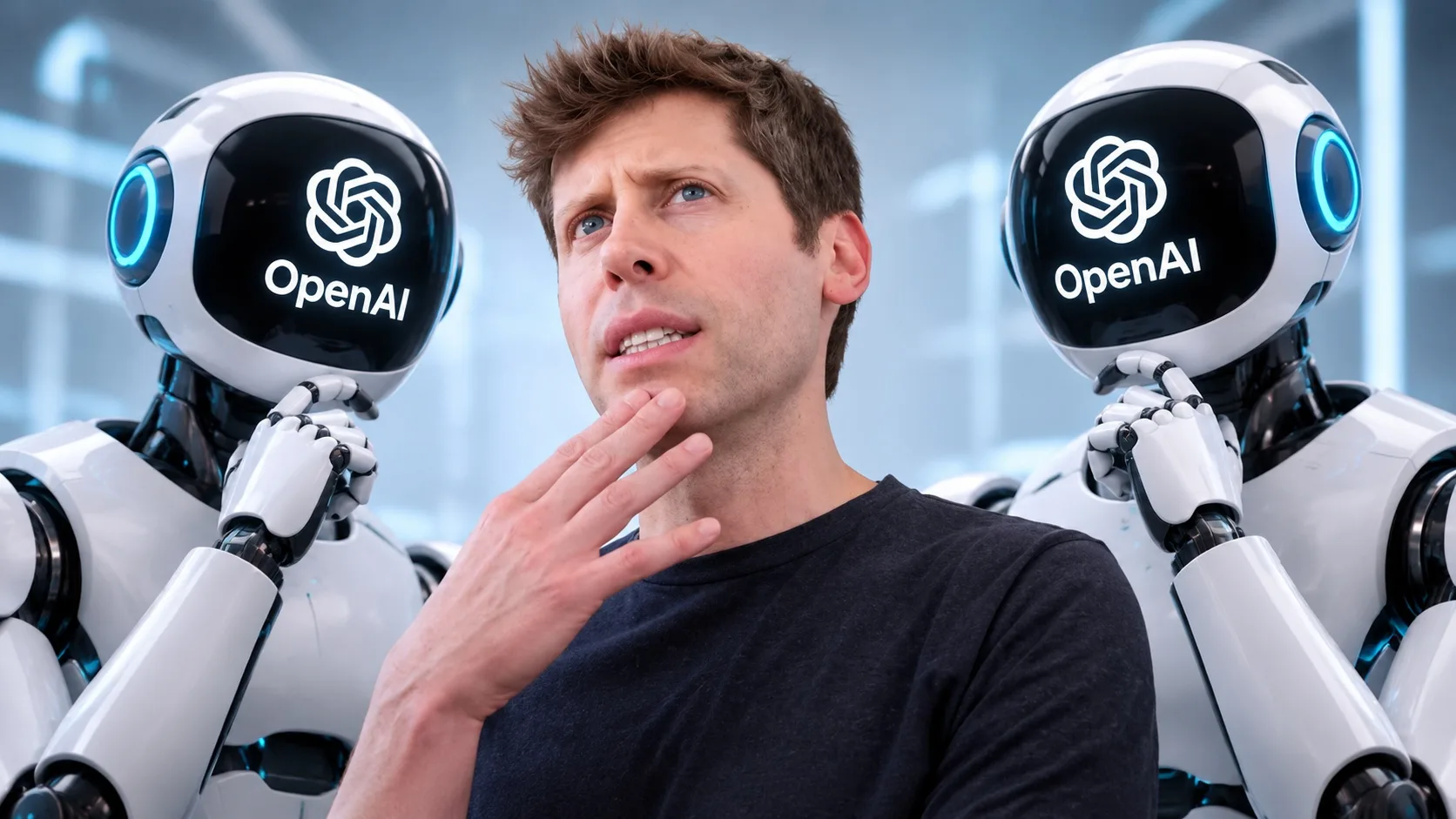
OpenAI is developing its own humanoid robot, and company CEO Sam Altman has already promised that we will see the first public demonstration in 2027. But just a few weeks after those remarks, news emerged that at first glance looks like a step backward. The company disbanded its standalone robotics team and reassigned its members to other departments. According to management, this is not the end, but an acceleration. The company discovered that its general-purpose artificial intelligence models can control robots better than it had expected.
Altman: We will definitely make a humanoid
In early September, Altman spoke at length on journalist Alex Heath's Sources podcast. Asked whether OpenAI was developing a humanoid or rather a machine for data centers, he replied that it was working on both. According to him, the company will definitely build a humanoid, alongside robots of other shapes.
Why a human-like form in particular? Altman explained that the world is built for people, from doors and keyboards to kitchen counters, and a machine with a similar body can move through it without major modifications. He does not see a robot in every home as the first step, because manufacturing and infrastructure must come first. In the long term, however, he is optimistic. “I think everyone should have a personal robot,” he said.
He clarified the timeline in an interview with Fortune. OpenAI wants to demonstrate something impressive in 2027, but according to Altman, it will still be several years before we see robots walking down the streets. The first machines are expected to enter industry, namely factories and data centers, and only later take on ordinary household chores. The company has not revealed what they will look like, exactly what they will be capable of, or when they will go on sale. It also has no specific production target or named manufacturing partner.
Although Altman claims that the robot's body is the simpler part and that the main work lies in its “brain,” OpenAI's job postings tell a somewhat different story. At the beginning of September, the company was recruiting for 19 robotics positions in San Francisco, compared with just 11 at the end of May. Many of them relate to actuators, namely motors and transmissions that turn computer commands into movement. OpenAI is looking for designers of electromagnetic components and gearboxes, as well as specialists in thermal simulations, firmware, and prototype manufacturing. No one hires people like that if they merely want to adopt someone else's finished chassis.
OpenAI has already abandoned robotics once because it lacked sufficient data from the physical world. Its own machines are the most direct way to collect such data, including information about how firmly a robot gripped something, what moved, and where it made a mistake.
The booth remained empty and the team disappeared
In mid-November, however, the company confirmed to Fortune that the standalone robotics team no longer existed. Researchers moved to the main research division led by Mark Chen. Staff working on applied robotics and hardware joined the part of the company overseen by President Greg Brockman. OpenAI did not disclose how many employees were affected by the change and issued no statement of its own.
The reshuffle happened so quickly that the company still had a registered booth at CoRL, one of the leading academic robotics conferences, held in Austin, Texas. OpenAI's spot was still listed in the conference app and on the exhibition floor plan. When Fortune reporters stopped by booth number 208, it was completely empty, with the company's logo nowhere to be seen.
Nevertheless, an OpenAI spokesperson emphasized that robotics remains a firm part of the company's long-term plans and that the reorganization is intended to accelerate its robotics work, not end it.
One model for text and robots alike
At the beginning of the year, OpenAI researchers expected the path to robots to run through models such as Sora. These models generated videos, and to make them look realistic, they had to understand to some extent how the physical world works. Over the course of the year, however, it became clear that general-purpose models, including GPT-6 Astra, could be used directly to control robots. According to the company, it was this discovery that led to the dissolution of the standalone team.
Test results partly confirm this. In an Nvidia study, the Astra model received camera images, information about the robot, and an interface through which it could issue commands. In simulated tasks in which the robot picked up and moved objects, it succeeded in nearly three-quarters of cases. The best specialized robotics models in the same comparison managed roughly half.
The catch, however, is that this was a computer simulation, not a real robot. Each trial cost more than $36 in computing fees, and every model call took almost 19 seconds. That is still far too slow for a busy factory line.
Guanya Shi of Carnegie Mellon University's Robotics Institute sees OpenAI's move as a signal that the company no longer considers robotics a separate discipline. In his view, it sees robotics as another application of general intelligence, much as the same models today power tools for programmers, lawyers, or finance professionals. According to him, general-purpose models can adapt when a bottle is placed somewhere else or the lighting changes, and they can reason about the order in which to complete a task and where an error occurred. Large language models, however, run in the cloud, and a robot needs a constant connection. Shi therefore expects smaller specialized models that run directly on the robot's computer to continue to have a role.
People in the industry also have doubts. Russ Tedrake, an MIT professor and head of Walden Robotics, points out that robotics companies have one advantage that artificial intelligence labs lack. Their machines are already gaining experience in factories, and the better general-purpose models become, the faster they learn from such data. Pete Florence, co-founder of the startup Generalist, also notes that it is not yet clear at all which model will ultimately prevail in robotics.
A third attempt and pressure to cut costs
For OpenAI, this is already its third round with robots. The company had a robotics team in its early days and introduced Dactyl, a system that controlled a robotic hand, in 2018. A year later, the same hand solved a Rubik's Cube, having learned primarily in a computer simulation. In 2020, however, the company disbanded the team. Co-founder Wojciech Zaremba later explained that robot data was lacking and that large language models offered a faster route to artificial general intelligence. That route ultimately produced ChatGPT.
OpenAI revived the standalone team in 2024 and at the same time began collaborating with Figure, a startup developing humanoids. The company also invested in it. But the partnership ended in February 2025, when Figure announced that it would develop its own artificial intelligence for robots. Its CEO, Brett Adcock, claimed at the time that it could not be done without bringing hardware and software together under one roof.
The reorganization also fits into broader pressure to cut costs. Altman told employees last year that the company had to abandon side projects. As a result, OpenAI shut down Sora, for example, and shifted the freed-up computing capacity to products that could generate revenue. According to available information, its operating loss for the most recent quarter reached nearly $11 billion, while the company is seeking to close a new funding round and preparing for a possible initial public offering in early 2027.
Back at booth number 208 in Austin, several former members of the disbanded team were milling around. They had no demonstration or display, yet they still attracted a small crowd of curious attendees. The main question animating the conference was what value robotics expertise would have once general-purpose models could handle more and more tasks. These people, who now work on other teams, were one possible answer.
Sources: timesofindia.indiatimes.com, ynetnews.com and forbes.com