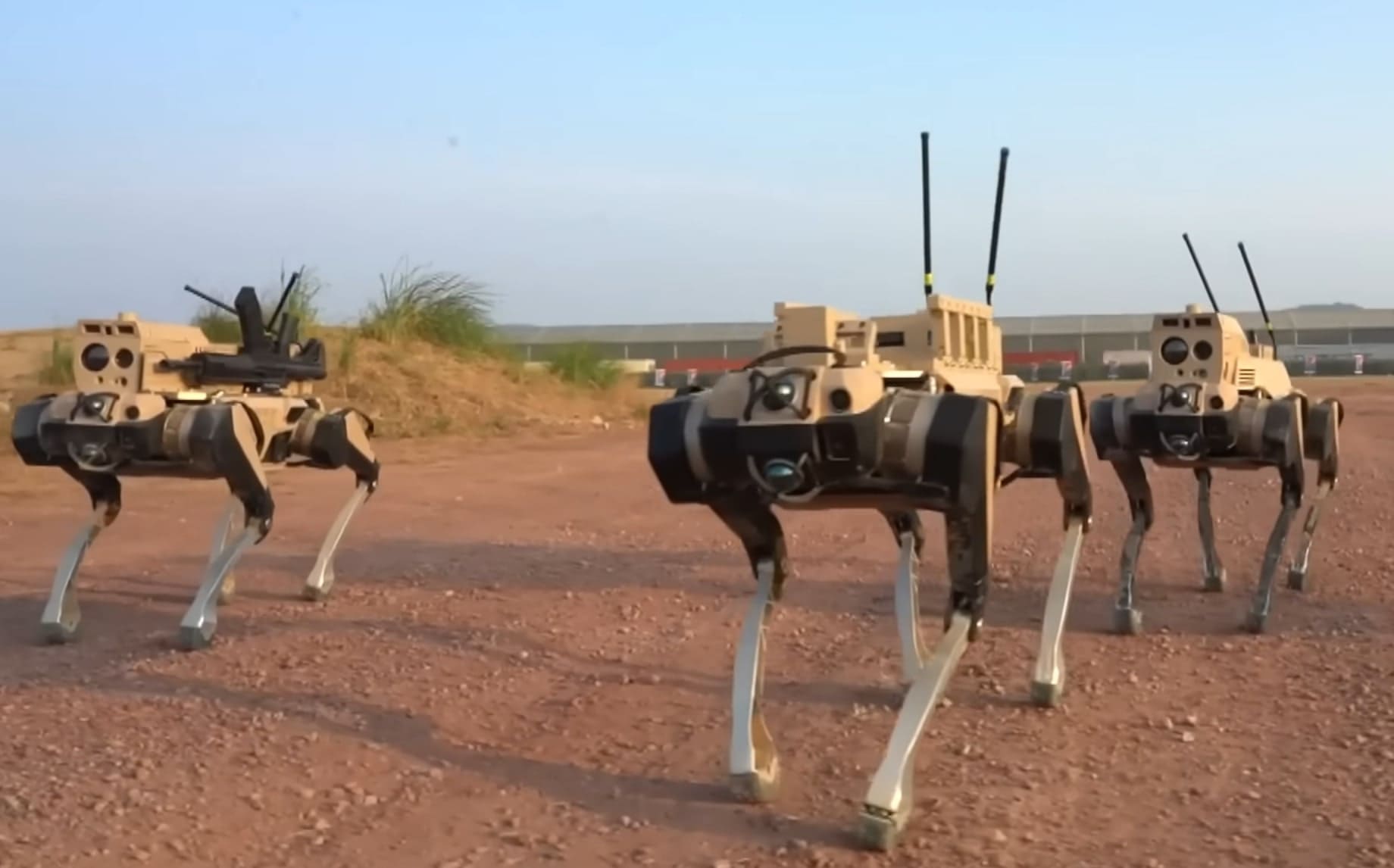
China has unveiled new four-legged robots that it calls "robotic wolves." These machines appeared at a major military parade in Beijing on September 3, 2025, where they were displayed on armored vehicles. The parade commemorated the 80th anniversary of the end of World War II and the victory over Japan. Guests included Russian President Vladimir Putin and North Korean leader Kim Jong-un, who sat beside Chinese President Xi Jinping. The robotic wolves were developed by China South Industries Group Corporation, and each weighs around 70 kilograms. They can carry weapons, transport supplies, or conduct reconnaissance. During the demonstration, they were seen carrying rifles on their backs, moving through smoke, and firing at targets from distances of up to 100 meters.
These robots differ from older models known as robotic dogs, which were used mainly for surveillance or carrying equipment. The new versions operate in groups like a wolf pack. One robot serves as the leader, collecting target data and sending images to the others. Some carry ammunition, while others attack directly. During an exercise with the 76th Group Army of the Chinese People's Liberation Army (PLA), they were seen moving across hilly terrain alongside infantry soldiers. The soldiers carried QBZ-191 rifles and portable rocket launchers, while the robots overcame obstacles and kept pace.
Exercise Simulating an Attack on Taiwan
In a recent exercise broadcast by Chinese state television CCTV, robotic wolves led a simulated attack on the Taiwanese coast. The exercise took place under the command of the PLA Eastern Theater Command's 72nd Group Army, which operates in the Taiwan Strait area. Helicopters brought soldiers to the coast, and the robots went first to search the area. Each robot has five thermal-imaging cameras, LiDAR sensors for measuring distances, and other equipment that scans its surroundings in a full circle. They use a Chinese chip for autonomous control, can climb slopes with a 40-degree incline, overcome obstacles 30 centimeters high, carry up to 20 kilograms, and travel 10 kilometers in roughly 2.5 hours.
During the exercise, the robots detected obstacles 10 meters ahead, and the soldiers followed them. The commander ordered the route behind a mountain to be blocked in order to cut off enemy reinforcements, and the robots once again went first. When one robot "died" in the simulation, the commander sent heavy weapons to the front lines. The exercise also included drones that attacked from the air while robots on the ground cleared the way. The entire process, from detecting a target to destroying it, took less than 10 seconds. The attack robots crossed barbed wire and trenches in three to five minutes, while transport versions carried ammunition and medical kits. One soldier controlled nine robots and six drones simultaneously through a 3D interface.
Cooperation Between Robots and Soldiers
Robotic wolves are intended to replace soldiers in dangerous tasks such as reconnaissance, mine clearance, or direct combat. During the exercise, they were seen walking beside infantry soldiers in hills where conventional vehicles have difficulty operating. Some had rifles on their backs to provide support, while others carried supplies. First-person-view (FPV) drones flew low, searched for targets, and carried out kamikaze attacks, while soldiers in camouflage suits controlled them from cover. Hu Te, a member of the brigade, said that this was the first time he had controlled a robotic wolf and that the goal was to integrate these machines with humans in combat.
These robots move stealthily, fire accurately, and operate in difficult terrain such as cities, mountains, or plateaus. Military analyst Fu Qianshao noted that encountering tireless machines could weaken enemy morale because even if some are destroyed, others continue onward. The robots were first unveiled at the Zhuhai Airshow last November and appeared at the parade this September as part of an "unmanned trio" alongside tanks and drones.
China's Military Is Modern
China is investing in robotics and artificial intelligence to strengthen its military. The robotic wolves also appeared during an exercise with Cambodia, where their use in conflicts was tested. At the parade in Beijing, Xi Jinping declared that China is "unstoppable" and will not be intimidated by "bullies." The parade also included hypersonic missiles, underwater drones, laser systems, and intercontinental ballistic missiles with nuclear warheads. The robots are part of a shift in PLA tactics, which now focus on coordinating machines rather than deploying large masses of soldiers.
Exercises showed that the robots extend combat range fourfold compared with conventional infantry. Nevertheless, they have weaknesses, such as a lack of armor and difficulty concealing themselves in open terrain. In one simulation, they were easily destroyed by light weapons. China plans to improve these systems for future operations, including large-scale attacks involving hundreds of robots running at speeds of 30 to 40 kilometers per hour.
Sources: interestingengineering, chosun.com, firstpost.com