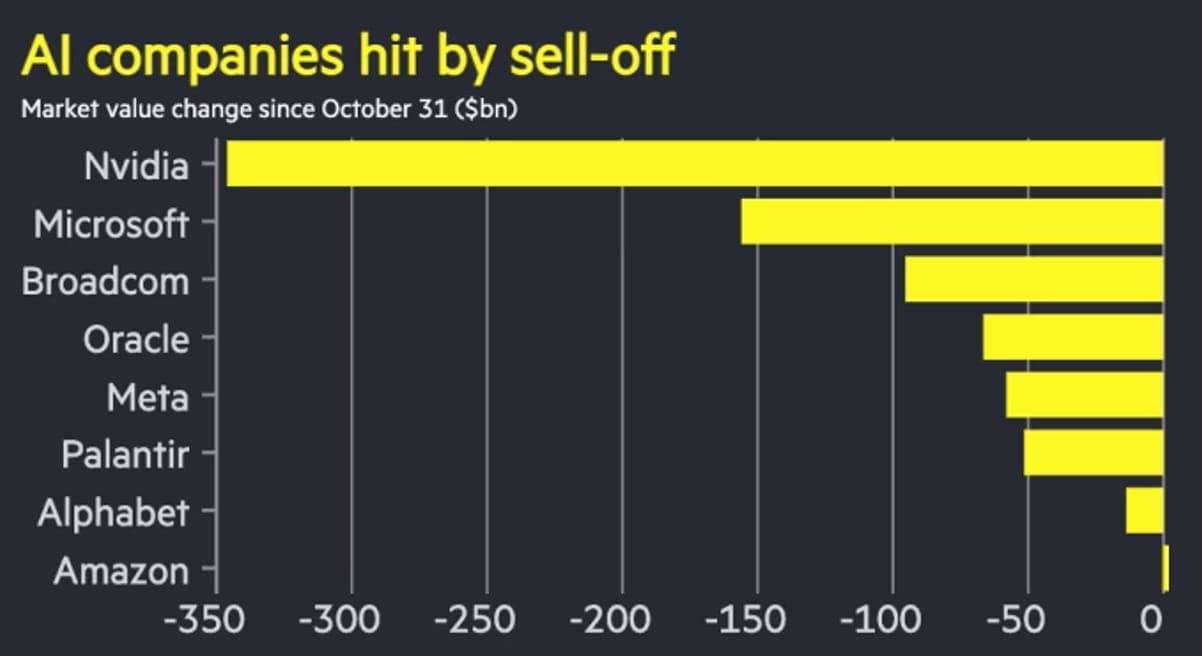
Imagine you are an investor watching your stocks suddenly collapse. That is exactly what happened last week to technology stocks, which suffered their worst decline since April 2025. The main culprit was a massive sell-off in companies associated with artificial intelligence (AI), which wiped a staggering $800 billion off their market value. Converted into Czech korunas, that is about CZK 18.8 trillion. The plunge came amid concerns about a weakening labor market, low consumer confidence, and the ongoing U.S. government shutdown.
The Nasdaq Composite Index, which includes many tech companies, fell by 3.03%. This was its steepest weekly decline since April. The S&P 500 Index, which tracks 500 of the largest U.S. companies, dropped by 1.61%. Investors sold off shares due to growing doubts about the excessively high valuations of these stocks, especially those associated with AI.
The sell-off hit major artificial intelligence companies the hardest, including Nvidia, Meta, Palantir, and Oracle, which were among the eight largest AI companies to suffer the heaviest losses.
Labor market and layoff concerns
One of the main reasons for the panic was the weakening labor market. October saw the highest number of announced layoffs for that month in the past 22 years. Layoffs this year are at their highest level since 2009, which alarmed investors. These figures emerged at a time when official government statistics were unavailable due to the U.S. government shutdown, further increasing uncertainty.
Despite this, some positive data also emerged. For example, a report from ADP showed stronger-than-expected growth in private-sector employment. Nevertheless, the mixed employment data contributed to volatility. Investors responded to these signals by selling rapidly, with the sell-off concentrated mainly in AI-related stocks, where concerns about overvaluation were intensifying.
Another factor was low consumer confidence, which was reflected in the overall economic sentiment. People were worried about the future, which also affected stock market behavior. This was compounded by the ongoing U.S. government shutdown, which prevented the release of key economic data. Without this information, investors had to rely on private sources, further intensifying the chaos.
Nevertheless, a brief recovery emerged toward the end of the week, and stocks are again rising slightly this week.
Correction or a sign of worse times ahead
For the average person who follows the news or has some savings invested in stocks, this means greater caution. A loss of $800 billion (CZK 18.8 trillion) is not just a number—it affects pensions, funds, and the entire economy. Investors are now watching closely to see whether concerns about AI prove justified or whether a rapid recovery follows.
The week was full of tension, with rapid fluctuations that served as a reminder of how quickly the situation can change. If you are new to this, remember: the stock market is not gambling, but it requires information and patience.
Source: ft.com