Everyone loves stories in which the little guy defeats powerful special interests. And it is even better when that little guy is a hog farmer and the other side is a city and a major hotel chain. That is exactly what happened in 1973, but Fort Worth’s love for these pink creatures dates back to the city’s very beginnings. Absolutely everyone raised hogs, and everyone had a smokehouse—including the soldiers at Fort Worth from 1849 to 1853. Whatever was not eaten as meat ended up as soap. Of all livestock, hogs were the easiest to keep—they ate anything, required almost no care, and bred like rabbits, ensuring a steady supply of meat or regular income from their sale. For these reasons, hogs were the most widespread livestock on the frontier—more numerous than horses or cattle. In 1860, there were 2.37 hogs for every resident of Texas—man, woman, and child.
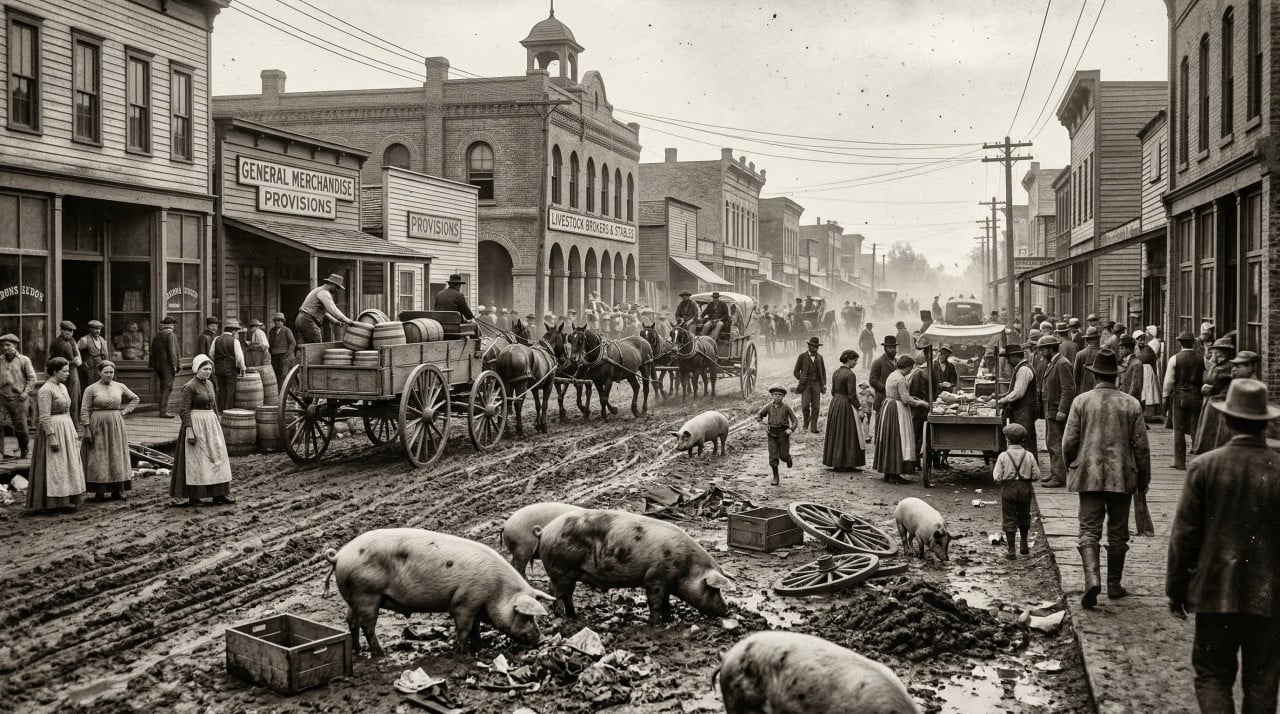
According to Fort Worth’s first city engineer, I. C. Terry, wild hogs roamed freely throughout the city in its early years. When R. E. Beckham became mayor in 1878, he vowed to remove the animals from the roads once and for all. The city council passed a hog ordinance, which was then put before the citizens in a referendum. It passed, but only by a narrow majority of 377 votes to 344. Even so, the animals continued to cause “great inconvenience” because old habits are hard to break. People’s habits, that is, not the hogs’.
Seven years later, another “hog election” was held to address the same issue: whether hogs and other livestock should be allowed to roam freely through the streets. Because most streets were still unpaved and the city had no sanitation department, the animals could make quite a mess. They also posed a physical danger to pedestrians. Fort Worth liked to consider itself a civilized city in 1885, but the reality was different. County Judge Sam Furman ordered the election after citizens presented him with a petition demanding that city hall address the situation. The proposed ordinance, however, was not popular with everyone. Many residents owned hogs and did not want the police to confiscate them, and they certainly had no intention of paying fines. After six days, the vote was still tied, but the ordinance was eventually declared to have passed. The city police then set up holding pens for stray hogs at the corner of Ninth and Throckmorton Streets—the site where Fort Worth’s first public library would be built in 1901.
Hogs roaming the streets may have been a nuisance, but the local economy needed them just as much as it needed cattle. While longhorns merely passed through the city on their way to Kansas railheads, hog processing was one of its earliest industries. In 1875, plans were being made for a Dallas-affiliated processing plant—John Peter Smith even donated six acres on the southern edge of the city for its construction. The plant was never built, however, and meat processing had to wait another thirty years until Swift and Armour came to the city. Yet it is often forgotten that these meatpacking companies, which helped make the Fort Worth Stockyards famous as a cattle kingdom, slaughtered more hogs than cattle each day. Hogs, after all, were never the exclusive domain of poor farmers and slaughterhouses. Khleber Van Zandt, remembered as Fort Worth’s first banker and a builder of the city, kept hogs on his property at the corner of Main Street and Sixth Street until 1884, when he sold it to State National Bank.
Hogs remained part of the political culture as late as 1926, when Baptist preacher J. Frank Norris thundered from the pulpit that Mayor H. C. Meacham was not fit even to be “mayor of a hog pen.” The mayor’s good friend Dexter E. Chipps then went to confront the preacher in person, much to his regret.
Hogs played such an important role in Fort Worth’s history that Howard Peak devoted an entire chapter to them in his first memoir, My Recollections of Fort Worth. He referred to them all as “razor-back hogs” even before the University of Arkansas virtually claimed the name as its own.
One Farmer Against the Entire City
As Fort Worth grew into a twentieth-century metropolis, hogs and hog farms seemed to be a thing of the past. That was until 1970, when hog farmer A. L. Miner declared war on city hall. Miner worked for Texas & Pacific while also operating a hog farm in the Sycamore Creek valley on the eastern edge of downtown, where he shared a 3.6-acre property with his son. They continued raising hogs even after the city expanded around them—following the completion of the Dallas–Fort Worth Turnpike, now I-30, in 1957 and the construction of its interchange with Beach Street near their farm. Then, in December 1970, the city council amended the animal-control ordinance to make it illegal to “keep or permit the keeping of any hogs within the city limits”—with exceptions for slaughterhouses (Swift and Armour) and exhibitions (the annual Fat Stock Show). A month later, Miner received his first citation and was fined $100 in municipal court. He appealed to the county court, while the police continued issuing him citations and the matter once again came before the municipal court.
During the legal dispute, it emerged that the Ramada Inn hotel chain planned to build a hotel on Beach Street directly above Miner’s farm. The developers offered him $50,000 for the property, which he refused. At the time, the two lots together were valued at approximately $10,000. The Miners offered to sell for $95,000 and swore they would go all the way to the Supreme Court if necessary.
It was a David and Goliath story, except that David was a hog farmer. Goliath was the City of Fort Worth, led by Mayor R. M. “Sharkey” Stovall, and the H.A.T. development company of Dallas. Miner posed for photographers with one of his animals, and local residents said in interviews that he was a good neighbor and that they had no complaints about his farm. Some even offered to testify on his behalf in court.
Miner’s stubbornness initially appeared to be a major mistake when his case came before the municipal court in 1973. The jury, which did not include a single farmer, found him guilty and ordered him to pay the fines. On appeal to the county court, however, he was found not guilty of violating the city ordinance. After winning the legal battle, Miner and his son sold their property to H.A.T. later that same year for an impressive $102,000. He had the last laugh by moving his hog operation across the highway to leased land, where he farmed until 1979. Miner died in 1989. The retired railroad worker spent his final years in comfort thanks to winning his legal battle with the city and the developers.
The Hog as a Pet
Little pigs retained a place in the hearts of Fort Worth residents long after they disappeared from the streets and backyards. In 1921, Jesse G. Kirby opened the first Pig Stand restaurant in Tarrant County, the first link in what eventually became a nationwide chain. It was the Pig Stand that introduced the now-familiar concept of the drive-in restaurant. The last Pig Stand location in Fort Worth, on W. Seventh Street, closed in the 1970s, while the last location in the entire country closed in 2006.
Served in a bun and covered in BBQ sauce, pork was one of everyone’s favorite foods. Live hogs as pets, however, were another matter. In the 1990s, keeping potbellied pigs as pets sparked a heated public debate. When the city council banned them, their owners joined forces and submitted a petition asking that they be treated the same as dogs and cats. Potbellied pigs even found their way into the Southwestern Exposition and Fat Stock Show—that Fort Worth cowboy festival full of bronc busting and bull riders. When traditionalists complained about their exhibition, the pig owners retorted that “if you can’t ride it, eat it, or rope it,” they were against it.
In recent years, not all hogs found in Fort Worth could be described as cute pets or show animals. The Parks and Recreation Department has been waging an ongoing battle against feral hogs for decades. These animals live in the Trinity River floodplain, emerging from it to destroy gardens, devastate landscaping, and frighten joggers throughout the metropolitan area. They began appearing in larger numbers around 1999 and have grown increasingly numerous and aggressive ever since.
Pioneers such as Joseph C. Terrell or K. M. Van Zandt might wonder what is so problematic about such a useful, nutritious, and profitable animal. But twenty-first-century Fort Worth residents are no longer accustomed to slaughtering a few hogs every fall to provide meat for the winter and raw material for making soap. Hogs are now considered “exotic animals.” Unfortunately, no one has told them that, so they apparently do not realize that their only place in the city now is either in a bun or on a plate as ribs.