Startup Physical Intelligence has published research that has sparked a wave of interest across the robotics world. Its new model, π0.7, can control robots as they perform tasks it was not explicitly trained for. And the results surprised even the researchers who built the model. This is not the first time that has happened, but this time it is different. It cannot simply be dismissed with the word "progress."
Physical Intelligence and the π0.7 model
Physical Intelligence is a two-year-old startup that has become one of the most closely watched artificial intelligence companies in San Francisco. Its new model is called π0.7 (pi-zero-seven) and represents the first serious step toward what the field calls a "general-purpose robot brain" - a system capable of handling a wide range of tasks without someone having to teach it each one individually.
The existing approach to training robots was essentially rote memorization. Engineers collected data for a specific task, trained a specialized model on it, and repeated the entire process for each new task. π0.7 breaks this pattern. The model can combine skills learned in different contexts and solve problems it has never seen in its training data.
This phenomenon is called compositional generalization. It works similarly to large language models: if a model knows how to translate text from English into French and knows how to format output as JSON, it can do both at once without any additional training. Physical Intelligence is now showing that something similar is beginning to work in the physical world as well.
The air fryer the robot knew almost nothing about
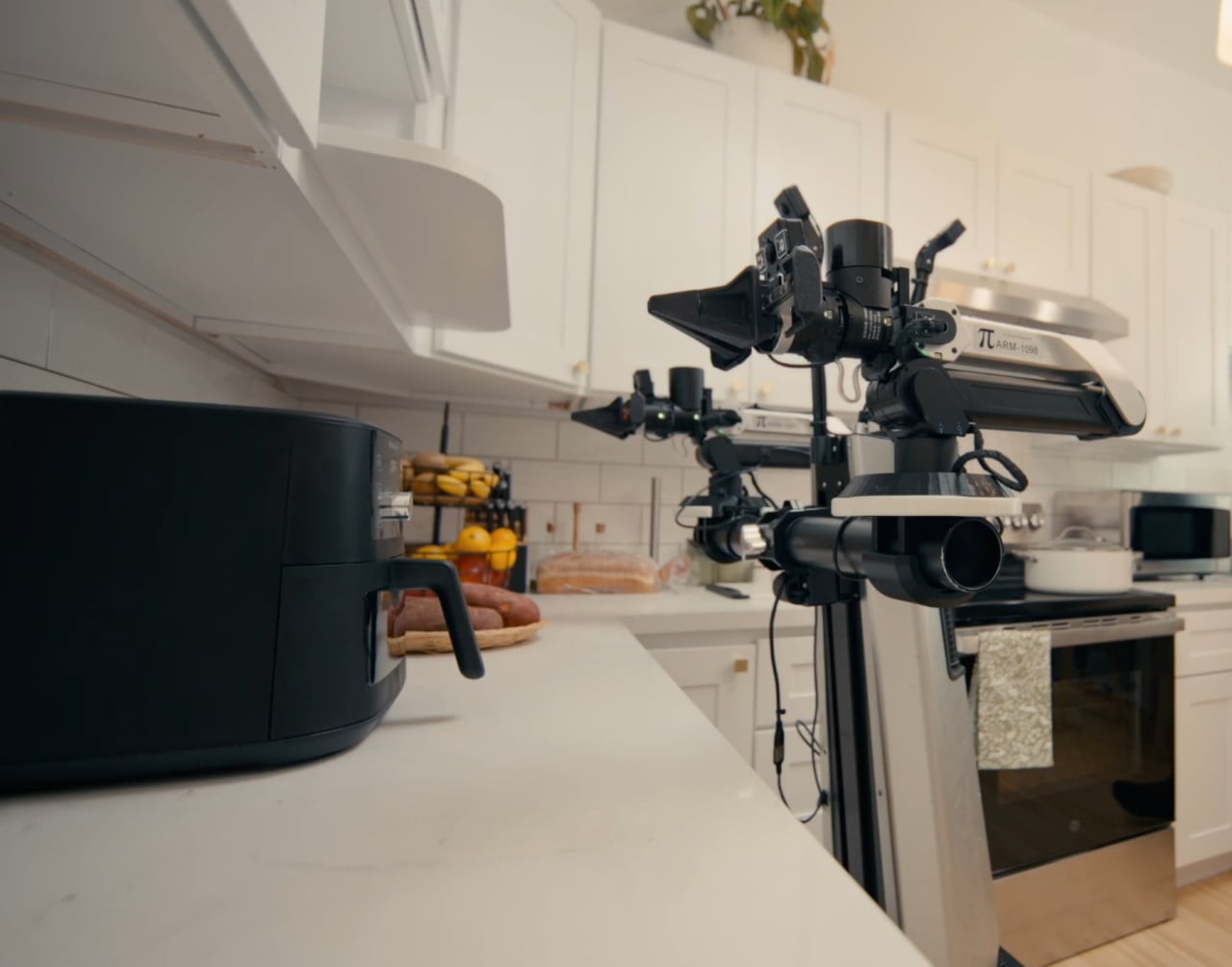
The most impressive demonstration in the research involves an ordinary air fryer. The research team went through the entire training dataset and found only two relevant episodes: one in which another robot closed the air fryer, and another from the publicly available DROID dataset in which a robot placed a plastic bottle inside it. That was all.
Nevertheless, from these fragments (along with general data from the web), the model assembled a functional understanding of how the appliance works. Without any guidance, it attempted to place a sweet potato in the air fryer and cook it. The attempt was not perfect, but it was reasonable. What happened when the researchers guided it through the task step by step? The success rate soared. And this is where a detail emerges that took the entire field somewhat by surprise.
Researcher Lucy Shi, a PhD student at Stanford and an employee of Physical Intelligence, described one of the first air fryer attempts: the success rate was just 5%. After about half an hour of refining how the task was explained to the model, it jumped to 95%. "Sometimes the problem is not the robot or the model," Shi says. "It is us. We are not good at giving instructions."
How instructions are given
This ability to accept verbal guidance is one of π0.7's most important features. Robots could be deployed in new environments and improved in real time, without collecting more data or retraining the model.
However, it works differently than you might imagine. The model still cannot handle the command "Make me breakfast". "You can't tell it, 'Hey, make me some toast,'" explains Sergey Levine, co-founder of Physical Intelligence and a professor at UC Berkeley. "But if you guide it step by step - 'open this part, press this button, do this' - then it works quite well."
The π0.7 training dataset is deliberately diverse. It includes data from different robots, recordings of human movements, and autonomous episodes in which different versions of the model performed tasks by themselves. The key to making this mixture actually work is what is known as heterogeneous conditioning during training. The model receives not only a description of what it should do, but also how it should do it: at what speed, to what quality standard, and with which intermediate visual goals.
The robot folded clothes on a machine it had never been trained to use
One of the most convincing experiments was a test of skill transfer to another robot. Physical Intelligence collected data on folding laundry using one specific robotic system. Then they put π0.7 to work with a UR5e industrial arm equipped with parallel grippers, a heavy, rigid machine fundamentally different from the original robot.
No laundry-folding data existed for the UR5e. Nevertheless, the model completed the task. What is more, its first-attempt success rate matched that of experienced teleoperators with an average of 375 hours of practice, who were also trying to fold laundry with this particular arm for the first time.
The company's surprising development and growth
Ashwin Balakrishna, a researcher at Physical Intelligence, admitted that the results genuinely surprised him. "My experience has always been that when I know the data well, I can estimate what the model will be able to do," he says. "I am rarely surprised by anything. But the past few months have been the first time that things have truly surprised me. I randomly bought a set of gears, gave it to the robot, and asked whether it could turn it. And it worked."
Levine compared the feeling to his memory of first encountering GPT-2, when the model spontaneously began writing a story about unicorns in the Andes. "Where the hell did it learn about unicorns in Peru? It is such a strange combination," he says. "And seeing something like that in robotics is truly remarkable."
By the time the research was published, Physical Intelligence had raised more than one billion dollars and was most recently valued at $5.6 billion. Co-founder Lachy Groom, formerly one of Silicon Valley's most prominent angel investors and a backer of Figma, Notion, and Ramp, played a major role in attracting investors. His involvement helped the startup secure serious institutional capital, even though the company refuses to give investors any timeline for commercial deployment.
Discussions are now reportedly underway regarding a new funding round that would nearly double the company's valuation to $11 billion. The company declined to comment. Levine remains cautious when journalists press him for more specific answers about real-world deployment. "I think there is good reason for optimism, and development is moving faster than I expected a few years ago," he says. "But I can't answer that question."
Criticism in robotics
Critics of robotics demonstrations have a favorite argument: robots do boring things. No flips, no acrobatic feats. Levine knows this objection well and turns it on its head.
"The criticism that can be leveled at any demonstration of robotic generalization is that the tasks are a little boring," he says. "The robot is not doing a backflip." But that is precisely the point. The difference between a dazzling robotic performance and a system that genuinely generalizes lies exactly in that "boringness." Generalization always looks less dramatic than a rehearsed trick - but it is considerably more useful.
In the scientific paper itself, the research team deliberately uses cautious language. They describe π0.7 as a model showing the "first signs" of generalization and "initial demonstrations" of new capabilities. These are research results, not a finished product. And paradoxically, it is precisely this honesty about the limitations that makes the research more compelling.