Following February's Qwen3.5 series, the Alibaba team is back with a noteworthy release. The Qwen Team has released the open-source Qwen3.6-35B-A3B model. The model has a total of 35 billion parameters but uses only 3 billion active parameters. How is that even possible, and what does it mean for developers?
MoE architecture
Qwen3.6-35B-A3B is a so-called sparse model featuring a mixture-of-experts architecture (MoE - Mixture of Experts). Although the model has a total of 35 billion parameters, only some of them—specifically 3 billion—are activated during each computation. In practice, this means faster processing with lower hardware requirements while maintaining performance that usually requires much larger models.
The model consists of 40 layers and uses a combination of so-called Gated DeltaNet and Gated Attention mechanisms. Within its MoE architecture, it works with 256 experts, with 8 routed experts plus 1 shared expert activated during each pass. The context window is 262,144 tokens by default and can be extended to approximately one million tokens using the YaRN technique. This gives developers room to work with truly extensive projects.
Better agentic coding
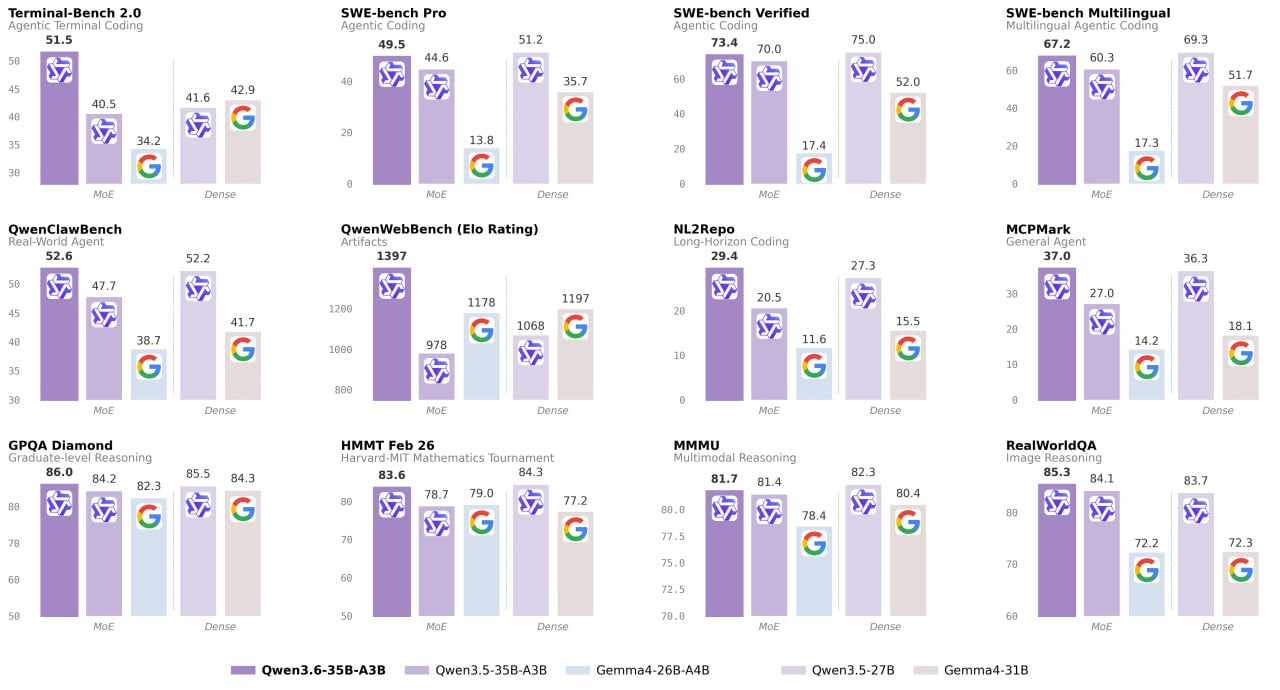
Where exactly does Qwen3.6-35B-A3B stand out? Primarily in agentic coding. On the Terminal-Bench 2.0 benchmark, it achieved a score of 51.5, outperforming both Qwen3.5-27B (41.6) and Gemma4-31B (42.9). A similar result applies to QwenWebBench, where the model scored 1,397 points compared with 1,068 for Qwen3.5-27B and 1,197 for Gemma4-31B.
On SWE-bench Verified, one of the most respected tests for agentic code work, it achieved a score of 73.4 points. While this is slightly below Qwen3.5-27B's result (75.0), it is significantly above the older Qwen3.5-35B-A3B (70.0) and far ahead of Gemma4-31B with only 52.0 points. At the same time, Qwen3.6-35B-A3B activates only 3 billion parameters during computation, while Qwen3.5-27B uses 27 billion.
On the AIME 2026 mathematics test, the model achieved 92.7 points, even surpassing Qwen3.5-27B (92.6). On the GPQA Diamond set, which tests scientific reasoning, it scored 86.0 points, more than any of the models compared.
Multimodal capabilities
Qwen3.6-35B-A3B is not purely a text model. It can handle image input, video, and documents, and its results in these areas are at least comparable to Claude Sonnet 4.5. On RealWorldQA, it achieved 85.3 compared with 70.3 for Claude Sonnet 4.5. In spatial reasoning on the RefCOCO benchmark, the model scored 92.0 points, while Qwen3.5-27B stopped at 90.9.
Particularly noteworthy is its result on ODInW13, a real-world object detection test: 50.8 points compared with 41.1 for Qwen3.5-27B. On the VideoMMMU video benchmark, the model then outperformed all competitors with a score of 83.7 points.
Preserving reasoning context
One of Qwen3.6's most practically interesting new features is preserve_thinking. By default, the model “thinks” before each response and produces reasoning content. The new option makes it possible to carry over this reasoning context from previous messages in the conversation as well, rather than only from the current query.
This has a direct impact on agentic scenarios: the model maintains decision consistency better throughout the entire workflow, repeats fewer unnecessary computations, and uses the cache more efficiently. The Qwen Team explicitly recommends this feature for agentic deployments. The model can also be switched to a non-thinking mode, in which it skips reasoning and responds directly if the user prefers a quick answer.
Where and how to run the model
The model is freely available on Hugging Face and ModelScope. The weights can be downloaded and run locally. For production deployments and higher-traffic scenarios, the team recommends the SGLang, vLLM, or KTransformers frameworks.
Through Alibaba Cloud Model Studio, the model is available under the name qwen3.6-flash and supports both the OpenAI-compatible protocol and an Anthropic-compatible interface. Specifically, this means it can be integrated directly into Claude Code simply by changing environment variables, without modifying any code.
For developers who want to run the model locally through SGLang, the basic command is all they need: python -m sglang.launch_server --model-path Qwen/Qwen3.6-35B-A3B --port 8000 --tp-size 8 --context-length 262144 --reasoning-parser qwen3
The procedure for vLLM is very similar. Both options support multi-token prediction (MTP), which further accelerates inference.
Integration with coding tools: OpenClaw, Claude Code, and Qwen Code
The model integrates seamlessly with three major agentic coding tools. OpenClaw (formerly Moltbot/Clawdbot) is an open-source agentic coder for the terminal that can be connected to Model Studio. Qwen Code is Qwen's own terminal agent, optimized specifically for models in the Qwen series. And then there is Anthropic's Claude Code, which can be used with the Qwen model simply by reconfiguring environment variables.
The community quickly embraced the model. In less than a week, 167 quantized variants of the model, 52 fine-tuned versions, and 8 adapters were added to Hugging Face. Downloads have already exceeded 200,000.
Recommended settings for optimal performance
The Qwen Team recommends different sampling parameter values for different types of tasks. For thinking mode on general tasks: temperature 1.0, top_p 0.95, top_k 20. For precise coding tasks such as WebDev: temperature 0.6, top_p 0.95. For direct mode without reasoning: temperature 0.7, top_p 0.8.
For benchmarking on difficult mathematical or programming problems, the team suggests setting the maximum output length to 81,920 tokens so that the model has enough room for detailed reasoning. For most queries, 32,768 tokens are sufficient.
The model can also process extremely long texts. Using the YaRN technique, the context window can be extended to approximately one million tokens, specifically 1,010,000. This opens up possibilities for analyzing extensive repositories or hours-long videos in a single pass, something even much larger models previously could not handle.