
Anthropic has launched Claude Opus 4.7, its most capable generally available model to date. What sets Opus 4.7 apart from its predecessor? At first glance, it may seem like a smooth transition, but beneath the surface there are numerous changes.
The biggest leap is in software engineering. Users in tests report that Opus 4.7 can handle even the most complex programming tasks that previously required ongoing supervision. The model actively verifies its own outputs before returning the result to the user.
In internal testing for coding and agentic tasks, Cursor measured a success rate of 70% compared with 58% for Opus 4.6. On its SWE-Bench benchmark, Rakuten found that Opus 4.7 solves three times as many production tasks as the previous model. Notion Agent reports 14% better results with fewer tokens and one-third as many tool-calling errors.
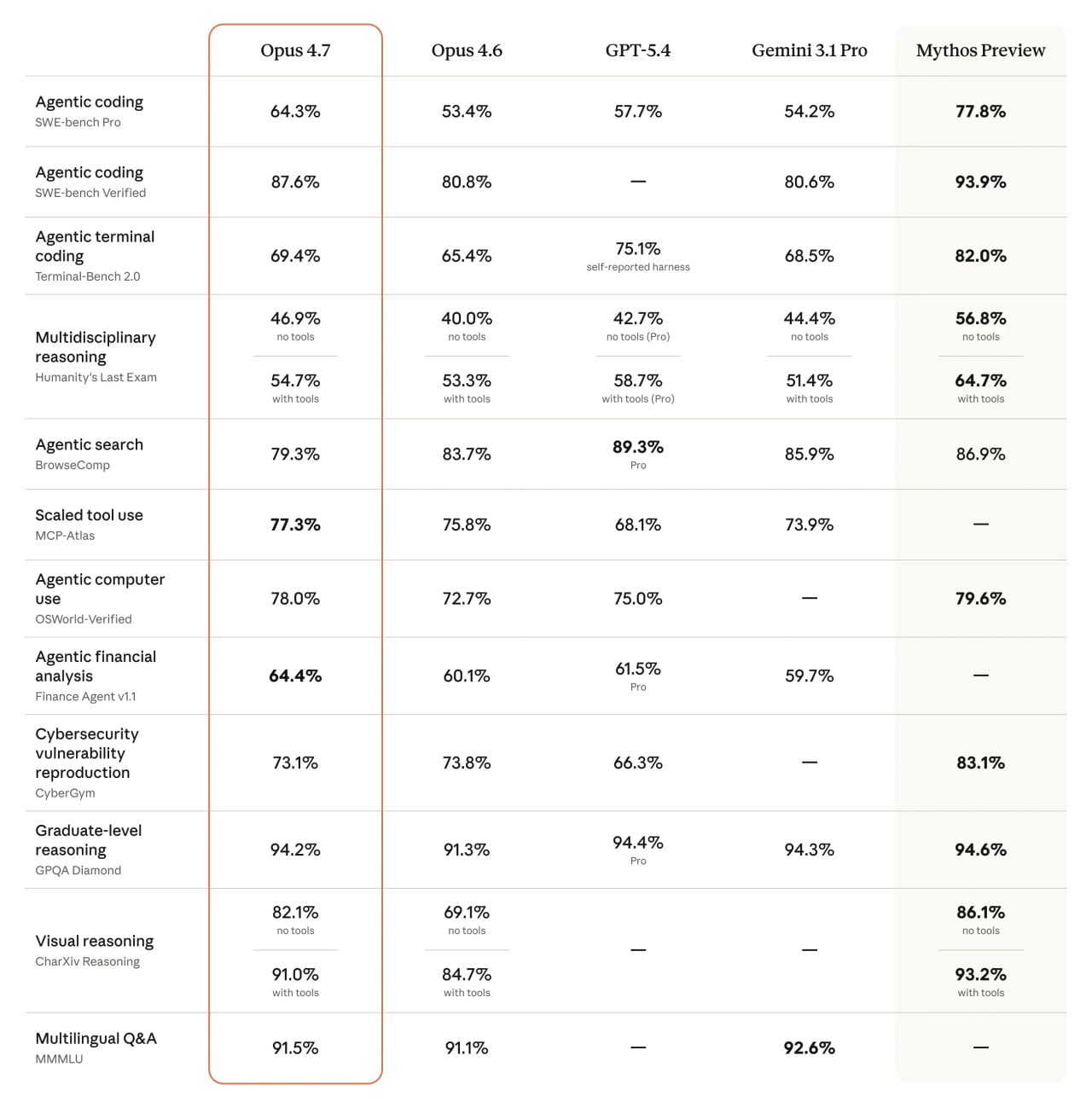
Opus 4.7 delivers the first major leap in visual perception within the Claude 4 series. The maximum image resolution has increased to 2,576 pixels on the longer side, equivalent to approximately 3.75 megapixels. That is more than triple the previous limit. In addition, the model's coordinate system now maps directly to image pixels, eliminating the need for any scale conversion.
In practice, this opens up new possibilities. Computer-using agents can reliably read dense screenshots, extract data from complex diagrams, or work with documents where every detail matters. XBOW, a company developing tools for autonomous penetration testing, measured 98.5% compared with 54.5% for Opus 4.6 on its visual accuracy benchmark. From its perspective, its biggest pain point disappeared overnight.
Better memory and security
A new capability in Opus 4.7 is its improved use of memory stored in the file system. It remembers important notes across multiple sessions and actively uses them in subsequent tasks, rather than starting from scratch every time. For developers working on long-term agentic projects, this means less repetitive context setup. The model carries its own working notes with it.
Anthropic does not shy away from sensitive topics in its announcement. The previous week, it released Project Glasswing, an analysis of the risks and benefits of artificial intelligence in cybersecurity. Opus 4.7 became the first model on which it is testing new safeguards in real-world operation.
The model automatically detects and blocks queries related to prohibited or highly risky areas of cybersecurity. Its cyber capabilities are deliberately below those of Claude Mythos Preview, a significantly more powerful model whose availability Anthropic currently restricts for security reasons. While training Opus 4.7, the company experimented with selectively reducing these capabilities.
Security professionals who need the model for legitimate purposes such as vulnerability research or penetration testing can apply for access through the new Cyber Verification Program.
Regarding its overall safety profile, Anthropic concludes its assessment by saying that the model is "largely well-aligned and trustworthy, but not entirely ideal in its behavior".
New features for developers
Alongside the model, three new features are coming to the platform:
xhigh effort level. Opus 4.7 introduces a new reasoning level between high and max. This gives developers better control over the trade-off between reasoning depth and response speed. Claude Code sets it as the default for all plans.
Task budgets in beta. Developers can tell Claude how many tokens it should use in total for a single agentic task. The model sees a running countdown and adjusts what it does accordingly. It is not an exact cap, but rather a message to the model: this is how much room you have, use it wisely.
The /ultrareview command in Claude Code. It launches a separate review session that examines code changes and flags errors and design issues that a careful human reviewer would catch. Pro and Max plan users receive three free trial ultrareviews.
Changes when migrating from Opus 4.6
Anthropic explicitly warns that Opus 4.7 takes instructions literally. Where the older model interpreted instructions loosely or skipped parts, the new model does exactly what you tell it to do, no more and no less. Prompts written for Opus 4.6 may begin producing unexpected results. The tokenizer has also changed. The same text may require approximately 1 to 1.35 times as many tokens for the new model compared with its predecessor. Pricing remains the same as for Opus 4.6: $5 per million input tokens and $25 per million output tokens.
Extended thinking budgets from Opus 4.6 have stopped working entirely. Opus 4.7 works exclusively with adaptive thinking, which according to Anthropic's internal tests reliably outperforms the original approach. The model is available through the API as claude-opus-4-7, as well as on Amazon Bedrock, Google Cloud Vertex AI, and Microsoft Foundry.