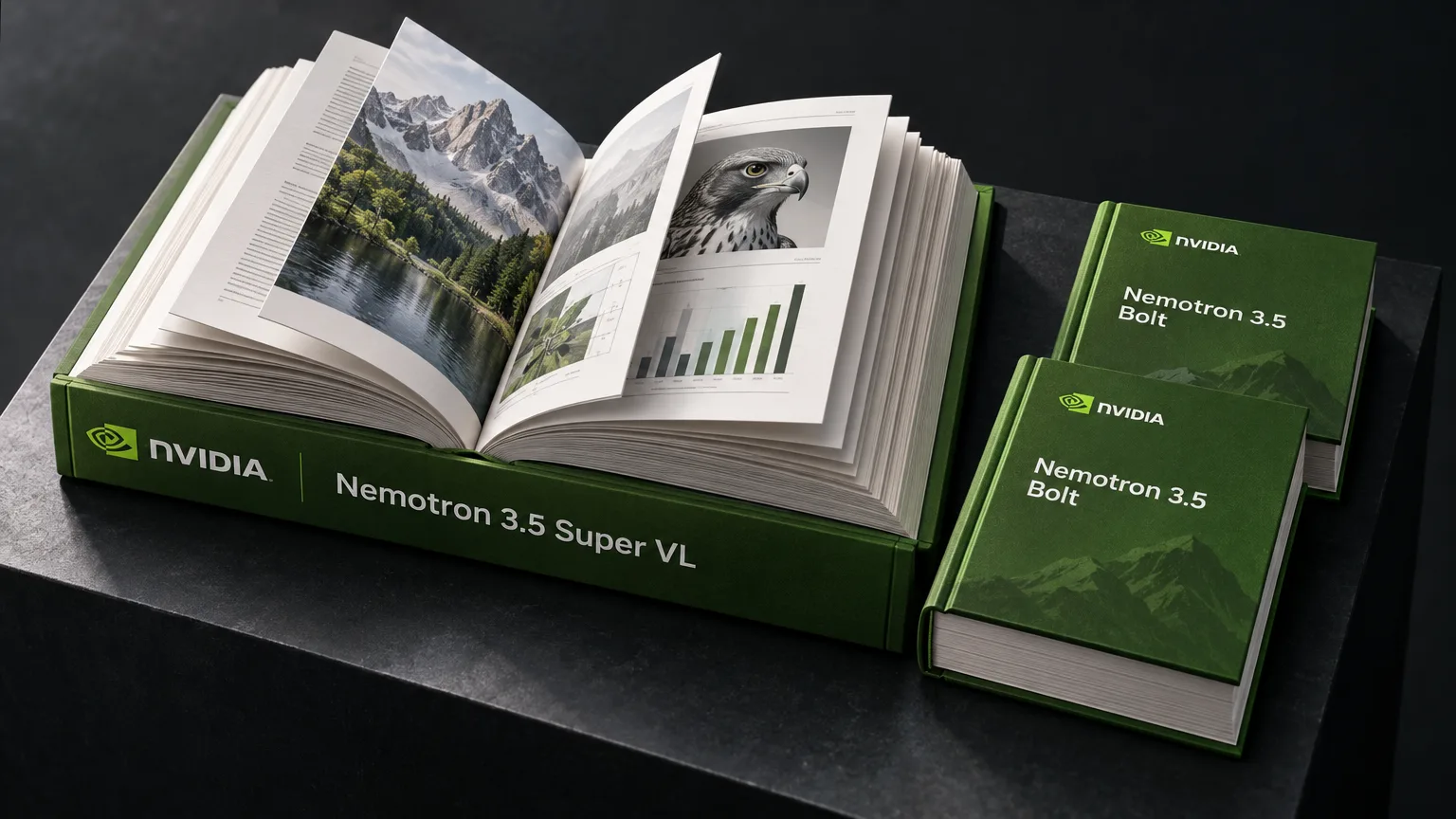
NVIDIA has released Nemotron 3.5 Super VL, an open 120-billion-parameter model for specialized, always-on AI agents. The company says it combines text and visual document processing in a single system. NVIDIA also introduced Nemotron 3.5 Bolt 74B-A9B 24GB and Nemotron 3.5 Bolt E4B 4GB for running agents locally.
Super VL connects document reading with agent tasks
NVIDIA has focused Super VL’s multimodal capabilities on content agents encounter at work: images, web pages and PDFs. According to the company, the model recognizes text, reads tables and charts, and processes structured information in visual documents. From a web page, it can extract both text and information presented in graphs.
Combining text and visual understanding is intended to reduce the need to pass tasks between separate systems, NVIDIA says. This is designed to preserve an agent’s context as it moves from a document to the extracted data and then to a decision.
The company says Super VL achieves accuracy comparable to its largest reasoning model on instruction following, tool use, multistep business workflows and visual understanding. It does so with roughly one-fifth as many parameters.
Open weights and resources for custom post-training
NVIDIA provides Super VL with open weights, datasets and training recipes. Organizations can further train the model on their own data and run it on their own infrastructure to meet security and data-residency requirements. The company says customization is supported through NVIDIA NeMo, Python-based pipelines and open datasets.
According to NVIDIA, pretraining and continued pretraining covered approximately 26 trillion tokens. This was followed by post-training on roughly 3.8 million examples and reinforcement learning across dozens of environments.
The company is also releasing open datasets on Hugging Face for agent tool use and financial tasks. Others cover instruction following, long context, fairness and vision-language understanding. Reinforcement learning environments are available through NeMo Gym.
Customization for finance and enterprise search
NVIDIA cites Scale AI’s work among its examples of customization. Scale AI post-trained Super VL for Skydance’s vendor credit finance agent and EY’s mergers-and-acquisitions due diligence agent. AfterQuery also customized the model for credit agreement analysis in Hebbia, according to NVIDIA.
Atlassian and Perplexity are also integrating the model into their platforms, NVIDIA says. Atlassian’s use involves agentic search across applications such as Jira and Confluence. Perplexity is integrating it for search and agentic tasks in Perplexity Search and Computer.
Bolt 74B-A9B targets local research and coding
The larger Bolt model is designed for everyday local agent tasks on NVIDIA RTX/DGX Spark, according to NVIDIA. Bolt 74B-A9B 24GB uses native 2-bit quantization, which the company says allows it to fit in 24 GB of memory and run alongside other applications.
NVIDIA says users can assign web research, writing and code debugging to local agent tools without sending those workloads to the cloud. The company ranks the model first among open models in its class on PinchBench and second among open models on BrowseComp.
Bolt 74B-A9B 24GB is already available on Hugging Face. It is supported by llama.cpp and Ollama, as well as LM Studio, Unsloth and vLLM. It runs on GeForce RTX PCs, DGX Spark, DGX Station and RTX PRO workstations, and is also designed for NVIDIA RTX Spark laptops arriving October 16.
Smaller Bolt due October 23; Super VL also available as NIM
Bolt E4B 4GB is due to become available on October 23. NVIDIA is targeting physical and conversational agents on GeForce RTX, Jetson and RTX/DGX Spark. Intended uses include local voice assistants, interactive characters and embedded interfaces with multi-turn interaction.
Super VL is already available on Hugging Face, through the ModelScope community and as NVIDIA NIM. The NIM option packages the model as a microservice for production deployment, with optimized and validated configurations and enterprise support. NVIDIA says security patches and performance improvements are delivered every two weeks.