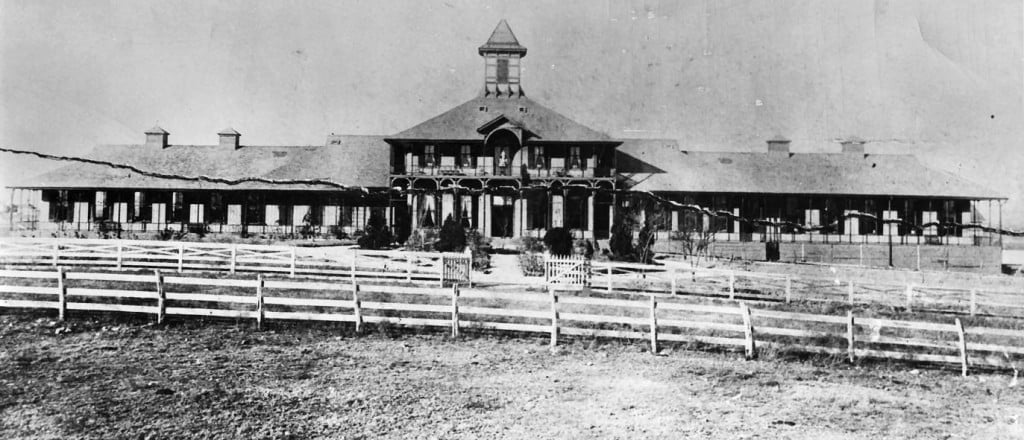
Thistle Hill, the last of the great estates built by Fort Worth’s cattle barons (1509 Pennsylvania Ave.), was commissioned by W. T. "Tom" Waggoner as a wedding gift for his daughter Electra and her husband, Albert Buckman Wharton. This generous gift came with conditions, however: Daddy wanted to keep his little girl as close to him as possible. The couple married on June 10, 1902, and while they were on their honeymoon, Tom purchased a plot of land on a rise south of the city and began construction. Albert and Electra moved into their new home in 1904. At the time, Electra was considered one of the jewels of Fort Worth society thanks to her beauty and charm, while Albert came from Philadelphia’s upper crust and fit seamlessly into local society. In 1903, he opened the city’s first automobile dealership, earning some extra money while indulging his passion for cars. But he spent far more time driving around in his own Winton than attending to its sales. That year, he and his friend Roy Kamp embarked on an adventurous cross-country journey from Denver to Fort Worth in one of these temperamental machines. There was little demand in Fort Worth for what were essentially expensive toys, but the handsome playboy did not mind too much. Albert and Electra represented Fort Worth’s aristocracy. In later times, they would undoubtedly have been counted among the so-called "beautiful people."
Electra readily embraced the role of "First Lady of Thistle Hill" and hosted lavish parties while supervising a large staff that included a gardener, a groom, a nanny for their son born in 1903, and her own personal maid, Mabel Palmer. Like Albert, Mabel came from Philadelphia and was not merely an employee but became Electra’s personal friend. Although the mistress of Thistle Hill was wealthy and privileged, she treated her personal servants like members of the family and even had them photographed during family vacations. Nor did she observe the customary social barriers separating her from other working-class women. She gave small gifts to salesgirls, manicurists, and other women who regularly attended to her. Whenever one of her favorite girls became exhausted from work, Electra invited her home to rest and enjoy refreshments. More than one working woman could boast that she had visited Thistle Hill and taken tea with its mistress!
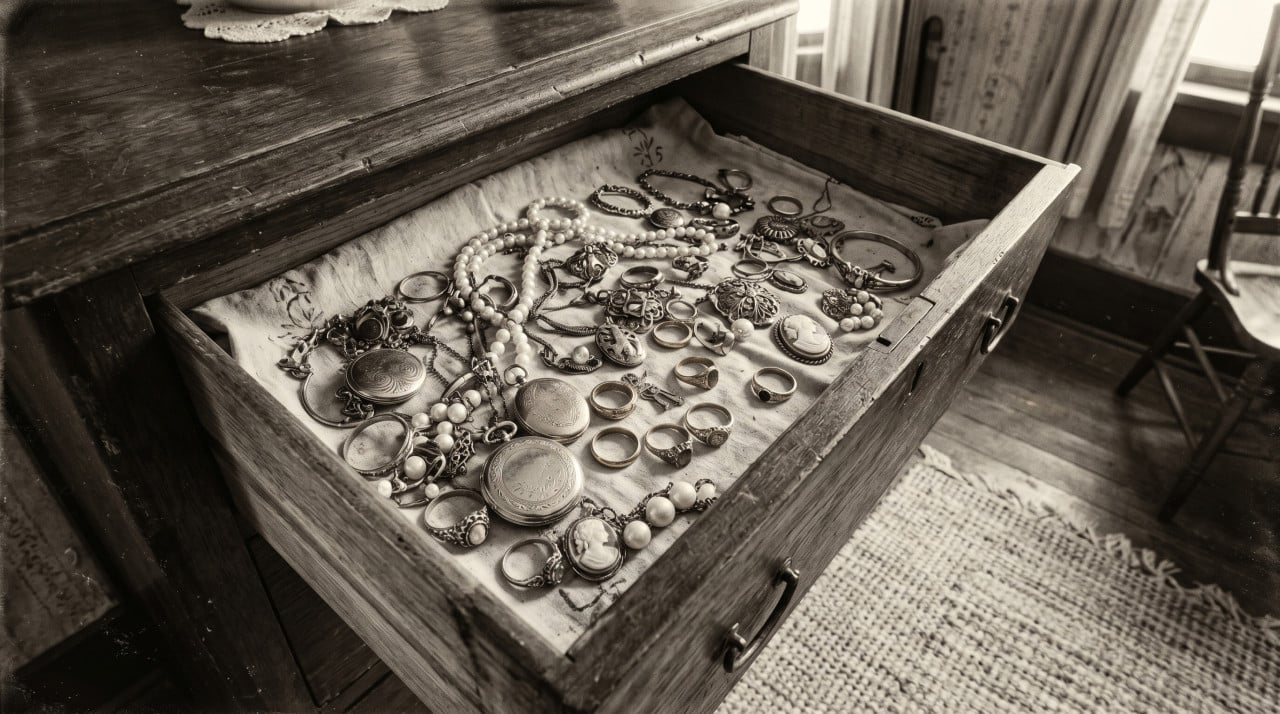
Thistle Hill, however, proved to be an unlucky house for the Wharton family. In 1905, Electra gave birth there to a second child, a girl who died almost immediately after birth. Although she did not withdraw from society completely afterward, she became more reclusive. It was at home that tragedy of another kind struck her on Wednesday, December 19, 1906. The previous evening, the couple had attended a holiday party, for which Electra wore a magnificent gown and her finest jewelry. When they returned home, instead of placing the jewelry in the safe, she put it in a leather case and hid it in a dresser drawer. Albert added his diamond-and-emerald ring, gold shirt studs, pocket watch, and cigarette case. That Wednesday afternoon, Electra asked Mabel to bring her the jewelry because she wanted to put it in the safe. A short while later, the maid returned and said there was nothing in the drawer. Electra was not initially alarmed, believing that Albert had put away his things when he left that morning and had also taken her jewelry to be cleaned. She called his office, but he was not there. When he called her back a few hours later, he told her that he had not taken the jewelry. Only then did panic erupt. He hurried home, and together with Mabel and the other servants, they searched the entire house. It was only then, late Wednesday afternoon, that he summoned the police. Because the victims were the Whartons, the police arrived immediately, led by Chief James Maddox, a veteran with twenty years of experience. The chief and his detectives declared that it was the work of "professional insiders." What led them to that conclusion? The jewelry had been upstairs in a dresser drawer, nothing else had been stolen, the lady of the house and the servants had been home all day, and the estate’s remote location made it impossible for some common street thief to come out from the city and leave unnoticed. Experience also suggested that thieves specializing in jewelry generally tried to pawn their loot as quickly as possible, yet nothing had appeared in the local pawnshops.
The police questioned all four servants who had been working that day but came away without a single clue. The case made headlines in the newspapers of both Fort Worth and Dallas. On Thursday afternoon, a Fort Worth writer reported that the police were "hopelessly at sea." They did not have a single "clue" or any suitable suspect. The stolen jewelry included several rings, one of which was valued at $1,000, as well as clasps and brooches. The total value of the stolen items was unclear: various reports gave figures of $3,000, $6,000, and $7,250, with different amounts even appearing in the same edition of a newspaper! The jewelry apparently was not even insured. Whatever its true value, the thief or thieves had carried out a highly profitable theft. Albert offered a $500 reward for the return of the jewelry and the capture and conviction of the perpetrators.
Under pressure from critics, the police decided on Friday to arrest two people: the maid, Mabel Palmer, and the Black butler, Sam Dunn. Questioning revealed that Mabel had worked as a domestic under several different names and had a criminal record in Philadelphia. The butler was released, while Mabel was questioned continuously until Sunday. A search of her quarters uncovered several items belonging to the Whartons, but not the jewelry. She was charged with their theft under the offense of "theft over $50." The police had reached a dead end and were preparing to turn her over to the county jail, where she was to be tried for the proven offense. Meanwhile, Mabel, who knew her way around the court system, hired a defense attorney and refused to make any further statements.
In the end, days and days of intense questioning—in other words, the "third degree"—broke her, and she confessed, at least formally, in the presence of Chief Maddox, a city detective, Albert Wharton, and Tom Waggoner. The presence of the latter two only demonstrated the importance attached to the case. Mabel also mentioned a "male accomplice" who had possession of the jewelry and was in Philadelphia. Fort Worth authorities contacted the Philadelphia police and scheduled a preliminary hearing for Tuesday morning, January 1. It seemed that the Fort Worth police might enjoy a happy New Year after all.
Mabel was charged under the names "Miss Rosa Devoe, alias Rosa Doran, alias Mabel Palmer." Justice of the Peace Hugh Bratton filed the charge of "theft over $50" and set bail at $10,000. She was then returned to her cell in the county jail to await the grand jury’s decision. The authorities, and naturally the Whartons as well, wanted her held without bail, but the weakness of the evidence and the relative insignificance of the charge made that impossible.
Philadelphia police sent a copy of Mabel’s criminal record and a photograph of her, identifying her as "Rose Palmer." (Unfortunately, this photograph, so kindly provided by the Philadelphia officers, never made it into the local newspapers.) Philadelphia had only two theft charges against her, both settled out of court. Philadelphia’s Rose was no saint, but neither was she a jewel thief. Yet because she was the only suspect Fort Worth authorities had, they continued searching for the accomplice. Even the local newspapers referred to him only as her "alleged accomplice." The intensity of the investigation was driven primarily by the social prominence of the victims. Someone simply had to pay.
A month later, a new player entered the game: Mabel’s husband. An elegantly dressed stranger walked into Sheriff Tom Wood’s office and introduced himself as her husband, newly arrived from St. Louis. He explained that they had been separated for some time and that he had therefore only just learned of her misfortune. He asked to see her. Sheriff Wood allowed him to speak with her in her cell and then referred him to her attorney. Until then, Mabel had never mentioned her husband or the fact that she had one in St. Louis, and as the Fort Worth Telegram observed: "This fact adds interest to the prisoner’s history."
Mabel remained in jail for more than two months while her case dragged on without progress. Detectives were unable to identify the accomplice, although they were convinced that he existed, and the Whartons’ jewelry was still missing. The case against the accused was as weak as water. An experienced defense attorney would have had little difficulty getting her acquitted or securing such a light sentence that it would have been meaningless. Neither prospect appealed very much to the Wharton or Waggoner families.
Finally, in April 1907, the prosecution took action, but in a completely unexpected direction. Instead of pursuing criminal charges, the county attorney petitioned the county court to have Mabel declared mentally ill, as such cases fell within its jurisdiction. The threshold for a finding of insanity was not very high; the testimony of one or two qualified physicians and a few witnesses who could attest to her strange behavior would suffice. The jury, of course, would consist entirely of men. Mabel’s female guards readily testified that she had "refused food for long periods" and sometimes "tore at her clothes." Clearly, she was not in her right mind. The prosecutor also introduced as evidence statements she had made during questioning that could be "construed as a confession." Mabel may genuinely not have been entirely sane, and her so-called confession may or may not have been coerced, but the prosecution desperately needed a conviction to satisfy Fort Worth society, and Mabel was all it had.
Just one week after the ruling that she was "mentally incompetent," Mabel was transferred to Terrell State Hospital, surprisingly quickly, simply to get rid of a major problem. Normally, the wait for an available bed at Terrell took months or even more than two years. The authorities seemed concerned only with sending Mabel as far away from Fort Worth as possible. The forced insanity ruling, however, proved to be an inadequate solution. Only five months after her transfer to Terrell, the doctors there declared her "cured" and waited only for instructions from the Fort Worth authorities. The county attorney announced that he had no intention of pursuing criminal charges and issued the following statement: "Mabel Palmer is no longer under investigation by the state in connection with the diamond robbery or any other case. Upon her release, she is entirely free to go wherever she pleases." The Star-Telegram added: "The belief in official circles is that the woman is innocent in the diamond robbery case."
Mabel was escorted back to Fort Worth under guard and again confined in the county jail, but without criminal charges the authorities could not hold her. Four days later, her attorney filed a petition for habeas corpus in the Sixty-Seventh District Court. Judge W. T. "Tom" Simmons held a formal hearing at which Mabel testified. The state opposed her release, but even the prosecutor’s harsh cross-examination failed to shake her testimony; she stubbornly maintained her innocence, just as she had before. Without new evidence, Judge Simmons had no choice but to release her. Mabel immediately disappeared and was never seen in Fort Worth again. The Fort Worth police, however, never forgot her name. Several years later, another "Mabel Palmer" opened a brothel in the local Acre district. The dismissal of all charges against the original Mabel Palmer was both a benefit and a disappointment. On the one hand, the case disappeared from the front pages; on the other, it served as a fresh reminder that even ten months after the Thistle Hill robbery, the Fort Worth police were no closer to solving it. After her release, the Star-Telegram published a summary of the case’s entire history for its readers.
But the case refused to go away. A few days after Mabel’s release, the Telegram reported a mysterious phenomenon captured in the Fort Worth Police Department’s (FWPD) annual group photograph, taken on the steps of City Hall. A ghostly circle appeared above the face of Detective J. D. Allgood. Some described it as an example of "spirit photography," the term used for inexplicable things captured in photographs that supposedly revealed the world of those who had "passed beyond." In Detective Allgood’s case, believers claimed that details of a jewelry setting could be discerned in the circle above his face and saw it as a message from beyond the grave from... whom, exactly? It was unclear who was speaking from beyond, but the newspaper cruelly needled the police by asking whether the "Wharton diamonds" would ever be found. The answer was no.
The Wharton robbery was destined to remain an unsolved case and eventually fade into obscurity, much to the FWPD’s relief. It is a textbook example of a poorly conducted criminal investigation. Chief James Maddox’s theory that it was an inside job may have been correct, but it focused on the wrong suspect. He apparently never considered that one or both of the Whartons might have been involved in the theft. No one ever accused either Albert or Electra, but the possibility of their involvement is supported by the fact that a year before the robbery Albert owed $2,124.50 in back property taxes, and although his net worth was not insignificant, he was certainly not yet a millionaire. He appealed, arguing that he had not been a resident of Fort Worth when part of the property was assessed and that another portion of the property was "not subject to taxation." He lost the appeal and had to pay all the arrears, plunging him into considerable financial distress. There is no doubt that Electra’s jewelry, if sold on the black market, would have significantly improved his financial situation. Both spouses were accustomed to a life of luxury, and cutting back on expenses would have been very difficult for them. (Electra could have gone back to Daddy, but that would have been equally humiliating for her.) At the time, Albert was vice president of Waggoner Bank and Trust, a far more stable and lucrative position than selling automobiles.
The Fort Worth police had an opportunity to restore their reputation in late 1914, when a similar jewelry robbery occurred at the home of Mr. and Mrs. C. H. Bencini. Diamonds worth about $14,000 disappeared at approximately the same time as a mysterious fire. Lena Bencini kept the jewelry hidden in a closet whenever she was not wearing it. As after the Wharton robbery, the police initially suspected an elderly Black servant, although Mrs. Bencini refused to believe it. More than a year later, detectives traced the diamonds to several Black men and charged them with arson and robbery. Unlike in the Wharton case, they also managed to recover some of the diamonds. Detectives emphasized that the accused were "remarkably clever Negroes." The Fort Worth Police Department’s record in jewelry robbery cases became an issue in the 1915 campaign for police commissioner. Candidate Mordecai Hurdleston accused incumbent commissioner Robert M. Davis of being unable to close such cases, and won the election in April 1915.
Because of the tragedies associated with their dream home, and probably also because they had become estranged, Albert and Electra decided to sell Thistle Hill in February 1911. Their separation was hastened, if not directly caused, by a stroke Albert suffered in September 1909 while on a business trip to Colorado. He was brought home by special train and recovered from "paralysis" at Thistle Hill. The stroke may or may not also have affected his mind. Such matters did not make it into the newspapers, but a year later one of the servants at Thistle Hill sued him for "physical and mental abuse." Twenty-four-year-old Margaret Butler, who had worked for the family for less than a month, claimed that Albert had beaten her so severely that she was unable to work and had to seek medical attention. She sought $10,000 in actual damages and another $10,000 in exemplary damages. A trial would have caused Electra great embarrassment, since she would probably have been called to testify. The case was ultimately settled out of court.
The Whartons’ fairy-tale life had turned into a nightmare. They sold the estate to Winfield Scott, a fellow cattleman and friend of W. T. "Tom" Waggoner, for $90,000 and went their separate ways. Albert moved into the Westbrook Hotel, and Electra eventually settled in Dallas. The marriage finally ended in divorce on January 12, 1921. Electra received a generous financial settlement and custody of both children, Albert Jr. (eleven years old) and Tom (seventeen years old).
Electra began a new life as a "colorful, wealthy divorcée" and became a jewel of Dallas society rather than Fort Worth society. She was never without precious jewelry, only now she kept it in a safe whenever she was not wearing it. Meanwhile, Albert’s luck with jewelry did not improve even after their separation. In January 1911, a barber came to his suite at the Westbrook Hotel to shave him. When he left, he took with him a pearl-and-diamond tiepin worth $350. The police caught the thief leaving work later that same day, wearing the pin on his tie.
And so ended the story of the Great Thistle Hill Robbery. The Whartons went their separate ways, Mabel Palmer—whatever her real name may have been—disappeared, the jewelry was never found, and Thistle Hill acquired a new owner. Taken together, it remains an unsolved mystery and an unsolved case for the Fort Worth police.