New York City has held more than 200 ticker-tape parades since the first one in 1886, which celebrated the Statue of Liberty. Charles Lindbergh received a ticker-tape parade for his solo transatlantic flight. Athlete Jesse Owens was honored for his four Olympic gold medals with a parade in 1936. British World War II Prime Minister Winston Churchill experienced a shower of ticker tape in 1946. The Apollo 11 mission team that landed on the Moon received a hero’s welcome with ticker tape in 1969.
Of all the people and professions honored in this way over more than 130 years, only one was a musician.
If you are thinking Elvis or Michael Jackson, you are way off. The only musician to return to America as a kind of conquering hero was Harvey Lavan “Van” Cliburn Jr., a tall, lanky Texan from Kilgore.
In 1958, he managed to pull back the Iron Curtain and thaw the Cold War for a few magical weeks. And he did not do it with a Springfield rifle or a Sherman tank: He did it with a Steinway piano.
Nigel Cliff, the late pianist’s posthumous biographer, says that his genius emerged early. His mother, Rildia Bee, herself an accomplished pianist, taught piano at home. She had just finished a lesson with her last student of the day and said goodbye to him. She left three-year-old Van sitting on the piano bench while she went to prepare dinner. After 15 minutes, she heard the piano and thought the student had returned, so she went back to the piano to send him home. The student was not there, but little Van was—playing the student’s lesson by ear. His mother immediately took him on as one of her students.
At the age of 10, Van told his parents that his dream was to become a classical concert pianist. His father told him that if he was going to be a pianist, he should be the best. He added a practice room to the garage of their ranch-style house and equipped it with a Steinway piano. There, Van Cliburn practiced for three to four hours a day. He kept that Steinway until the year before his death in 2013 in his adopted hometown of Fort Worth.
Young Van also faced distractions along the way. Because he had grown to more than 183 cm before high school, the basketball coach came to recruit him. His mother told the coach that Van’s hands were insured for a million dollars. There was no way she would let him risk them by playing basketball.
Cliburn’s mother took the teenage Van to New York, where he attended master classes at the famous Juilliard School, which offered him a scholarship. But he preferred his mother’s instruction, so they returned to Kilgore. Eventually, at the age of 17, he accepted the Juilliard scholarship. Two years later, in 1954, he won the Leventritt Foundation Award, which secured his debut with five major orchestras. In 1958, at the age of 23, he agreed to participate in the inaugural International Tchaikovsky Piano Competition in Moscow.
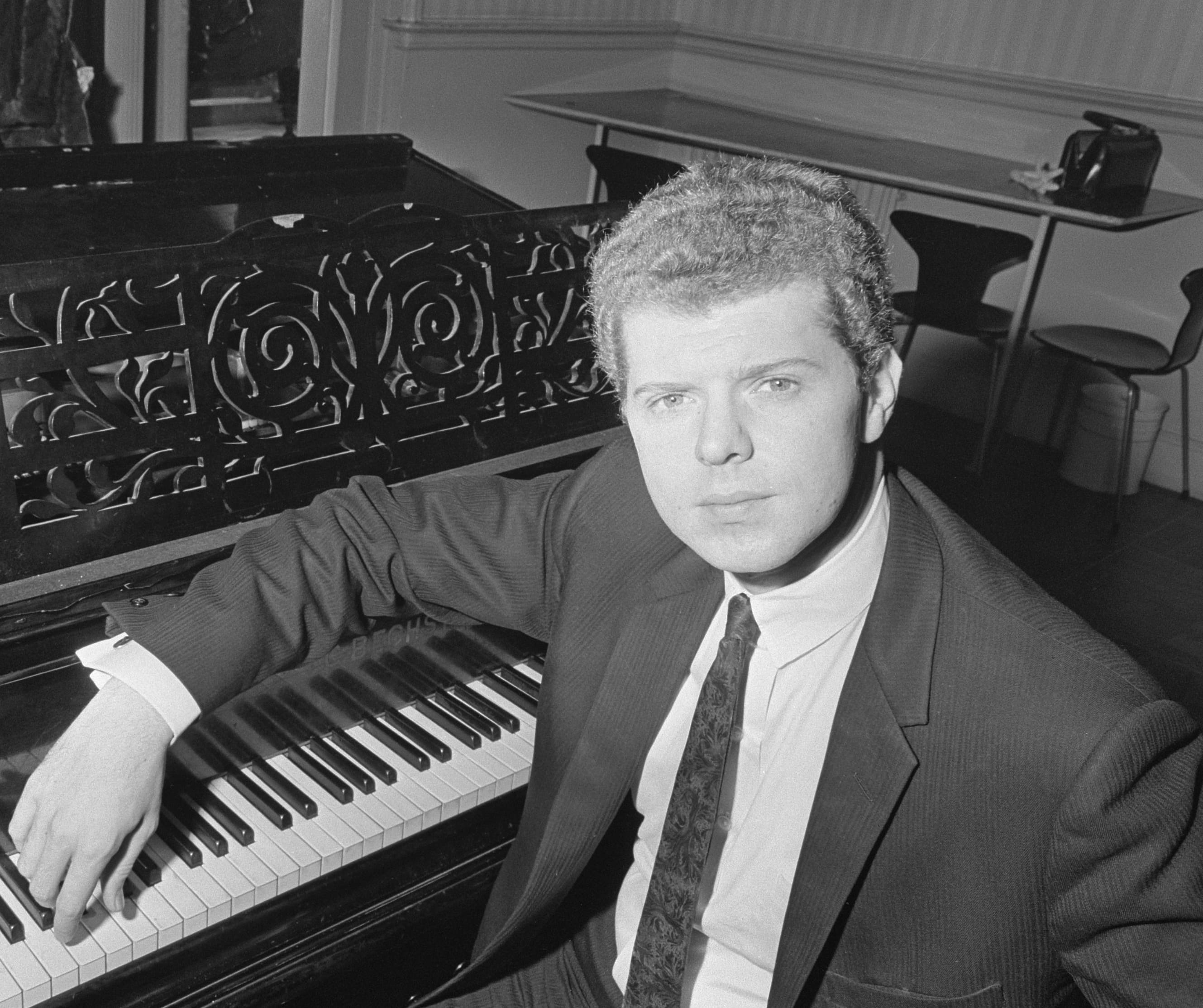
This competition was Russia’s way of showing the world not only that it was a technological leader—six months earlier, it had launched Sputnik, the first man-made satellite, into space—but also that it was culturally superior to the decadent West.
The Russians did not expect the tall young Texan to enchant them with his masterful interpretations of Tchaikovsky and Rachmaninoff. Olga Kern, the famous Russian-American classical pianist, said: “Van Cliburn won because he played magnificently. Soaringly. It was beautiful; the piano sang. It sounded so new and fresh. It was incredible.” And when she visited his childhood home in Kilgore many years later, she said she understood where his style came from, because East Texas has enormous trees, expansive fields, and a natural grandeur that may have shaped him.
Cliburn’s reception in Moscow would have been the envy of any rock star. Women fainted. They wept over his powerful and fresh interpretation of Tchaikovsky. They carried flowers onto the stage and laid them in front of the piano. It is widely reported that the judges did not know whether they were allowed to award the grand prize to an American, so they appealed directly to Soviet Premier Nikita Khrushchev and asked whether they could declare Cliburn the winner. Khrushchev is said to have replied in Russian with something that roughly translates as: “Is he the best pianist? Then give it to him.”
Just as the Russians opened their hearts to him, he opened his heart to them. The country had always fascinated him, and in an interview with the New York Times, he said that Russians “remind me of Texans.”
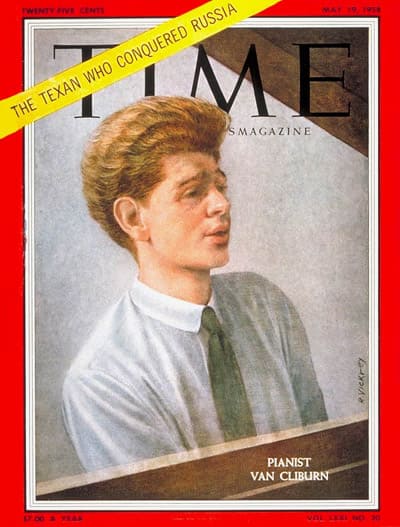
And so Van Cliburn returned to New York as a victorious cultural warrior. He was given a rapturous ticker-tape parade—the only one in history for a musician. He appeared on the cover of Time magazine. The headline read: “The Texan Who Conquered Russia.”