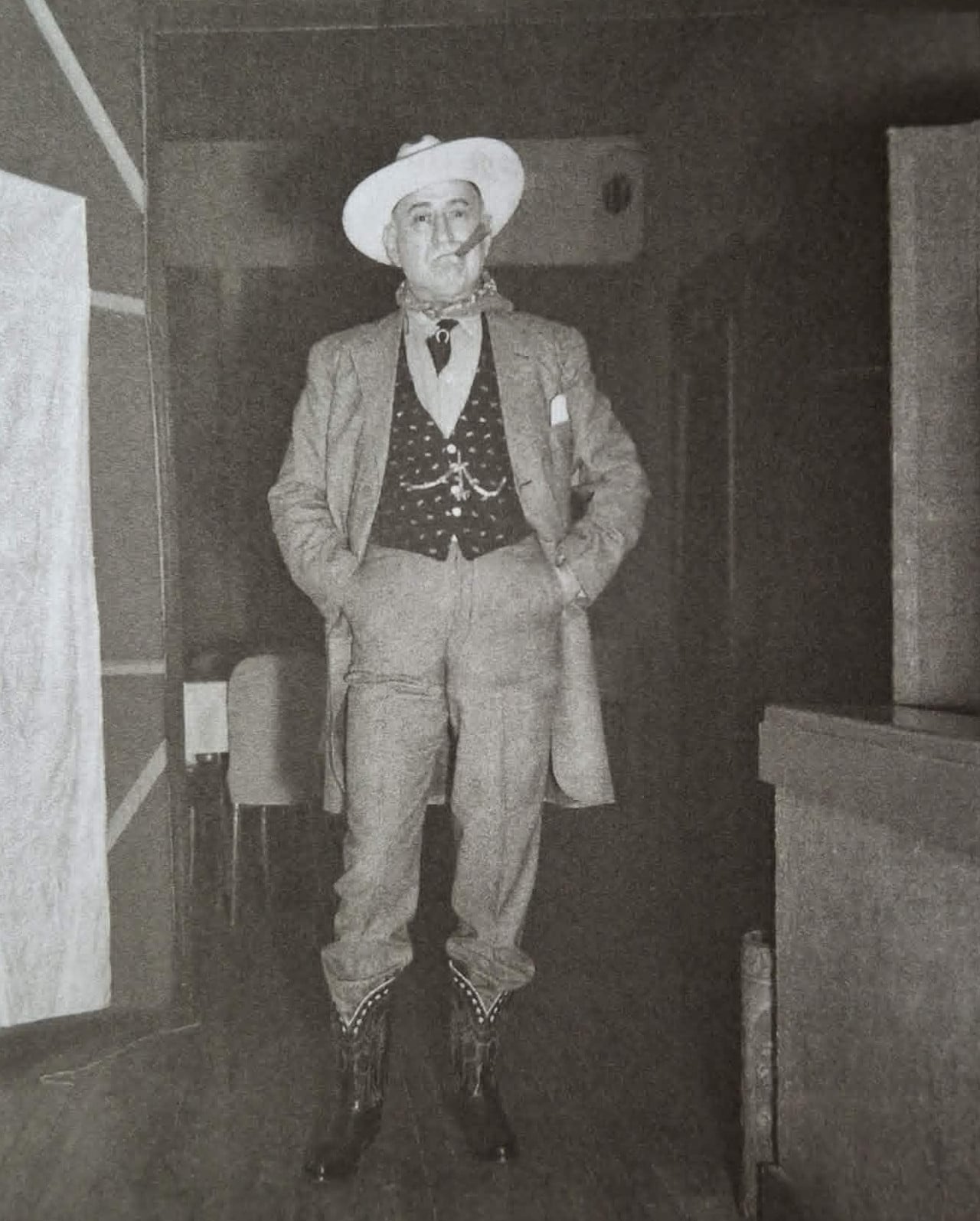
Two of the most prominent names in 1920s New York society proudly embraced their Texas roots: Tex Rickard and Texas Guinan. Both were larger-than-life personalities, and the moniker “Texas” suited them perfectly.
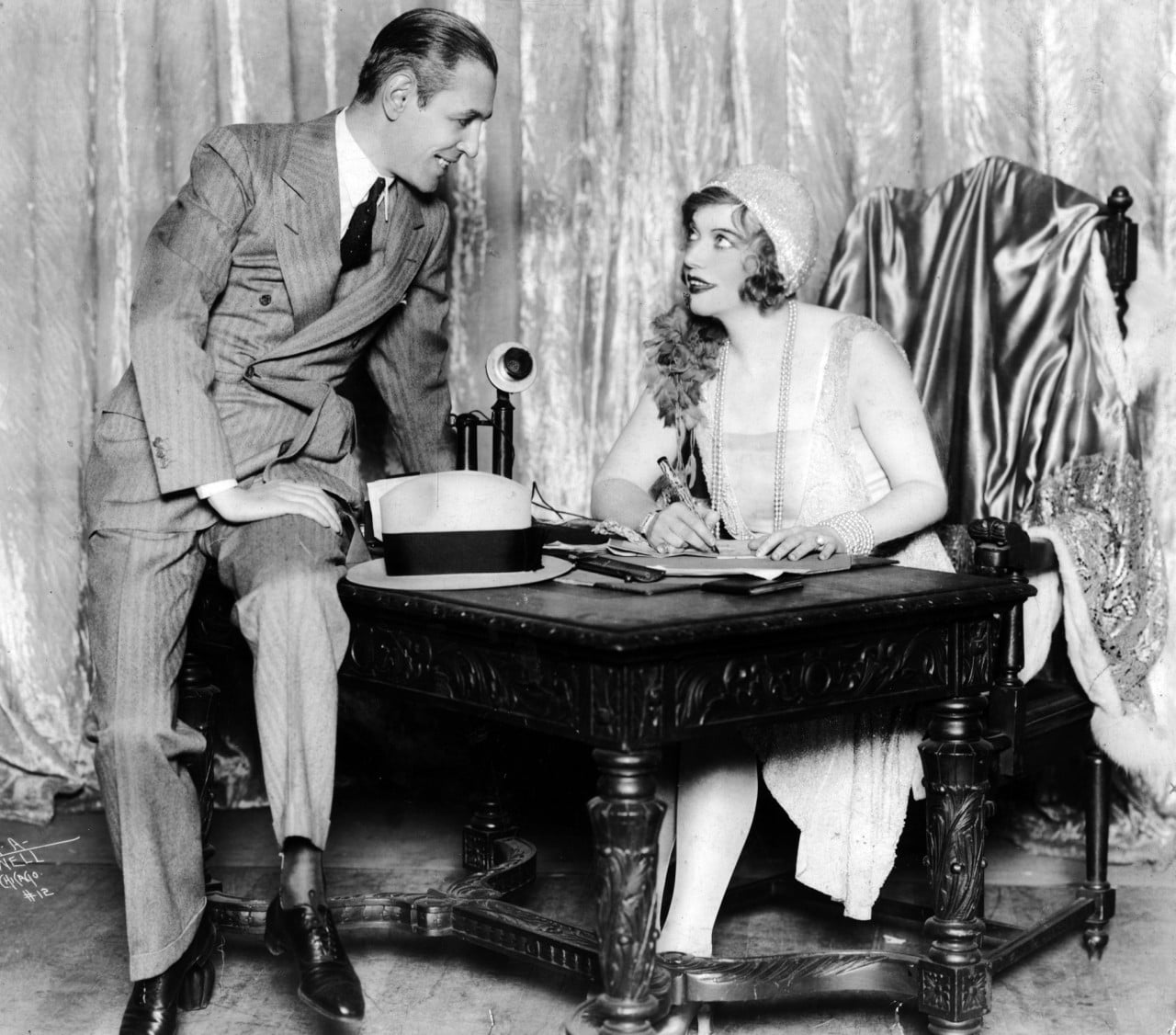
George Lewis “Tex” Rickard (1870–1929) was the greatest entertainment promoter of his day. He acquired the nickname while serving as a town marshal in Henrietta, Texas. Mary Louise Cecilia “Texas” Guinan (1884–1933) was a stage and film star from Waco, Texas, who told reporters that “Texas” was her birth name. The true source of her fame, however, was something else: she became the “queen of the nightclubs,” a legendary hostess at speakeasies who welcomed guests with her famous greeting, “Hello, sucker.” After becoming famous, she regularly instructed reporters and admirers on how to pronounce her surname correctly: “with a long ‘i,’ a silent ‘u,’ and the accent on the first syllable.”
Guinan never forgot her Texas roots. As a girl, she learned to throw a lasso and ride a horse on her father’s ranch before receiving a scholarship to the American Conservatory of Music in Chicago in 1898. She demonstrated genuine singing talent as well as courage, and after graduating from the conservatory she joined a traveling Wild West show. In 1904, she settled down as a respectable wife, but that lasted only two years. Her restless nature eventually led her to divorce John Moynahan and head for the bright lights of New York. She quickly found work in vaudeville, starting in the chorus and gradually working her way to the front of the stage. It is believed that she adopted the name “Texas” to give herself an advantage in the highly competitive world of vaudeville.
Guinan was a robust woman, and her weight eventually cost her first her place in the chorus and then her roles as young heroines. She tried to at least gain publicity from her lifelong struggle with her weight by becoming the face of a weight-loss company. The advertising campaign, however, proved to be a scam that drove her from the New York stage. She therefore turned to touring the vaudeville circuit inland, which brought her to Fort Worth in 1917. Her biographer describes the years from 1915 to 1920 as the “least documented” period of her life, because alongside her stage work she was also launching a film career in California and claimed that during World War I she had traveled to France to entertain the troops, for which she supposedly received a French state decoration. These latter claims are clearly false, but it is a fact that for several years she successfully juggled both stage and film careers.
Her films were short two-reel pictures that presented her as a Texas-born Western gunslinger. She was called the “female Tom Mix,” and she carried this image onto the stage as well. After making nearly thirty films for other production companies, she founded her own in 1921 and made three more pictures in which she maintained complete control. She eventually returned to the New York vaudeville stage and in 1923 launched her legendary nightclub career, first as a singer, then as a hostess and emcee. It was here that her most famous catchphrases originated: “Hello, suckers!” and “Give the little girl a great big hand!” Her style drew from the same source as that of her contemporary Mae West: a blend of glamour and witty, sarcastic remarks that audiences eagerly sought. She once summed up her likes and dislikes as follows:
“I love noise, rhinestone heels, customers, lots of attention, and red velvet bathing suits. I smoke like a factory chimney, take an aspirin every night before bed, call every strange man ‘Fred,’ and they love it. I have six uncles, sleep on my right side, like to eat carrots, and eat a dozen oranges every day. Once I lost more than thirty pounds in two weeks. I think that speaks volumes about me.”
During the aforementioned “less documented” period of her life, she appeared on stages in both Fort Worth and Dallas, although she was better known from the silver screen. She first appeared in the area at Dallas’s Majestic Theatre in 1917, together with Billy Dixon in a short act called “Honk, Honk Maybe!” She and Dixon were the headliners of a seven-act bill that ran in Dallas for three weeks before moving to the Majestic Theatre in Fort Worth at the corner of Tenth and Commerce, an equally opulent auditorium with a marble foyer and red velvet seats. The Star-Telegram heavily promoted the program before it opened on the local side of the Trinity River, promising “vaudeville of the highest class” and “a storm of entertainment.” Management was betting that Guinan and Dixon were sufficiently well-known names, while also emphasizing that Guinan was “Texas’s own daughter.” The show opened in Fort Worth on February 16 with a matinee, followed by an evening performance that same day. Admission for adults was 25 cents. Vaudeville life was demanding, requiring two performances a day, six or seven days a week, and that was exactly how it was scheduled. This time, however, management had misjudged the situation. The “comical tale of a temperamental automobile” featuring the two stars had scored with Dallas audiences, but did much less well on the local side of the Trinity River. Their frenetic song-and-comedy act “flopped,” which in the vaudeville world usually meant that it was moved to the end of the program and a more popular act was made the headliner.
Although Guinan’s vaudeville act failed in Fort Worth, her films continued to attract audiences there. In January 1918, just one year after her disappointment on the local stage, the Hippodrome cinema booked the film The Gun Woman for three days. Guinan was the main attraction of the film, which promised “a gripping story with human moments.” It was a silent film, but Guinan could convey “romance and suspense” through gesture better than anyone else. It was her third picture for the Triangle Film Corporation, but “her first major film role,” making it essential viewing for every cinema lover. Her films continued to do well in Fort Worth in the years that followed, including her independently produced pictures from 1921. One of them, The Hermit, which had its first Fort Worth showing, is not even mentioned in her filmography.
She did not personally return to North Texas until 1922. For her return, Dallas’s Majestic Theatre booked her for a week-long program combining a film with a live performance. Naturally, she was the headliner. The film shown was her own production, a two-reel Western titled The Scrapper, written especially for her by “acclaimed vaudeville writer” Jack Lait. Once again, Guinan played a courageous Western heroine, an “accomplished horsewoman and quick-witted fighter” of the wild frontier. Ticket holders were reminded that the star came from Waco, that she was “remarkably convincing in Western scenes,” and that “everyone who has ever seen a film knows her.” Regular cinema admission was 10 to 15 cents for adults, but this show, featuring both a film and a live appearance by Texas Guinan, was in a different category. Admission was 25 to 35 cents. Guinan and her company still had to perform twice a day, at both matinee and evening shows. After the screening ended, the star rode onto the stage on horseback, accompanied by four fellow performers, all still in costume. One critic remarked that as attractive as she looked on screen in her riding outfit, she looked even more glamorous in the bright red dress into which she changed for the second half of the program. The most important feature of the entire show, however, was the blending of film and live performance, which, at least for Texas audiences, was a complete novelty. After 1920, vaudeville was slowly dying while cinema was becoming the main form of entertainment. Offering the best of both worlds was a brilliant idea, whether it came from Texas Guinan or someone else.
After the first performance, she gave the obligatory press interview, in this case to the Dallas Morning News and the Dallas Times-Herald. She declared that she was happy to be back “in the state after which I am named.” She added, however, that she was not particularly fond of Texas weather in August. She said it seemed as though everyone who had known her during her youth in Waco had moved to Dallas. It was for them that she held an elegant reception at the Adolphus Hotel, scheduled between performances. She also remarked that Dallas would be a wonderful place to make films and wondered why the city had not yet joined the Hollywood trend. The show did not visit Fort Worth. After finishing in Dallas, the star traveled to Mexico to shoot another Western. Production must have moved very quickly, because by mid-December she was back in New York, hosting a farewell dinner for her colleague, actress Pearl White, famous for her role in the serial “The Perils of Pauline.”
When she grew tired of constant touring in 1923 and longed for greater earnings, she began her New York nightclub career as a singer at the Beaux Arts Club. It was the Prohibition era, and all nightclubs were actually speakeasies where entertainment was supplemented by overpriced illegal alcohol. Guinan’s singing talent was adequate, but what made the Beaux Arts the right place for New York’s elite was her quick, sarcastic verbal sparring with customers. She soon had her own show, in which her main task was to introduce the performers in her unmistakable style. She moved to her own establishment, the Texas Guinan Club, until the police shut it down, and then to Club 300, until federal agents raided it and charged her with violating Prohibition laws. She was acquitted in 1929 and discovered that her clash with the law had made her too notorious to return to the speakeasies, just as had earlier happened to comedian Fatty Arbuckle. She was undeterred, however, and assembled a revue that did not shy away from her daring reputation but instead exploited it. She named it “Too Hot for Paris,” took it on tour, and convinced skeptical theatrical agents that she still had what it took.
In September 1933, a rumor circulated in Dallas, enthusiastically fueled by the management of the State Fair, that she would come to Dallas that year as part of the annual fair festivities (October 7–22, 1933). She was supposedly going to appear at the Majestic Theatre, where she would present her latest film, Broadway Thru a Keyhole, written especially for her by journalist and radio commentator Walter Winchell. To enliven the program, she was also supposedly bringing “her girls” from the tour. The rumors proved false, but the Majestic Theatre did indeed book her for a series of performances beginning November 25. As with Sally Rand, the name Texas Guinan on the bill carried the promise of scantily clad girls and a risqué program strictly for adults. That never happened, however, because two weeks earlier, on November 5, the day her New York office signed the Dallas contract, she died in British Columbia, where she was completing her tour. She had already contracted amoebiasis in Chicago but carried on until the final scheduled performance.
Fort Worth received its last glimpse of Texas Guinan during her lifetime nine months earlier, in February 1933. Her short film Texas Guinan in a Reminiscent Mood was shown as part of a double bill at the Palace cinema together with “State Fair,” starring Janet Gaynor and Will Rogers. Admission of 25 cents would have been too much for the short film alone, but combined with a newsreel and a feature film it was a good bargain. Today, the film is so forgotten that it is not even included in her filmography.
It cannot be said that Texas Guinan put Fort Worth on the entertainment map or that she achieved her big breakthrough there. But like Buffalo Bill, Will Rogers, Sally Rand, and other major stars of her era, she did not consider Fort Worth too small or too provincial. It was simply another stop on the theatrical circuit at a time when major stars also performed in small cities and left local audiences with unforgettable memories.
Somewhat belatedly, Guinan’s story received the Hollywood treatment in Paramount’s 1945 musical, Incendiary Blonde, starring the glamorous Betty Hutton of Annie Get Your Gun in the leading role. The film bears about as much resemblance to the real life of its subject as Guinan’s stage act did to serious art. Today, some film lovers see it as a story of female strength and independence, which is closer to the truth than the screenplay itself ever was.
Texas Guinan returned to Fort Worth in spirit in 1969, when the city hosted the world premiere of the musical Hello, Sucker!, written by Casa Mañana director Robert Turoff and starring Ruta Lee in the comic role of Guinan. It was reportedly headed for Broadway, and Lee’s extravagant costumes sparked discussion in the fashion pages of the Star-Telegram. Unfortunately, not even Ruta Lee’s star power could save the show from oblivion after its two-week run.
Source: en.wikipedia.org