

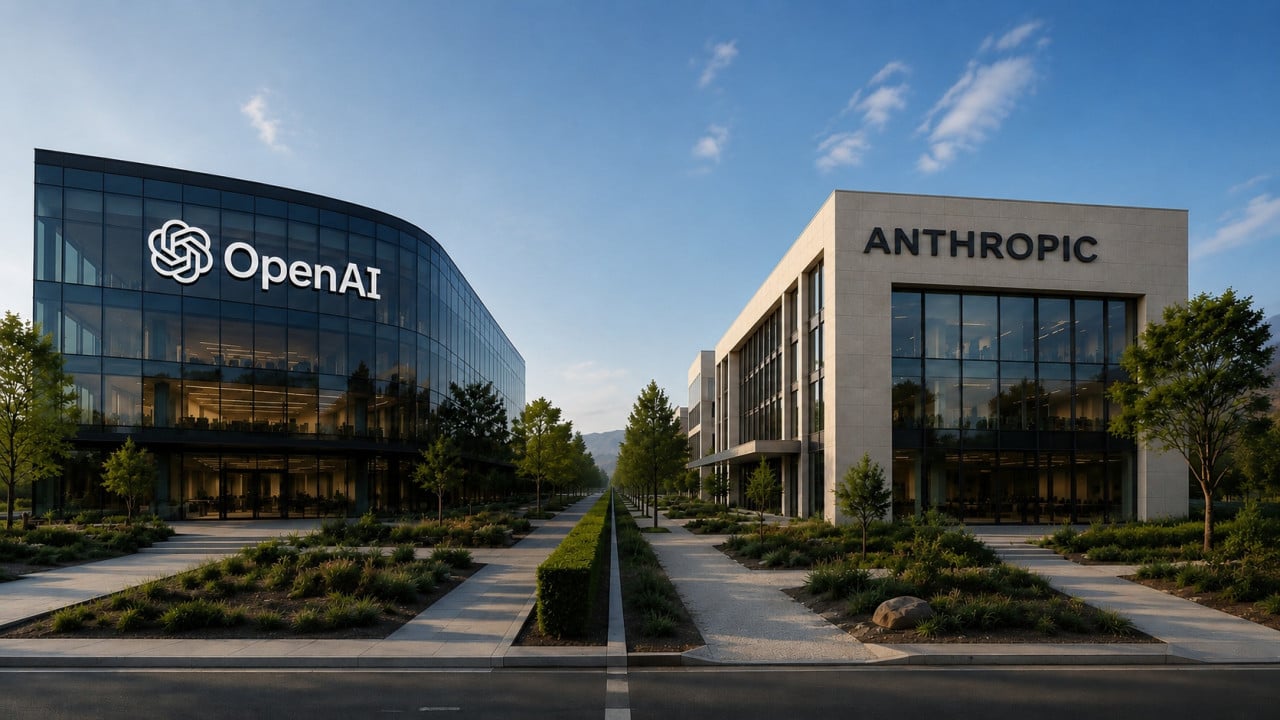
The two biggest rivals in the world of artificial intelligence are waging a war for customers, talent, and public attention. Their CEOs refused to shake hands at a business summit in India, where all the other technology company leaders symbolically joined hands. And yet OpenAI and Anthropic have one surprisingly strong connection: their investors.
Approximately 90 venture capital funds and asset managers have invested in both companies at the same time. OpenAI shares roughly 42 percent of its investors with Anthropic. And nearly a third of Anthropic's investors also hold a stake in OpenAI.
Rivals in the Market, Partners in the Portfolio
How is something like this possible? Venture capital funds traditionally back a single horse in a given category. The reason is simple: investors tend to have access to companies' internal information, sit on boards, and advise on strategic decisions. When someone holds stakes in direct competitors, awkward conflicts of interest arise.
But the artificial intelligence market operates by different rules. The two companies have raised more than one hundred billion dollars, and their valuations are approaching a trillion. With numbers like these, any single investor's stake is so small that virtually no conflict arises. “Investors traditionally wanted to back one company and turn it into the winner. But these companies are growing so quickly that this distinction has ceased to make sense,” says Kyle Stanford, director of venture capital research at PitchBook.
Tom Nicholas, a professor at Harvard Business School and the author of a book on the history of the investment industry, sees it as a clear signal. “Sophisticated investors simply do not know who will ultimately win. “Few people believe this will be a winner-takes-all market. And even if it is, no one knows who the winner will be,” Nicholas says.
It is the same as with Pepsi and Coca-Cola. Why wouldn't you want to own shares in both companies? Artificial intelligence is driving growth across every industry, and it would be a mistake to bet on just one company. Some investors ended up in this position unintentionally. Madrona Ventures wound up with stakes in both companies after OpenAI acquired one startup in its portfolio and Anthropic acquired another. Similar accidental overlaps will become more common as the artificial intelligence sector continues to fragment and startups change direction.
However, some fundamentally refuse to bet on both. Thrive Capital has backed only OpenAI, and its founder Joshua Kushner wrote on X last year: “Call us old-fashioned, but we are serial monogamists.” Menlo Ventures, meanwhile, has invested exclusively in Anthropic. Partner Matt Murphy says his fund always goes all in on its portfolio company and does not back direct competitors.
Who Will Go Public First?
Right now, both companies are preparing to go public, and it matters which one moves faster. Anthropic was the first to file confidential IPO documents, with the offering potentially taking place this fall. OpenAI, meanwhile, is in talks with banks about its own listing.
Why does the order matter? The market is open and receptive. Cerebras, a manufacturer of artificial intelligence chips, gained 68 percent on its first day of trading. Figma rose 250 percent last year. SpaceX is preparing for an IPO (initial public offering) with a target valuation of more than one and a half trillion dollars. Academic research has repeatedly shown that IPOs come in industry waves, and companies that go public later in the cycle generally perform worse. Stronger companies with more solid foundations go public first, followed by weaker successors.
So which one should you invest in? Analysts at Seeking Alpha tried to answer this question. The conclusion is not clear-cut. They see Anthropic as a slightly cleaner financial bet, with analysts expecting it could achieve an operating profit before OpenAI. OpenAI, on the other hand, has a stronger brand and greater potential as a platform.
Nevertheless, both companies face the same problem: high computing and token costs threaten enterprise adoption. Large companies are considering whether they would be better off building their own models. These are risks that going public will not eliminate, only make more visible. Moreover, OpenAI operated for years under an unusual legal structure that explicitly limited investor returns. Some funds therefore preferred to bet on Anthropic at the same time, where no such restrictions applied.
The Old World of Investors Is Changing
The overlap of investors between two direct competitors is unprecedented in the history of venture capital funds. The closest comparison is SoftBank, which invested heavily in ride-hailing services around the world a decade ago. But even SoftBank backed only Uber in the US, rather than also investing in Lyft, for example.
Another factor today is that funds have grown enormously and companies remain private much longer than they used to. The influx of money from hedge funds, private equity firms, and family offices has blurred the boundaries between investor types. Roughly thirty of OpenAI's and Anthropic's shared investors are hedge funds or private equity firms, for which spreading bets across multiple sides is standard practice. The rest are traditional investment funds, which are now looking over their shoulders and doing the same.
Sources: wsj.com and wired.com


