

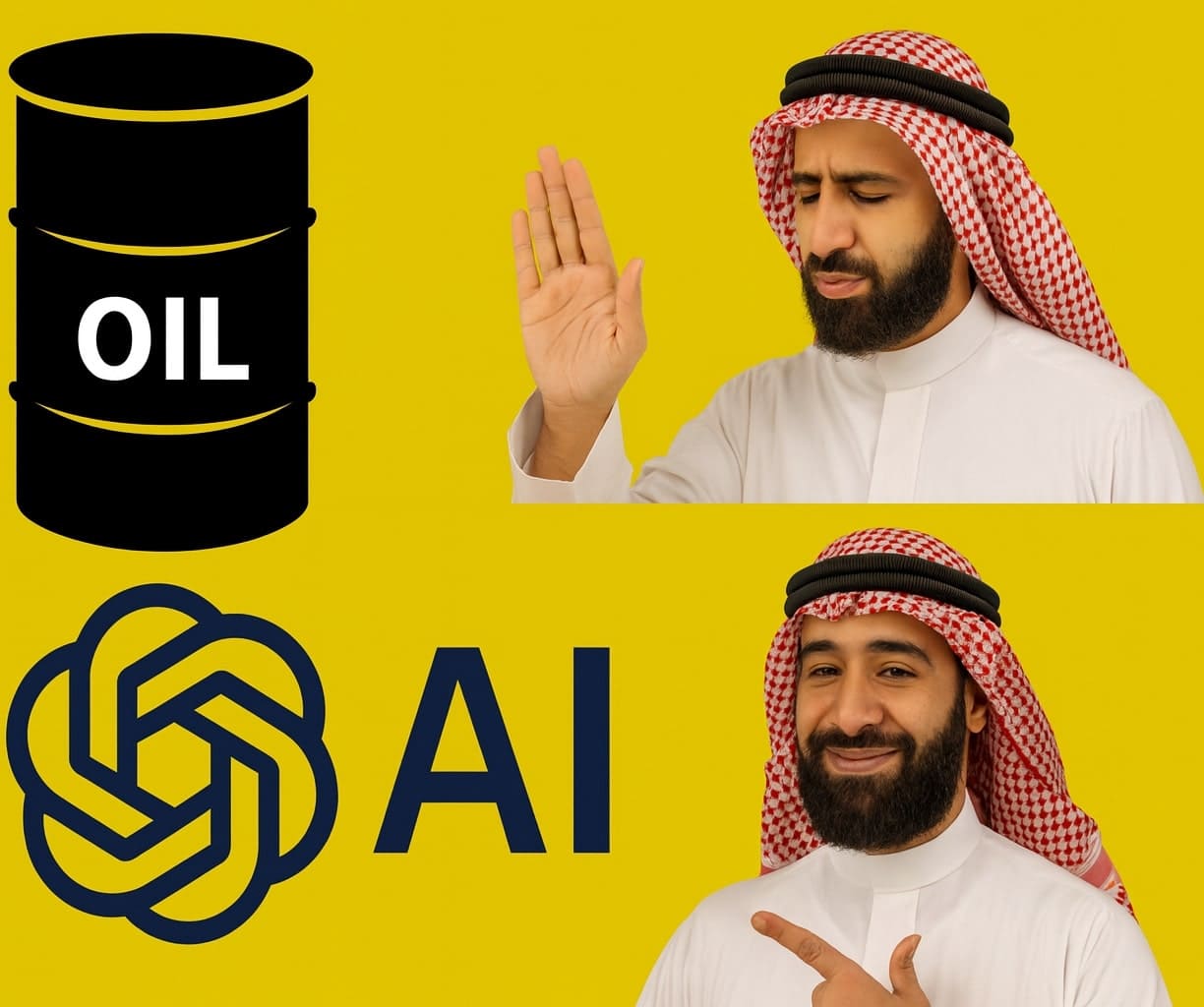
The Gulf Bets on AI as the New Oil
When people think of the Persian Gulf, most picture oil, wealth, and desert metropolises. But now something much bigger is happening here—a bet on artificial intelligence (AI), which could replace black gold as the main source of prosperity. Countries such as the United Arab Emirates (UAE) and Saudi Arabia are investing billions in the infrastructure that powers AI and are seeking to become global hubs for this technology. All of this is happening at a time when the world is looking for alternatives to fossil fuels.
Symbol of a New Alliance
Let's start with a key moment. When Donald Trump visited the United Arab Emirates this year, it was not just a diplomatic formality. The US president received a royal welcome, but the main item on the agenda was the announcement of a new AI campus—a joint project between the UAE and the US. This campus is described as the largest AI infrastructure project outside the United States. During the visit, Trump and UAE President Sheikh Mohamed bin Zayed Al Nahyan unveiled a 3D model of the facility.
This event was no coincidence. The White House eased restrictions on exports of the most advanced microchips made by US company Nvidia to the UAE and Saudi Arabia. This means that these countries can now obtain technology that is crucial for training powerful AI models. For the US, this means strengthening allies in a technology alliance, while for the Gulf, it is a path toward diversifying its economy beyond oil.
Data Centers
At the heart of these plans are data centers—vast complexes full of servers that process the enormous amounts of data needed for AI. In the UAE, this effort is being led by G42, a state-linked company that drives the country's AI ambitions. G42 is financing the multibillion-dollar "Stargate" project in Abu Dhabi, where data centers are being built for companies such as OpenAI. Nvidia will supply its most advanced chips, while giants such as Cisco, Oracle, and Japan's SoftBank will also participate.
Hassan Alnaqbi, CEO of Khazna—the UAE's largest data center operator, majority-owned by G42—compares it to the success of Emirates airline. "Just as Emirates turned the UAE into a global air transport hub, the UAE can now become a center for AI and data," says Alnaqbi. Khazna currently operates 29 data centers across the country and is building infrastructure specifically for Stargate. The Gulf's location between Asia and Europe provides an advantage in data transmission speed, which is crucial for AI.
Saudi Arabia is taking a similar approach. The Public Investment Fund (PIF) has launched the national AI company Humain, which plans to build "AI factories" with several hundred thousand Nvidia chips over the next five years. All of this shows how the Gulf views "computing power" (compute) as the new oil. As Mohammed Soliman of the Middle East Institute in Washington, DC, says: "Compute is the new oil." By this, he means the enormous processing capacity provided by data centers, much as oil powered the industrial era.
Geopolitics
Although money is flowing freely, not everything is easy. Attracting top AI talent is a major challenge. The UAE offers low taxes, long-term "golden visas," and looser regulations to attract companies and researchers from abroad. Baghdad Gherras, founder of an AI startup in the UAE, says: "Building world-class AI infrastructure will be like a magnet." But the region has yet to create a globally recognized AI company such as OpenAI or Mistral, and it lacks a deep pool of researchers. The UAE's small population—just over 11 million—limits the development of a large research ecosystem.
Geopolitics also plays a role. The Gulf's rise in AI is fueling tensions between the US and China. The UAE has scaled back some projects with China, such as cooperation with Huawei, in order to move closer to the US. Trump's visit shows that AI is now part of American diplomacy. Soliman sees it as an attempt by the US to draw the Gulf into the "American AI stack"—the entire chain from chips to software controlled by American companies. Gherras adds: "The Americans are ahead in AI, so it made sense for the UAE to bet on them."
According to Reuters reports, the Stargate project is awaiting security clearance from the US due to concerns about Chinese influence, but it is expected to be approved. While the US is in the lead, Soliman warns against underestimating China: "They have their own AI stack, which is cheaper, and for many countries, 'good enough' is sufficient."
Related Trends
Looking further ahead, AI is not just about infrastructure—it is also changing creativity and productivity. AI increases efficiency by taking on repetitive tasks, allowing people to focus on original ideas. In creative fields such as design or writing, AI generates content faster, but it still needs human intuition for true originality. Risks include job losses in some professions where AI analyzes patterns and creates aesthetically high-quality outputs.
Ethical questions are on the table: authorship, originality, and privacy. AI already creates images, music, and videos, expanding possibilities while challenging the boundaries between humans and machines. In the context of the Gulf, this means that investments in AI could lead to new forms of collaboration in which technology enhances human creativity rather than replacing it.


