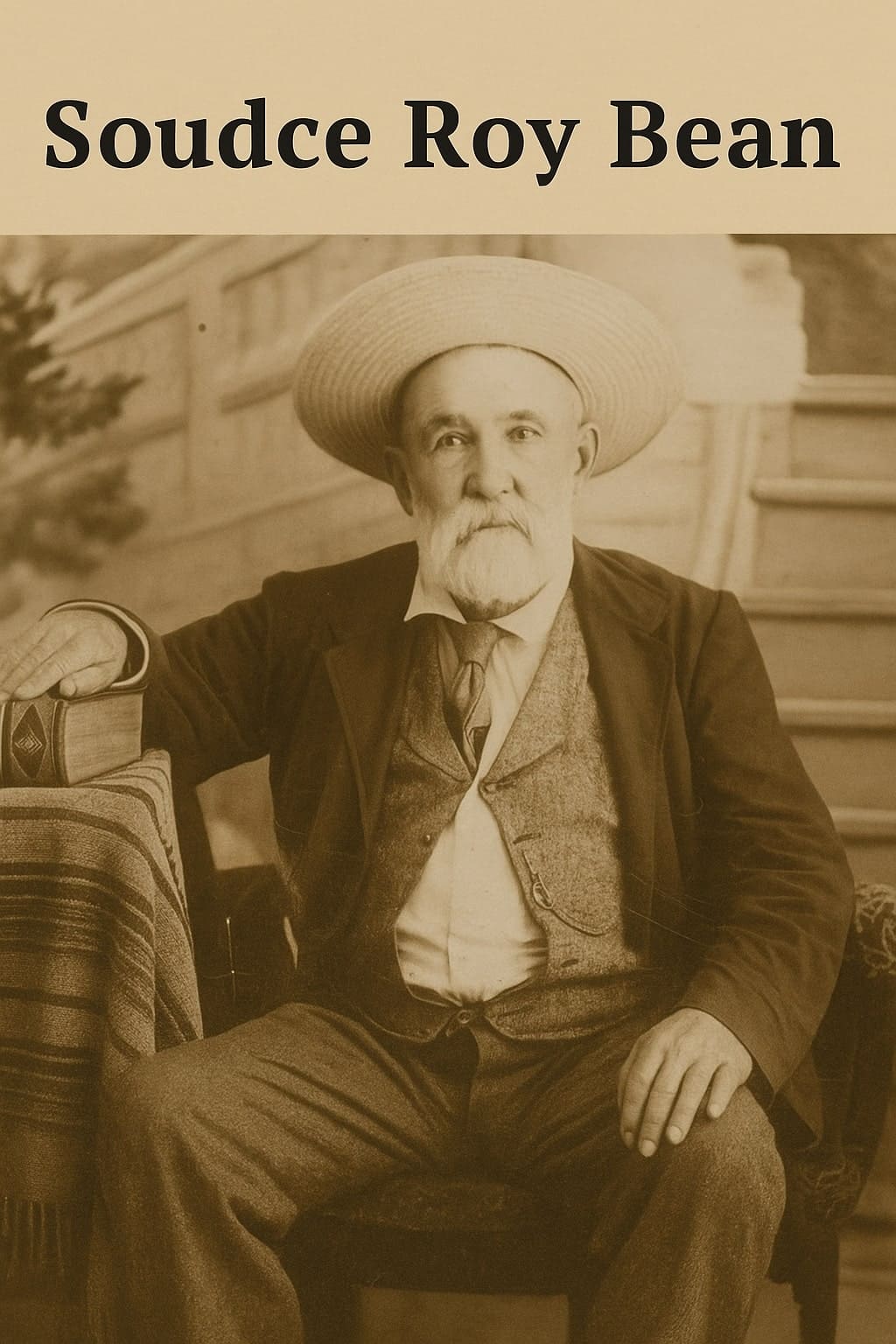
Texas has given the world many colorful characters, but none was as colorful as the multifaceted Judge Roy Bean. He crammed a host of flamboyant roles into a single lifetime. In fact, he did not become the famous Judge Roy Bean, portrayed by Paul Newman on the silver screen, until after middle age. This confirms my favorite saying: "The greatest mistake in life is thinking it's too late." (The greatest mistake in life is thinking it is too late.)
He was born in Kentucky (accounts of his birth date vary from 1825 to 1835), and as a young man he was restless, moving from New Mexico to Mexico, then to California (San Diego and later San Gabriel), and back to New Mexico in the mid-19th century, often following one of his older brothers. Wherever he went, he usually ended up having to move on because of run-ins with the law, narrow escapes, or other troubles. During the Civil War, he eventually settled in a poor San Antonio neighborhood around South Flores Street, where he continued to build his notoriety. His dubious schemes and exploits frequently appeared in the newspapers, as a recent article in the San Antonio Express News reports, with one headline referring to him as "Scoundrel Bean." (Scoundrel Bean.) Eventually, the neighborhood was named after him: It was called Beanville. Hispanics called him Frijoles. He soon abandoned his first name, Phantly, and used his middle name, Roy.
In San Antonio, Roy and his brother Sam ran a freight-hauling business (including weapons from Mexico for the Confederate Army). Roy married a teenage girl, and they began having children; according to some accounts, he was arrested for assaulting his wife a year after the wedding. To supplement his modest freight business – one customer described his team and wagons as "the sorriest I ever saw" – he tried and failed at many things. He failed at selling timber because he cut down trees that did not belong to him. He failed as a butcher because slaughtering other people's unbranded cattle before buying them is not considered proper. He failed at selling milk because he diluted it with water. One apocryphal story tells how a customer complained that he had found a minnow (a small freshwater fish) in the milk, and Bean defended himself by saying: "That's the last time I let that cow drink out of the creek before I milk her." (That is the last time I let that cow drink from the creek before milking her.) He opened a saloon in Beanville, but when he heard about the rare opportunities in West Texas, where the transcontinental railroad was being built, he sold everything and headed there to try his luck, leaving his divorced wife and children behind. Most accounts agree that his more respectable neighbors encouraged his departure.
It was in the lawless railroad camps along the Pecos River that Bean's extensive knowledge of people, his fluency in both Spanish and English, and his unique powers of persuasion proved very useful. Bean set up a makeshift tent saloon in one of the camps that sprang up as the tracks advanced, at a place called Vinegarroon. The Texas Rangers needed a justice of the peace to tame the violent and more dubious elements that had gathered around the rough railroad camps; Bean needed a livelihood. The Rangers, themselves known for making their own laws, liked his style. In 1882, the Pecos County commissioners officially appointed him justice of the peace in those parts. He took to the role as though he had been sent there by central casting. Bean made it known that he was the "Law West of the Pecos." (The law west of the Pecos.) In fact, he was paraphrasing an older saying that went: "West of the Pecos there is no law; west of El Paso, there is no God." (West of the Pecos there is no law; west of El Paso, there is no God.) So now, at least west of the Pecos, there was "law." He settled in another tent town on the Rio Grande, in Langtry, and put up a sign bearing this designation (along with a sign offering cold beer).
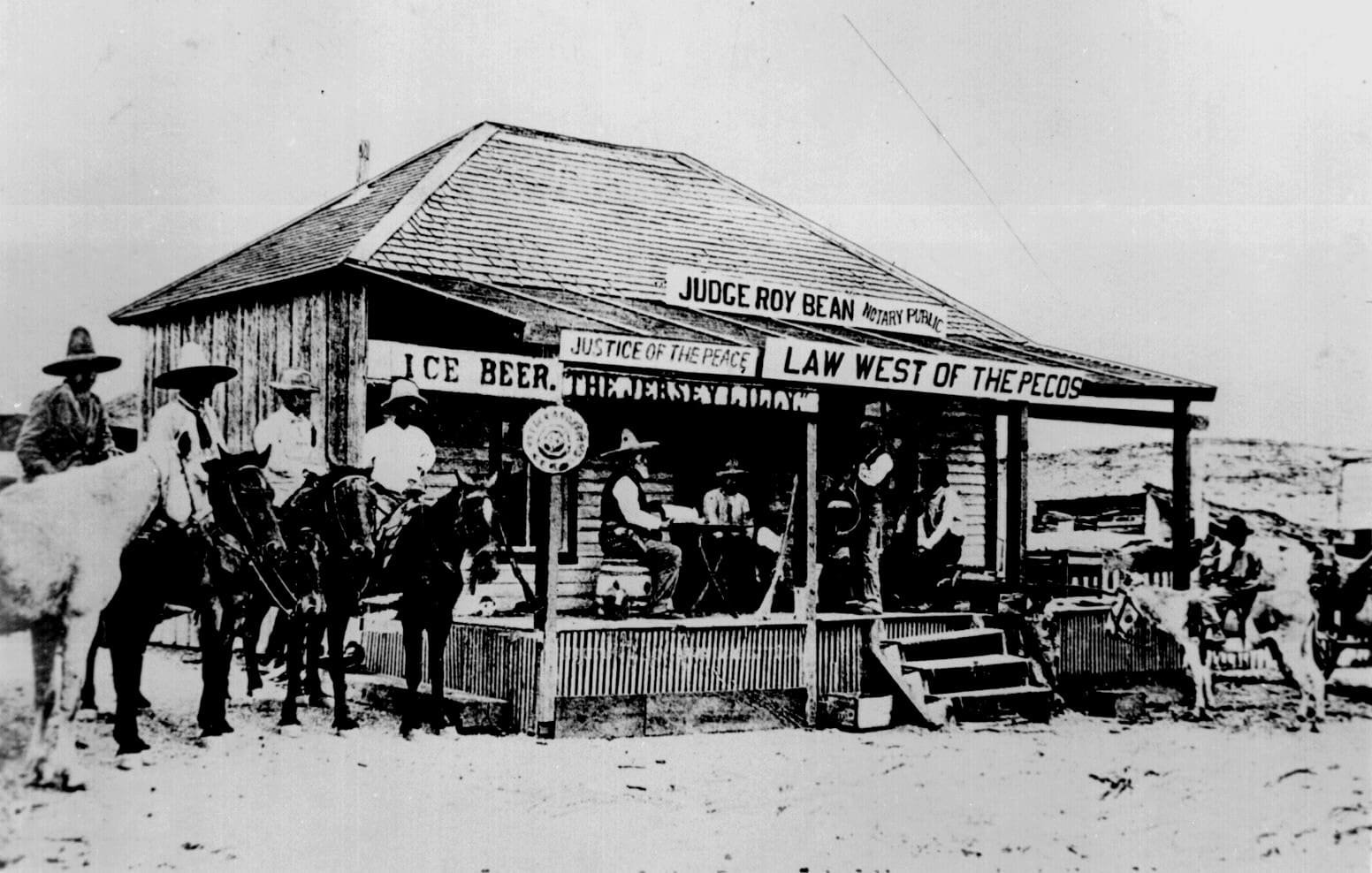
Bean was also famous for saying, "Hang 'em first and try 'em later." (Hang them first and try them later.) Although this surely worked as a deterrent, it seems likely that he was never responsible for an actual hanging. In his meticulously researched history Judge Roy Bean Country, Jack Skiles writes that "there is no evidence to suggest that Judge Roy Bean ever had anyone hanged."
There was no jail in Langtry, so Judge Bean often kept accused criminals chained to a mesquite tree outside until he could hold court. Most cases were settled with fines, which often ended up in Bean's pocket. According to Texas historian C. L. Sonnichsen, in several cases he would sentence a young man to hang for some offense that was not generally punishable by hanging. On the night before the execution, as recounted in Sonnichsen's book Roy Bean: Law West of the Pecos, Bean left the lock open, allowing the prisoner to escape. The young criminal would then never appear in those parts again.
Bean's famous saloon in Langtry stood on railroad property. Technically, it was merely squatting there, but the railroad eventually entered into a legal agreement allowing it to remain. He named his saloon the Jersey Lilly in honor of the English actress Lillie Langtry, who was considered one of the most beautiful women in the world and was known by the nickname "Jersey Lily" (The Lily of Jersey). The infatuated Bean once wrote to her and asked her to visit Langtry, Texas, which was supposedly named after her (it was probably named after a railroad engineer). According to the story, she replied that she could not come at the time, but would be happy to donate a drinking fountain to the town. He declined her offer, saying that the people of Langtry did not drink water. Lillie Langtry eventually did visit Judge Roy Bean, but she had to visit his grave. She arrived 10 months too late.
Stories of Bean's bizarre interpretations of his office are legendary. Bean cleverly placed his saloon right next to the station in Langtry, where trains stopped to take on water. Many passengers would get off to have a drink at the Jersey Lilly. When Judge Roy Bean served customers, he never had change. So if a customer paid a dollar for a 25-cent beer, he did not get 75 cents back. If he complained, the judge fined him 75 cents for disturbing the peace.
As stories about the judge spread, more and more train passengers wanted to stop and be harassed by the hot-tempered Bean. It was a little like the prestige of being insulted by the "Soup Nazi" on Seinfeld or the popularity of the Dick's Last Resort chain of bars/restaurants, which became famous for having its staff insult customers.
The Jersey Lilly was also where Bean held court. So naturally, according to legend, you could not serve on the jury unless you were drinking. Right in the middle of "happy hour," as one might call it, he assembled a jury and swore it in. The case was presented, the verdict delivered, and the sentence pronounced, all within an hour or two. The punishment for offenses often consisted of having to buy a round of drinks for the jury. Bean was also intensely patriotic toward Texas, according to Sonnichsen. Before passing sentence, he often said words such as: "You have offended the great State of Texas by committing this crime on her sacred soil ..." (You have offended the great State of Texas by committing this crime on its sacred soil ...)
Bean's only law book was the 1879 Revised Statutes of Texas. He liked it. Although the Texas legislature sent him updated new books every two years, legend has it that he burned them. Even though he used it more as a seat than as a reference, he said that he preferred the old book and the old laws as well.
As a justice of the peace, he could marry people. He had no legal right to divorce them, but he did so anyway, as Sonnichsen's book recounts: He believed that if he had made a mistake by marrying them, he should have the right to correct that mistake and set them free. Bean also officially declared people dead. Sometimes he combined his wedding and funeral rituals. He used his official declaration of death as the closing words at weddings: "I pronounce you man and wife. May God have mercy on your souls." (I pronounce you husband and wife. May God have mercy on your souls.)
One of his most famous cases involved a dead man who had fallen from a bridge. According to the story, Bean found $40 and a pistol on the body. He fined the corpse $40 for carrying a concealed weapon.
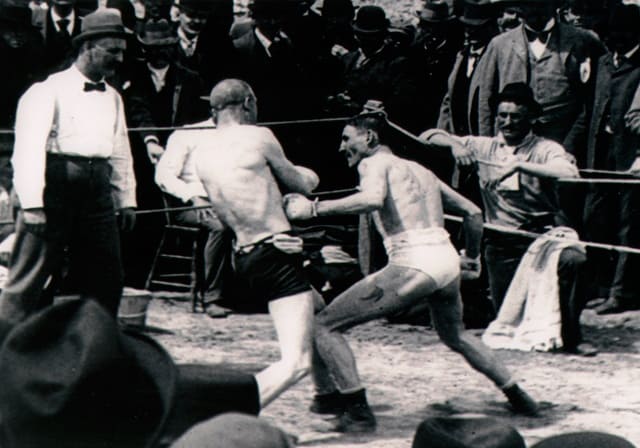
Bean gained international attention through his involvement in the boxing match between Bob Fitzsimmons and Peter Maher, which was promoted as the 1896 world heavyweight championship. Boxing had been declared illegal in Texas at the time. The sport was only beginning to become organized, and a promoter from Dallas arranged the match.
Fans in El Paso raised a substantial sum with the idea of holding the match either in their city or across the river in Juárez, so the governor of Texas, who was fiercely opposed to boxing, sent Texas Rangers and other law enforcement officers to the border city to ensure that it did not happen. Such matches were also illegal in Mexico, though only as a misdemeanor. Nevertheless, because of all the commotion over the possible match, the governor of the state of Chihuahua sent troops to Juárez as well.
Finally, Roy Bean, always alert to such opportunities, entered the picture. He sent the promoter a telegram saying that he could hold the match near Langtry, on a sandbar in the Rio Grande between two jurisdictions. Even if the sandbar was closer to the Mexican side of the river, it was still a mile away from any Mexican authority that might stop it. The location of the match naturally had to remain secret so that the authorities could not send reinforcements. And so the whole group of unlikely companions – boxers, gamblers, wealthy Easterners, Texas Rangers, and spectators of every kind – boarded a train bound for parts unknown. Bean welcomed them at his saloon by the tracks, sold everyone beer at the exorbitant price of a dollar apiece, and then escorted them across a pontoon bridge to the sandbar. The Texas Rangers watched from the Texas side, satisfied that they had no jurisdiction. The match began, and before the spectators had properly settled in for a long fight, it was over. Fitzsimmons knocked Maher out in the first round. The match lasted 95 seconds. But the big winner was Judge Roy Bean. He sold plenty of beer, and his name traveled over telegraph wires around the world as the clever man who had made the match possible.
Roy Bean lived his life on a constant upward trajectory, going from a small-time swindler and boisterous man of local notoriety to a folk legend in his later years. Had he died 20 years earlier, in 1883 instead of 1903, you would never have heard of him. His fame still draws about 40,000 visitors a year to Langtry, more than a century after his death. That is not a bad figure for a dead man. You can be sure that, as a lifelong showman, he is smiling in his grave.
FOR FURTHER READING: Roy Bean: Law West of the Pecos, by C. L. Sonnichsen; Judge Roy Bean Country, by Jack Skiles.