

AlphaGenome: The AI Model Uncovering the Secrets of Human DNA
Humanity uncovered the secrets of heredity more than 70 years ago. Yet even today, 98% of DNA remains a mystery whose significance we cannot precisely describe. However, this may now change. Last month, Google DeepMind introduced a new AI model called AlphaGenome, which is designed to help scientists better understand human DNA.
What Is AlphaGenome?
Human DNA is a vast library of information containing more than 3 billion letters of genetic code. Most genetic information lies outside genes, within the 98% known as “dark matter,” which controls their behavior and whose functions are still not fully understood. These extensive sections of non-coding DNA are crucial for understanding genetic disorders and diseases such as cancer, cystic fibrosis, and muscular atrophy.
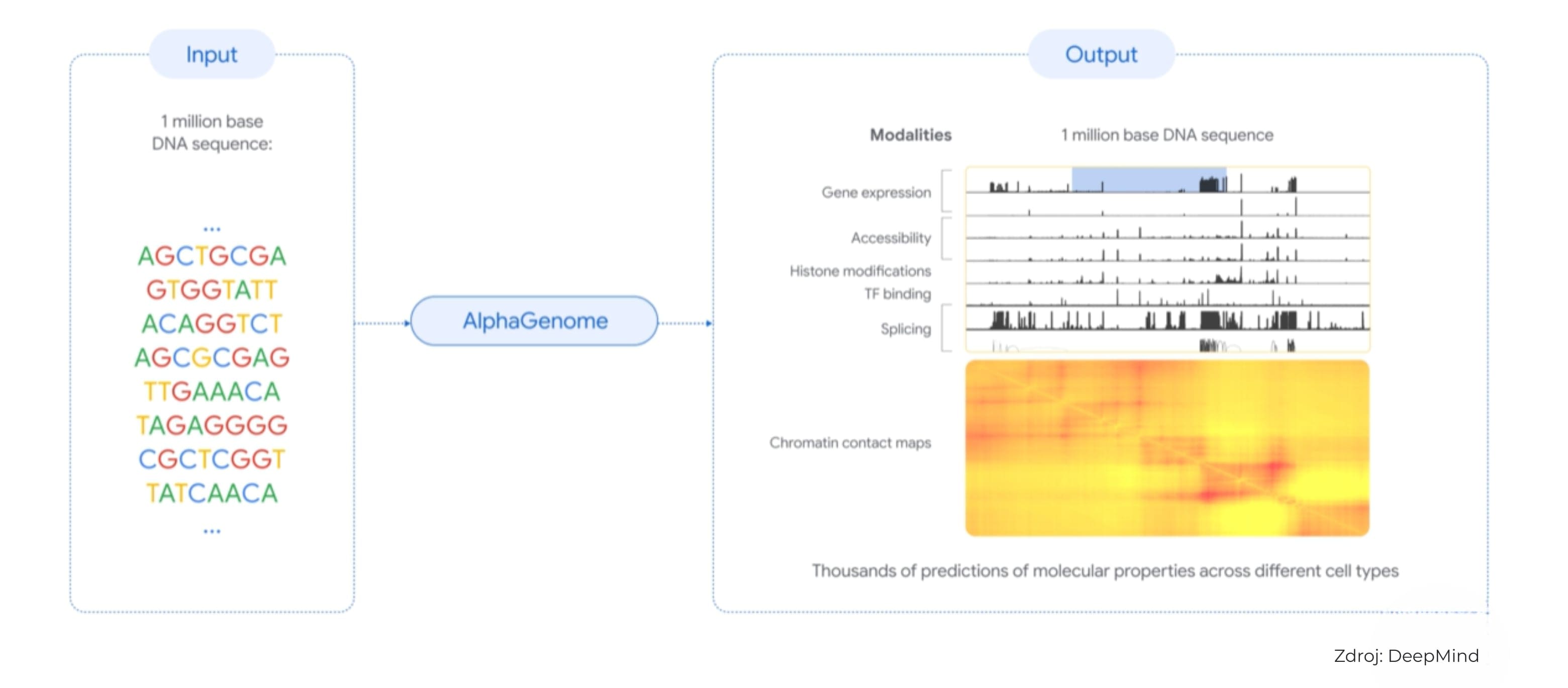
However, the AI model AlphaGenome can now analyze this non-coding DNA and predict from very long sequences how a gene will behave or how a particular change may affect its function.
How AlphaGenome Works
AlphaGenome uses machine learning principles and can identify patterns in both short DNA sequences and broader relationships across the entire genome. It can therefore analyze up to 1 million DNA letters at once, with single-letter resolution. By recognizing both fine details and the broader context, it can cover regions separated by great distances and identify relationships that we would not ordinarily see.
For these purposes, the model was trained on extensive biological databases such as ENCODE and GTEx. These contain the results of experimental measurements of gene regulation in both human and mouse cells and tissues. This gives AlphaGenome enough information to work with and to compare its results with further observations.
What Understanding the Genome Will Bring
The greatest and most significant benefit is that AlphaGenome can determine very quickly and accurately what will happen when a particular genetic mutation occurs. In practice, this means that the AI model can identify the genetic causes of diseases, allowing doctors to respond promptly and appropriately.
Scientists will therefore be able to investigate how changes in non-coding DNA are linked to the development of common diseases as well as rarer genetic disorders. This will make it possible to develop new and effective medicines and design appropriate treatments.
Another breakthrough is that AlphaGenome can produce in a single second predictions that would previously have taken a very long time. This will improve the accuracy and speed of diagnosis for a wide range of genetic diseases and changes.
The Beginning of Major Research
AlphaGenome is new, and it is certainly not a tool that could reveal during an initial medical examination what a patient is suffering from and how to proceed with their diagnosis. It is primarily intended for mapping the human genome and scientific research, which is crucial for progress in medicine.
For this very reason, DeepMind released it as an API for non-commercial use, making its new AI available to scientists around the world. Thanks to AlphaGenome, we are now on the verge of understanding unknown regions of DNA and the functions and behavior of the human genome.
Source: DeepMind, Scientific American, EM360 Tech, Science.org


