I had always wanted to visit the part of Miami called Little Havana. I had thought about it several times during previous visits to Miami – various online tutorials and Miami guidebooks frequently mention Little Havana. It looked great in the photos, but on two or three occasions it didn't work out because we ran out of time. We were flying on to Orlando or Sarasota, and there simply wasn't enough time to get there.
And this time, it finally worked out.
I brought it up while we were at the Epic Webinar Summit conference with my business partner and associate, Štěpán. We agreed that on the final day after the conference, before I flew to Dallas, we would go out for dinner together – along with his wife, Anetka – in Little Havana. They had already been there, but I hadn't. And apparently, it's good.
What is Little Havana, and why is it so special?
Little Havana is a neighborhood located west of downtown Miami, and its story is inextricably linked to the Cuban Revolution. Before it became a Cuban enclave, it was a quiet middle-class neighborhood inhabited primarily by a Jewish community. But that changed dramatically after 1959, when Fidel Castro took power in Cuba.
Cuba lies only about 400 kilometers across the sea from Miami, so Florida became a natural refuge for hundreds of thousands of Cuban exiles fleeing the communist regime. The U.S. government accepted them as political refugees and processed their cases in the building known as the Freedom Tower in downtown Miami. Gradually, Cuban immigrants began settling west of downtown around SW 8th Street – now the famous Calle Ocho – and the neighborhood acquired its new name: La Pequeña Habana, or Little Havana.
During the 1960s, further waves of refugees arrived, especially after the failed Bay of Pigs invasion (Bahía de Cochinos in Spanish) in 1961, which showed that returning to Cuba would not happen as quickly as many had hoped. Cubans began settling here permanently, opening restaurants, cafés, cigar shops, and bakeries. Spanish signs appeared in shop windows, salsa and son began flowing out of doorways, and the air filled with the aroma of Cuban coffee and fresh bread.
For those who don't know what the Bay of Pigs (Bahía de Cochinos in Spanish) is – it is a bay on Cuba's southern coast that became a symbol of one of the best-known episodes of the Cold War.
In April 1961, a failed military invasion took place there, when approximately 1,400 Cuban exiles – armed and trained by the American CIA – attempted to overthrow Castro's regime. The entire operation ended in catastrophic failure within three days. Castro's army defeated the attackers, captured most of them, and caused the United States enormous international embarrassment.
For Miami's Cuban community, it was a turning point – it became clear that a quick return to Cuba would not be possible, so the exiles began settling permanently in Little Havana. That is why I mention it in this article in the context of the neighborhood's growth.
Today, Little Havana is considered the cultural and political center of the Cuban diaspora throughout the United States. In 2017, the National Trust for Historic Preservation designated it an American “National Treasure.” The neighborhood is home to approximately 50,000 residents, and in addition to Cubans, it now includes communities from Nicaragua, Honduras, and other Latin American countries.
Among the best-known places is Domino Park (officially Máximo Gómez Park), where older Cuban gentlemen drink coffee, smoke cigars, and play dominoes every day – just as they did back home in Havana. There is also the Calle Ocho Walk of Fame, featuring stars dedicated to famous Latin personalities such as Celia Cruz, Gloria Estefan, and Julio Iglesias, as well as Cuban Memorial Boulevard, with its memorial to the Bay of Pigs invasion.
Every year, the Calle Ocho Festival takes place here. It is one of the world's largest street festivals and attracts more than a million visitors. Reggaeton, salsa, bachata, and merengue fill the streets, flags from across Latin America fly overhead, and the air is scented with Caribbean specialties.
Old's Havana Cuban Bar & Cocina – a restaurant that lived up to the hype
Based on the reviews, I found a restaurant called Old's Havana Cuban Bar & Cocina – and the reviews definitely weren't lying. It has a 4.8 rating on Google from almost 23,000 reviews, which speaks for itself.
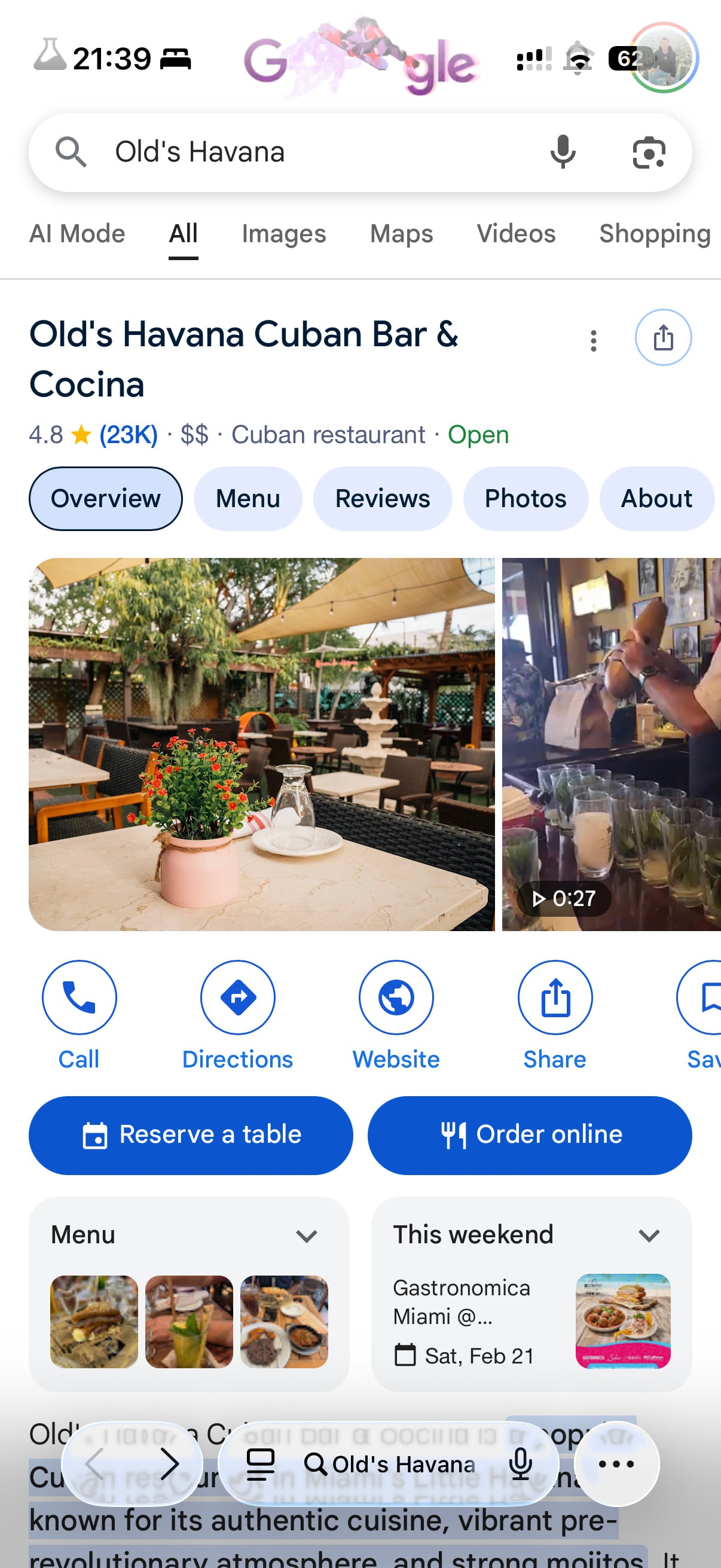
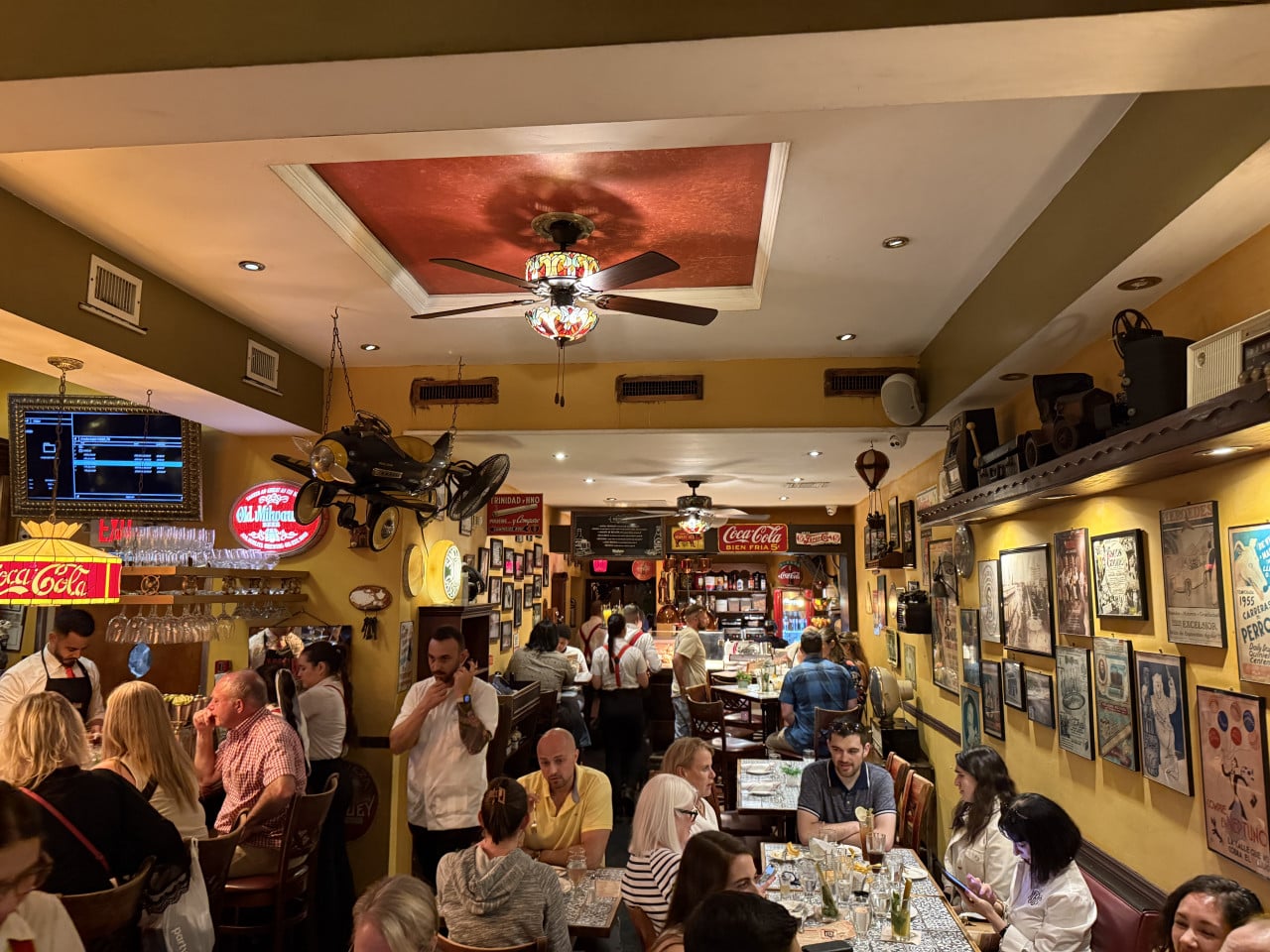
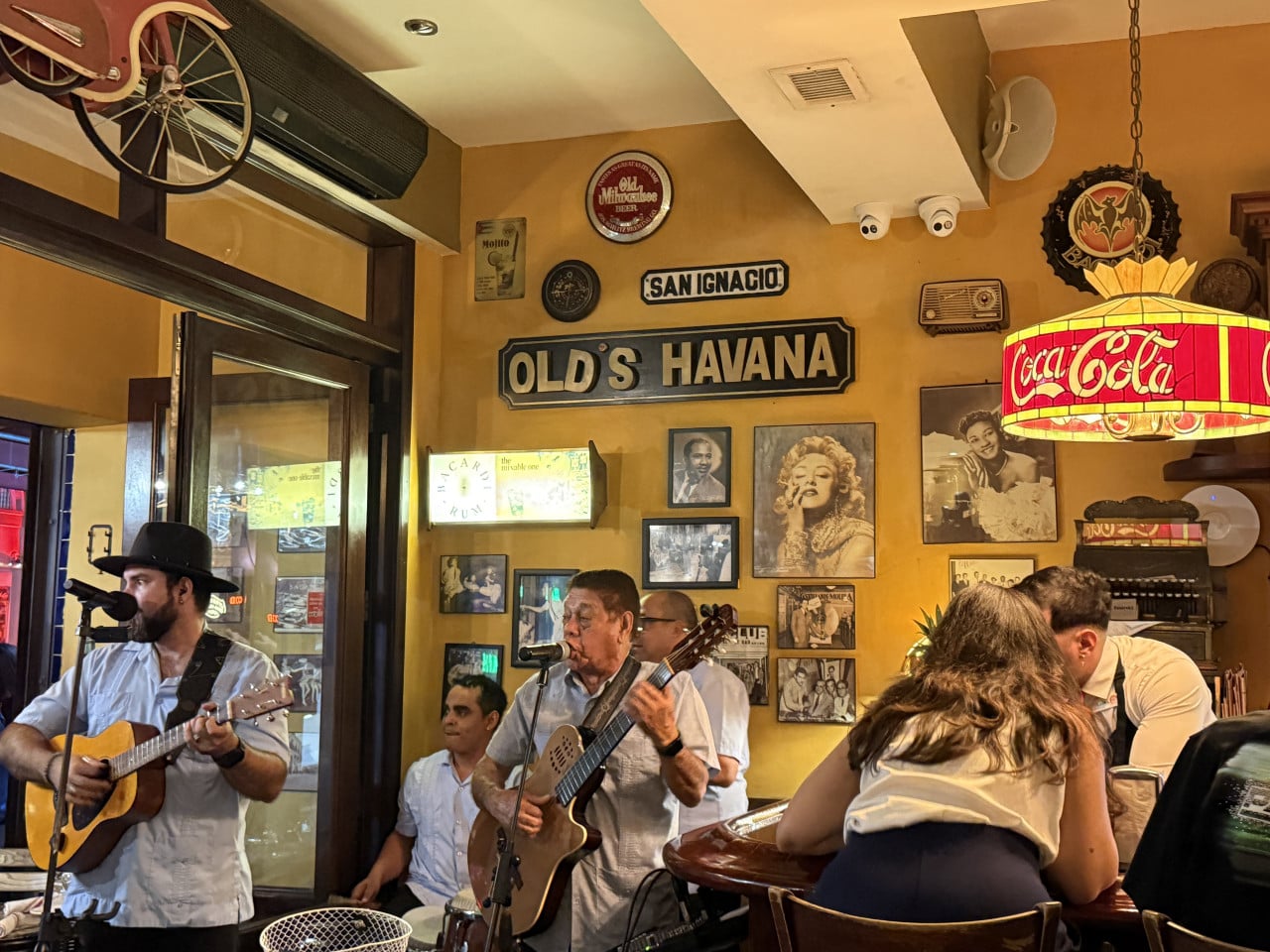
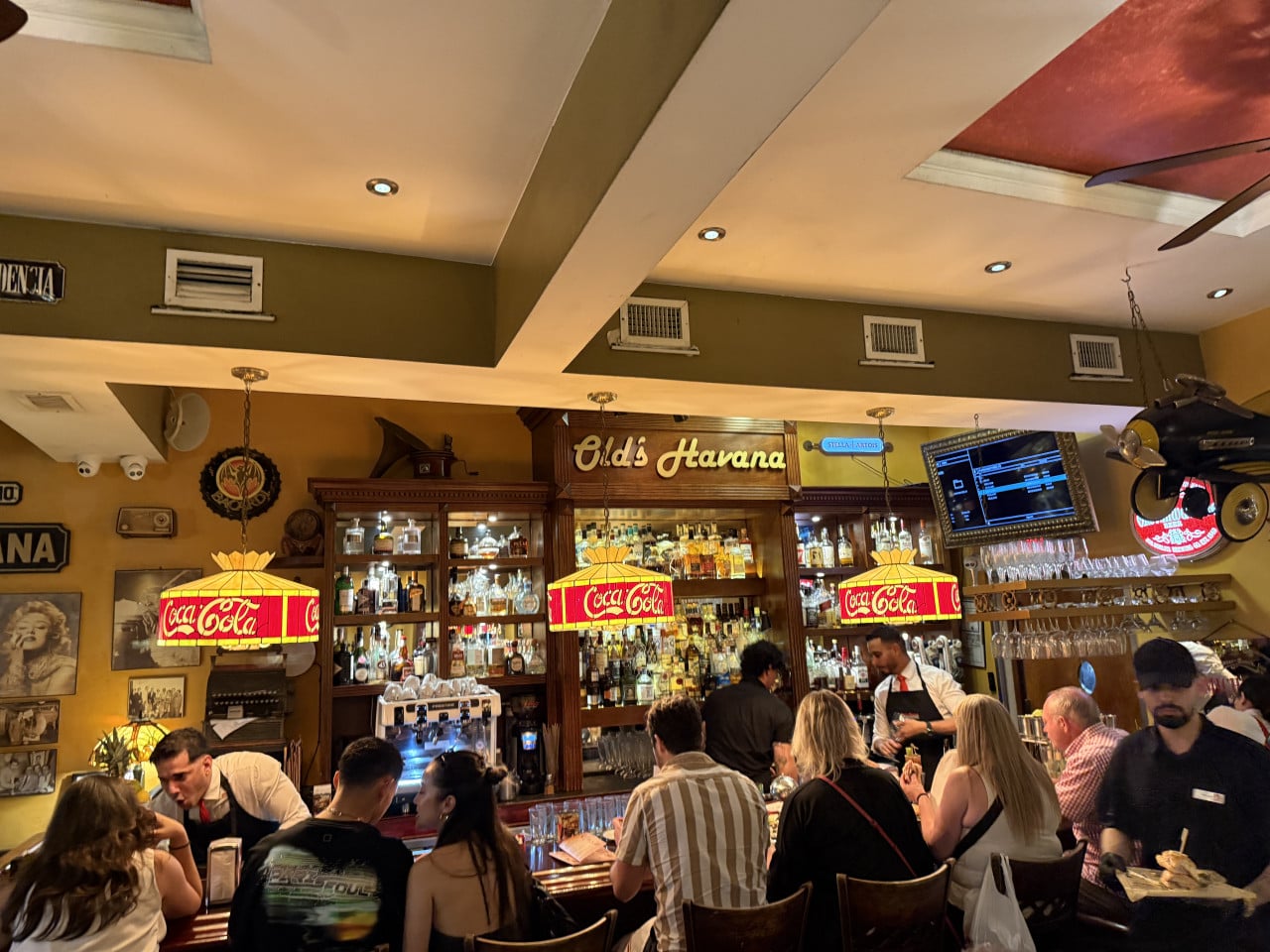
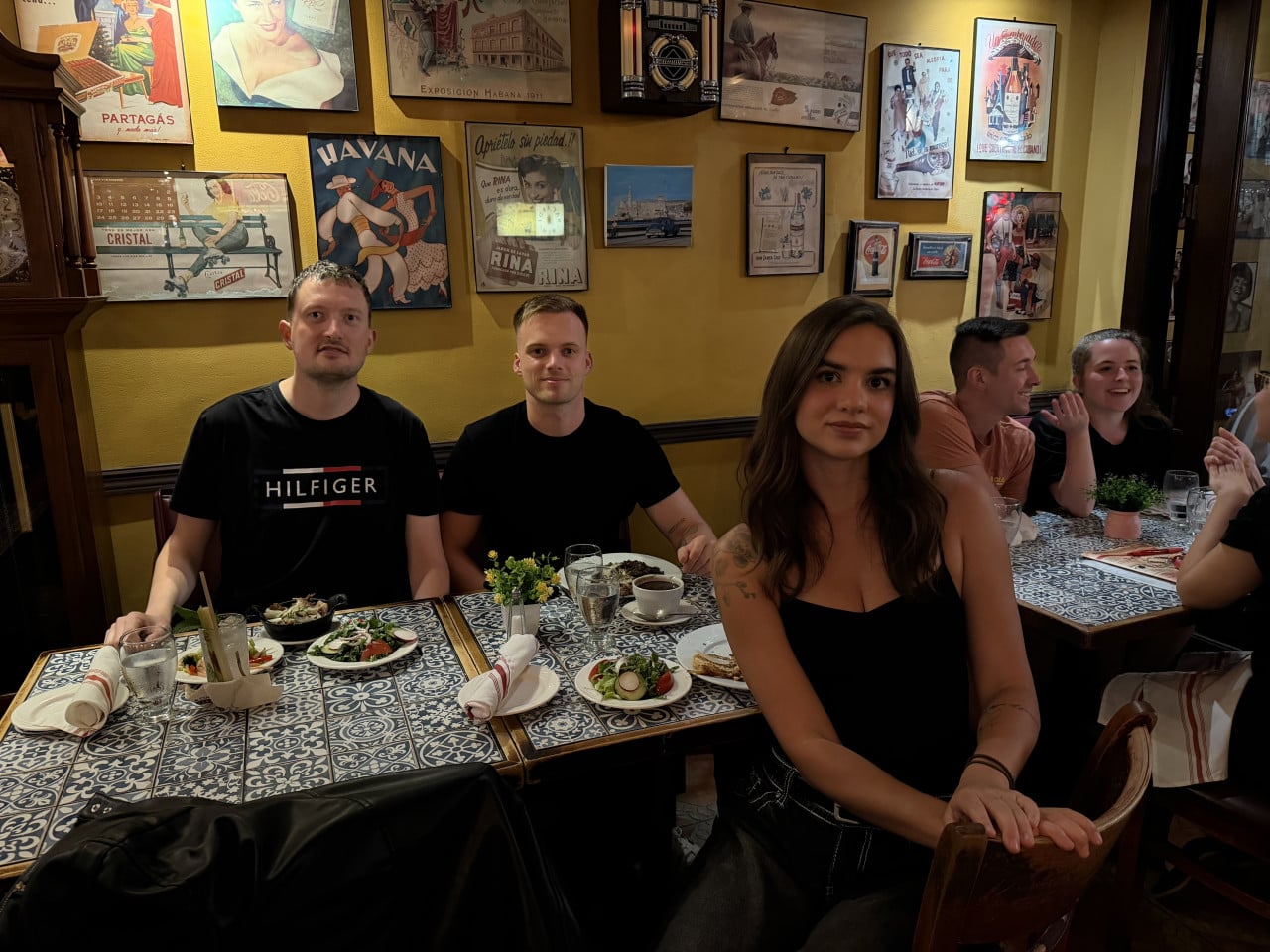
The restaurant has been operating since 2010 and is located directly on Calle Ocho. When you enter, there is a bar at the front with an authentic Cuban atmosphere – old signs, retro Coca-Cola advertisements, historic photographs, and Cuban posters hang everywhere. A model airplane hangs from the ceiling, neon signs glow on the walls, and a ceiling fan with stained glass spins overhead. It's like stepping into 1950s Havana.
Behind the bar is the first section of the restaurant, and then you can continue farther back to a second, larger section. A live Cuban band was playing there, which added a completely different dimension to the whole experience.
What to order: the menu and typical Cuban dishes
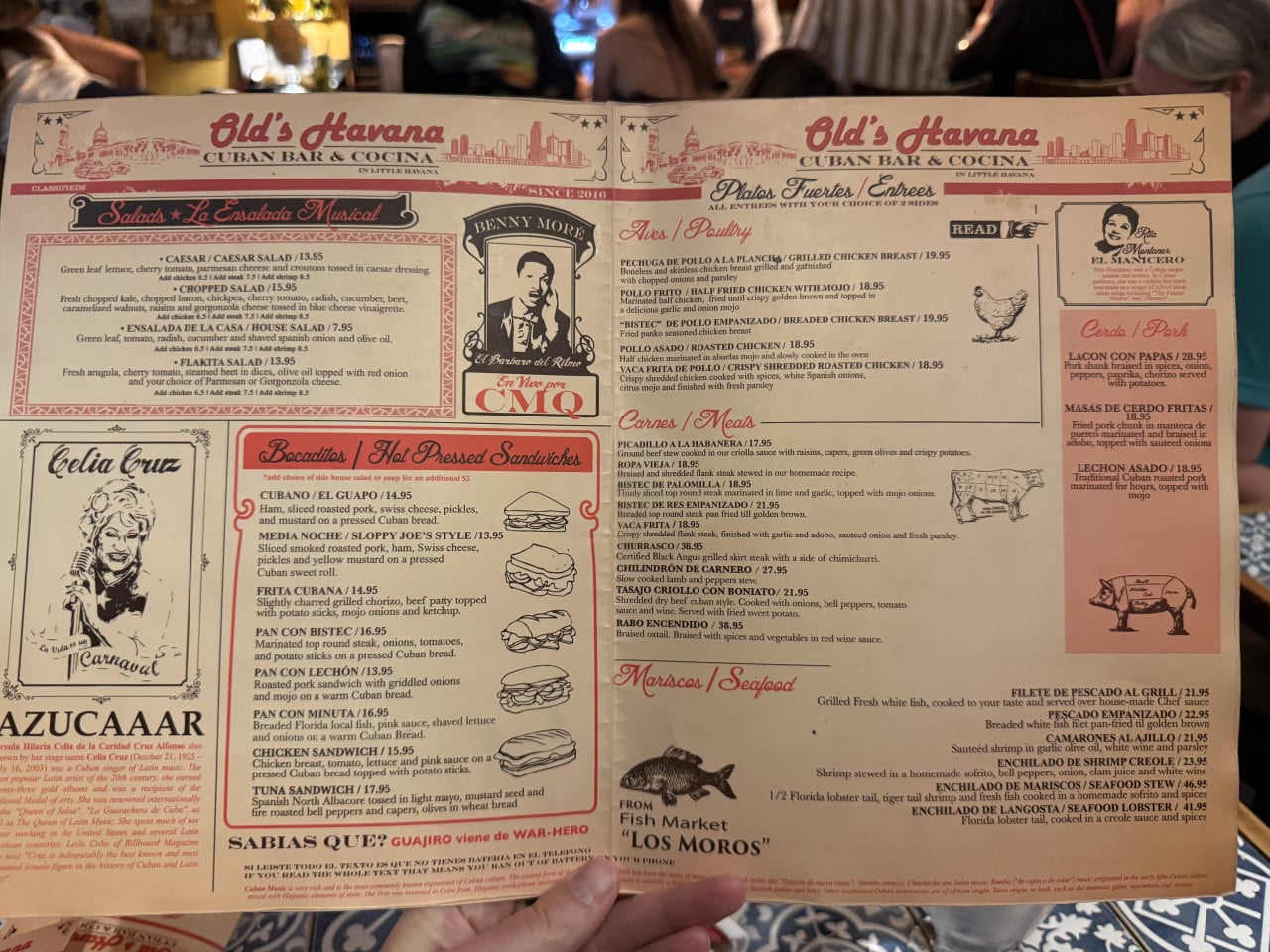
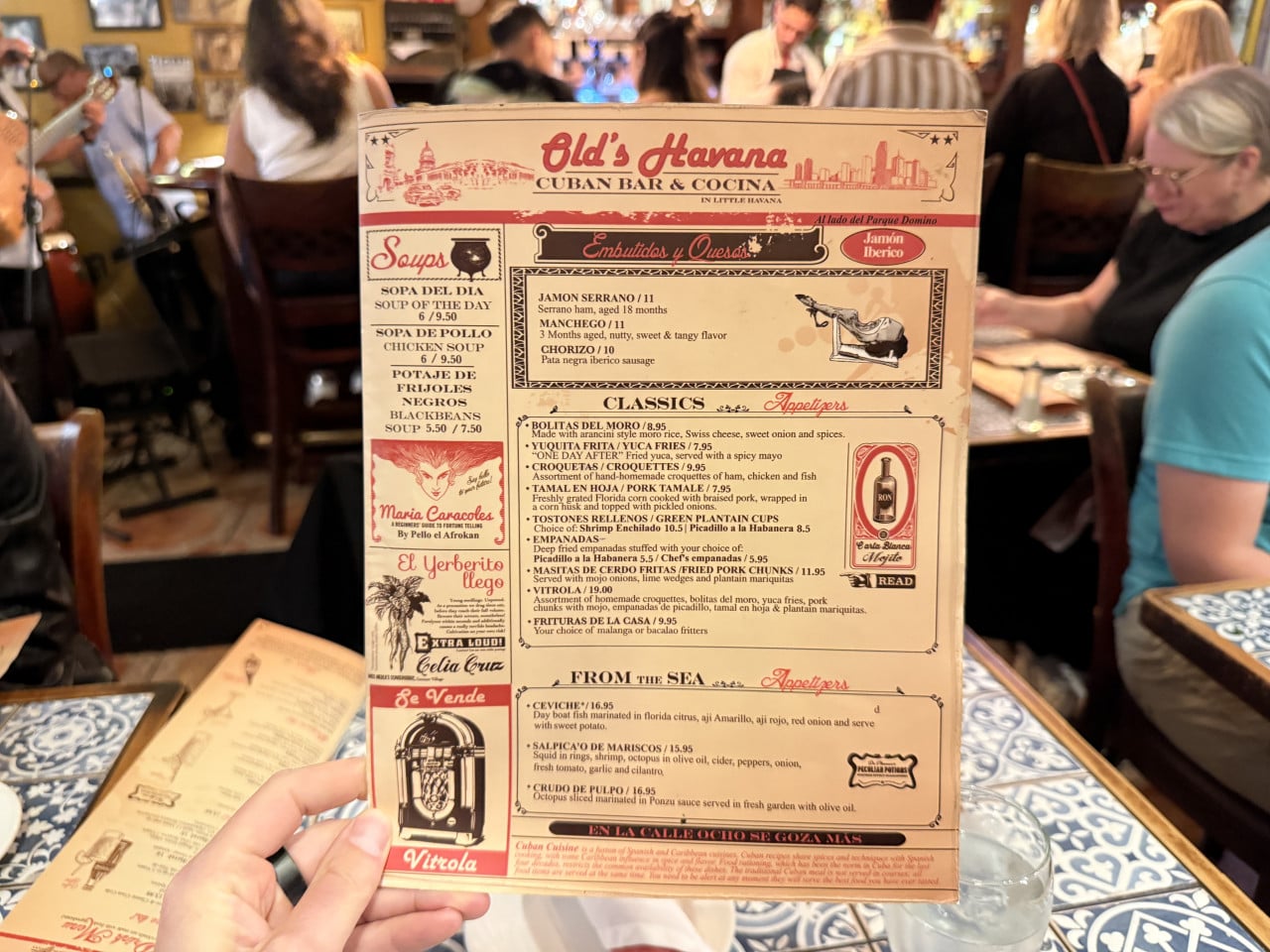
The menu is truly extensive and offers authentic Cuban cuisine. Based on what I saw on the menu, here is an overview of what you can try:
Appetizers: Croquetas – homemade ham, chicken, and fish croquettes for $9.95. Yuquita Frita – fried yuca with spicy mayonnaise for $7.95. Empanadas with various fillings for $5.50–$5.95. Or you can go straight for the Vitrola for $19.00, which is a mix of everything – croquettes, bolitas del moro, yuca fries, pieces of pork, and plantain chips.
Soups: Sopa de Pollo (chicken soup) for $6/$9.50 or Potaje de Frijoles Negros (black bean soup) for $5.50/$7.50.
Sandwiches (Bocaditos): The classic Cubano – ham, roast pork, Swiss cheese, pickles, and mustard on pressed Cuban bread for $14.95. Or the Media Noche for $13.95, which is the same thing but served on a sweet Cuban roll. Frita Cubana for $14.95 – grilled chorizo and beef sausage with potato sticks and mojo onions.
Poultry (Aves): Pollo Frito – half a fried chicken with garlic mojo sauce for $18.95. Or Vaca Frita de Pollo – crispy shredded chicken for $18.95.
Meat (Carnes): Ropa Vieja – a Cuban classic, stewed shredded beef for $18.95. Picadillo a la Habanera – ground beef in Creole sauce with raisins, capers, and olives for $17.95. Churrasco – grilled Black Angus flank steak with chimichurri for $38.95. Or Rabo Encendido – oxtail braised in red wine for $38.95.
Pork (Cerdo/Pork): Lacon con Papas – pork knuckles roasted with spices and potatoes for $28.95. And, of course, Lechón Asado for $18.95 – traditional Cuban roast pork marinated for several hours and served with mojo sauce.
Seafood (Mariscos): Camarones al Ajillo – garlic shrimp with olive oil for $21.95. Enchilado de Mariscos – lobster tail, tiger shrimp, and fish in homemade sofrito for $46.95.
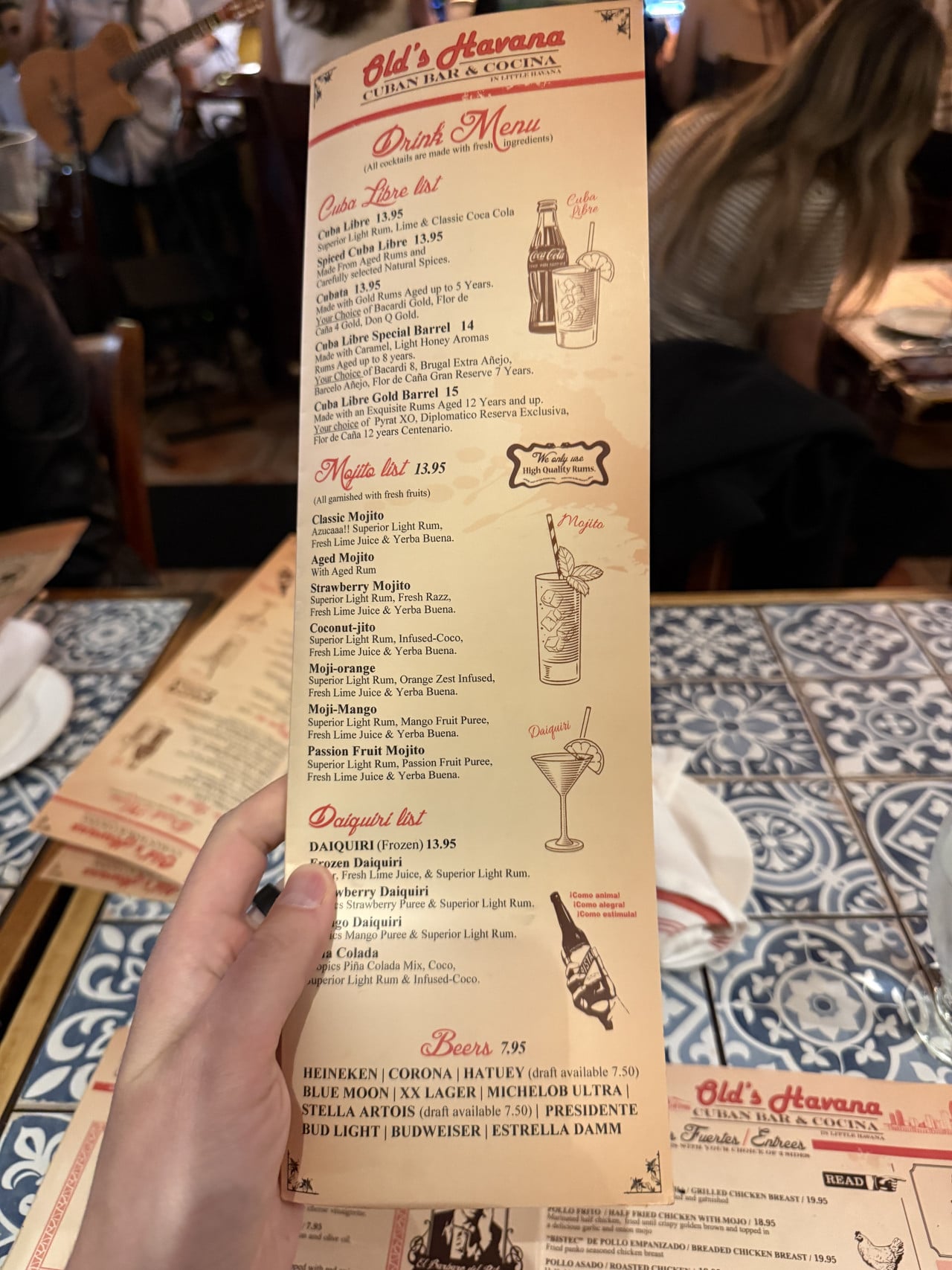
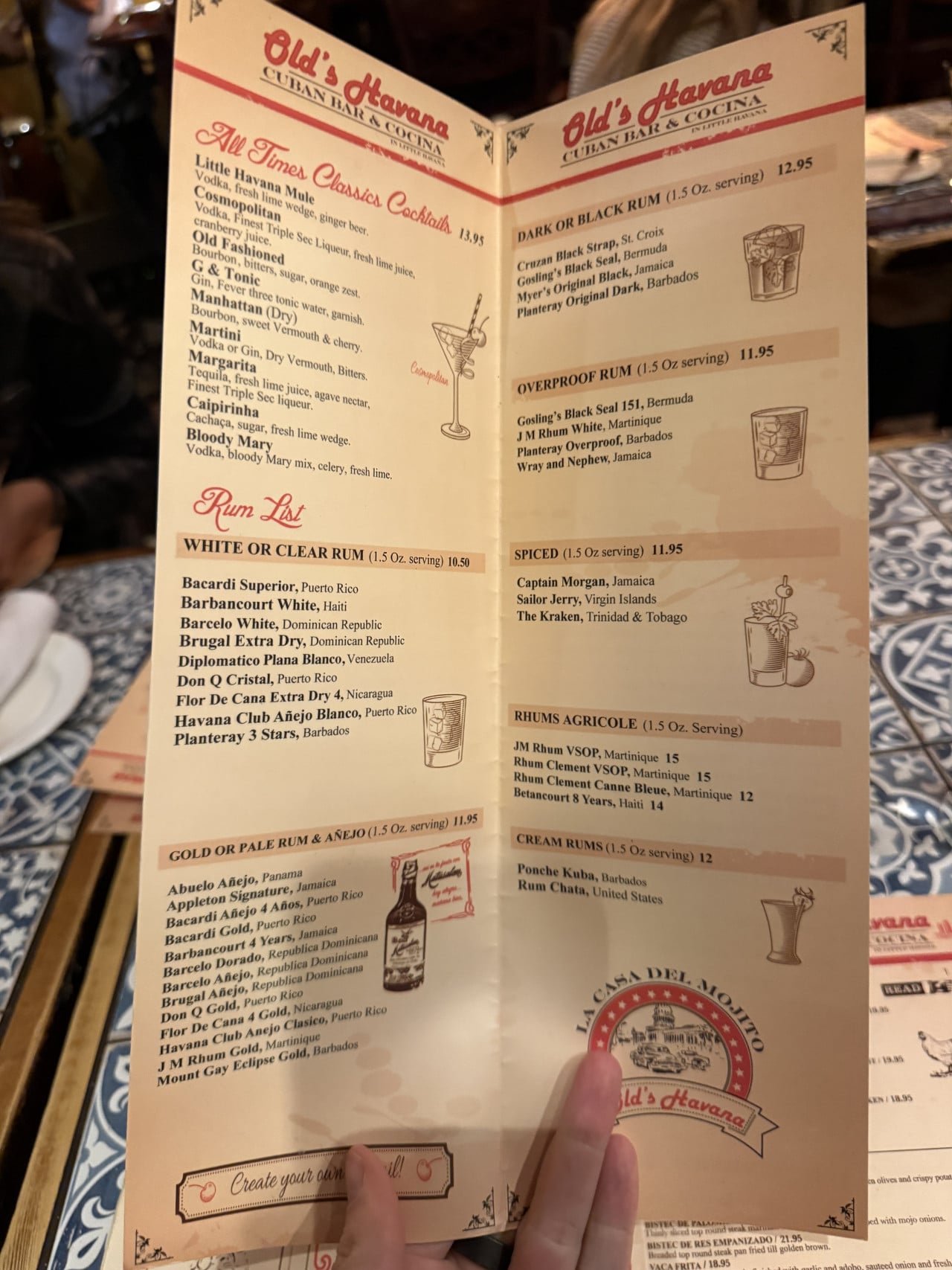
The drinks menu is also fantastic. The Mojito List offers seven kinds of mojitos for $13.95 – classic, strawberry, coconut, orange, mango, or passion fruit. Cuba Libre ranges from $13.95 to $15 depending on the age of the rum. The daiquiri list includes both classic and fruit varieties. And beers cost $7.95, including the Cuban Hatuey.
Lechón Asado – a dish you have to try
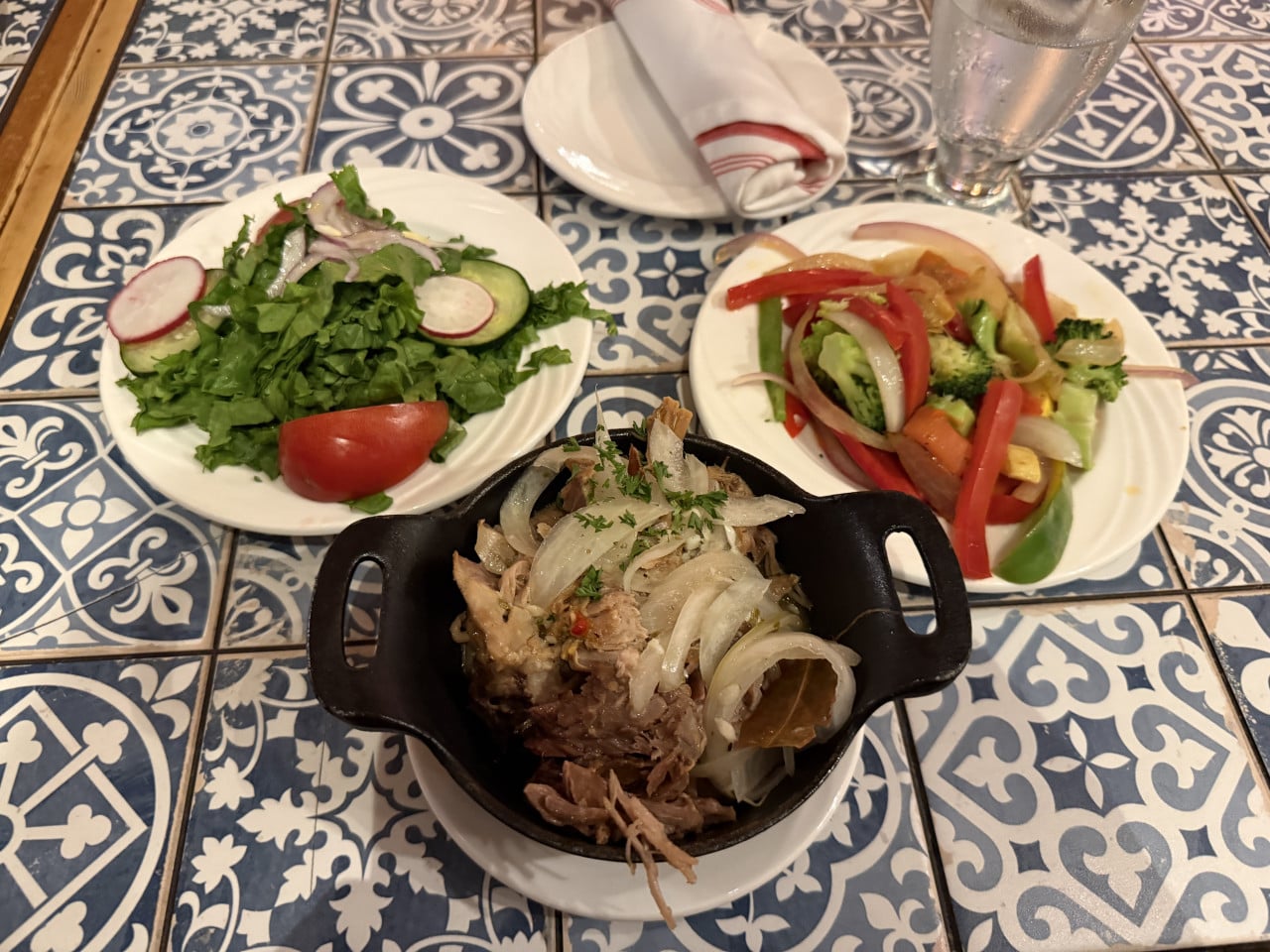
I ordered the Lechón Asado, and it was absolutely delicious.
Lechón Asado is considered one of the most important dishes in Cuban cuisine – literally “the heart of Cuban food.” The name comes from Spanish: “lechón” means a young pig (originally a suckling pig), and “asado” means roasted. Traditionally, it is made from a whole pig, which is slowly roasted over a fire or in a special “Caja China” (wooden roasting box) for hours until the meat is incredibly tender and the skin is perfectly crisp.
The key to the flavor of Lechón Asado is the mojo marinade – a mixture of garlic, bitter oranges (or a combination of orange and lime juice), oregano, cumin, and olive oil. The meat is left in this marinade overnight so that it absorbs all those citrus and garlic flavors. The result is juicy, fall-apart pork with a bold yet fresh flavor, served with caramelized onions.
In Cuba, Lechón Asado is a traditional dish for festive occasions – especially Noche Buena (Christmas Eve) and weddings. In Miami, however, it is served year-round and can be found in practically every Cuban restaurant. At Old's Havana, it was served for $18.95 in a cast-iron skillet, exactly as it should be – with a layer of onions on top and a side dish of your choice.
Traditional side dishes include Moros y Cristianos (black beans with rice), maduros (fried sweet plantains), tostones (fried green plantains), or yuca con mojo (boiled yuca with a garlic-citrus sauce).
A Cuban band played while we ate, the food was absolutely excellent overall, and the service was great – so we were very satisfied and had a fantastic meal.
A walk along Calle Ocho
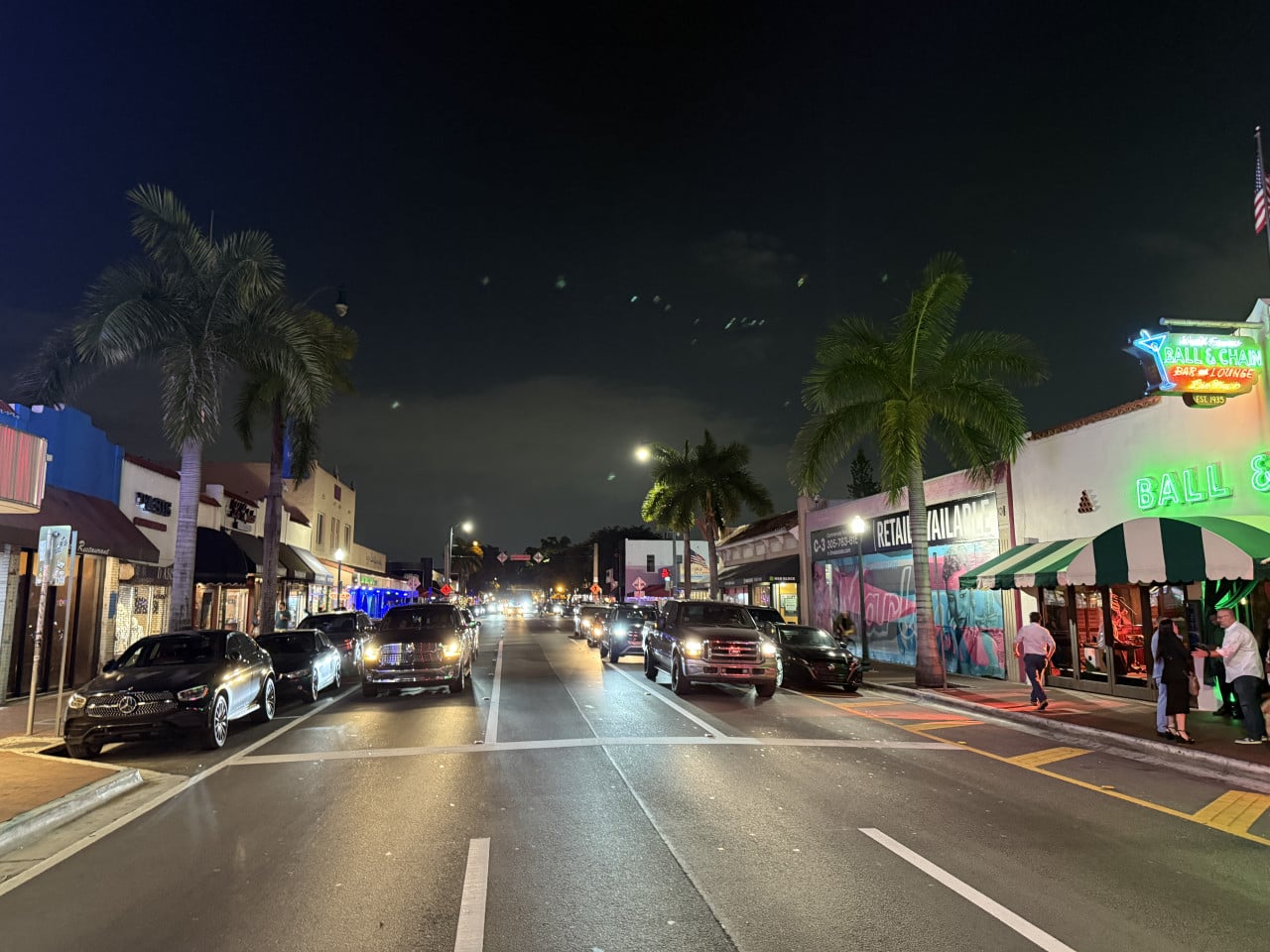
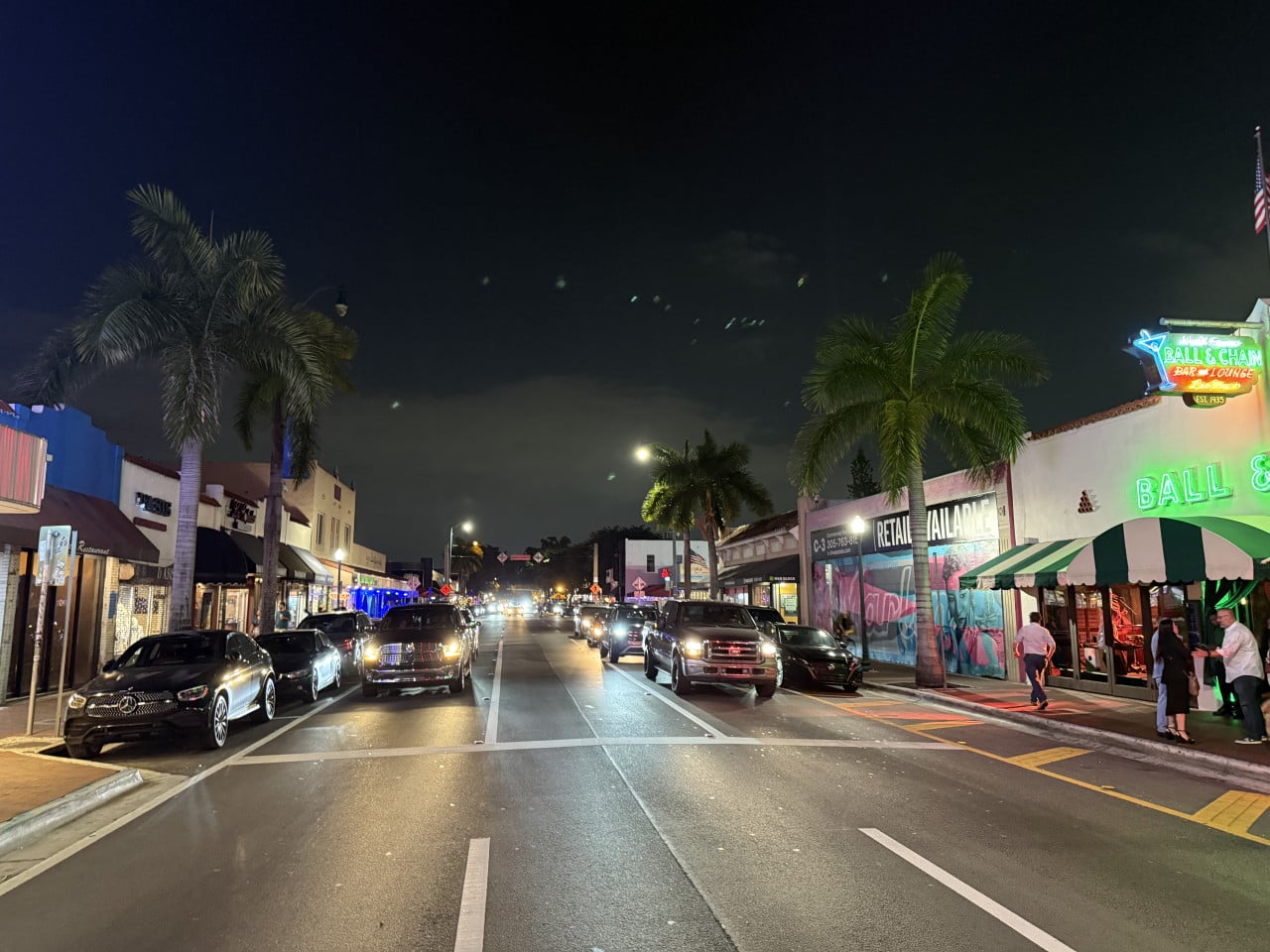
After dinner, we went for a walk along the street and soaked up the typical Havana atmosphere. We saw plenty of other bars and restaurants, as well as shops selling Cuban cigars and alcohol. Neon signs, live music flowing out of venues, and the smell of cigars in the air – all of this creates an atmosphere that is truly unique in Miami.
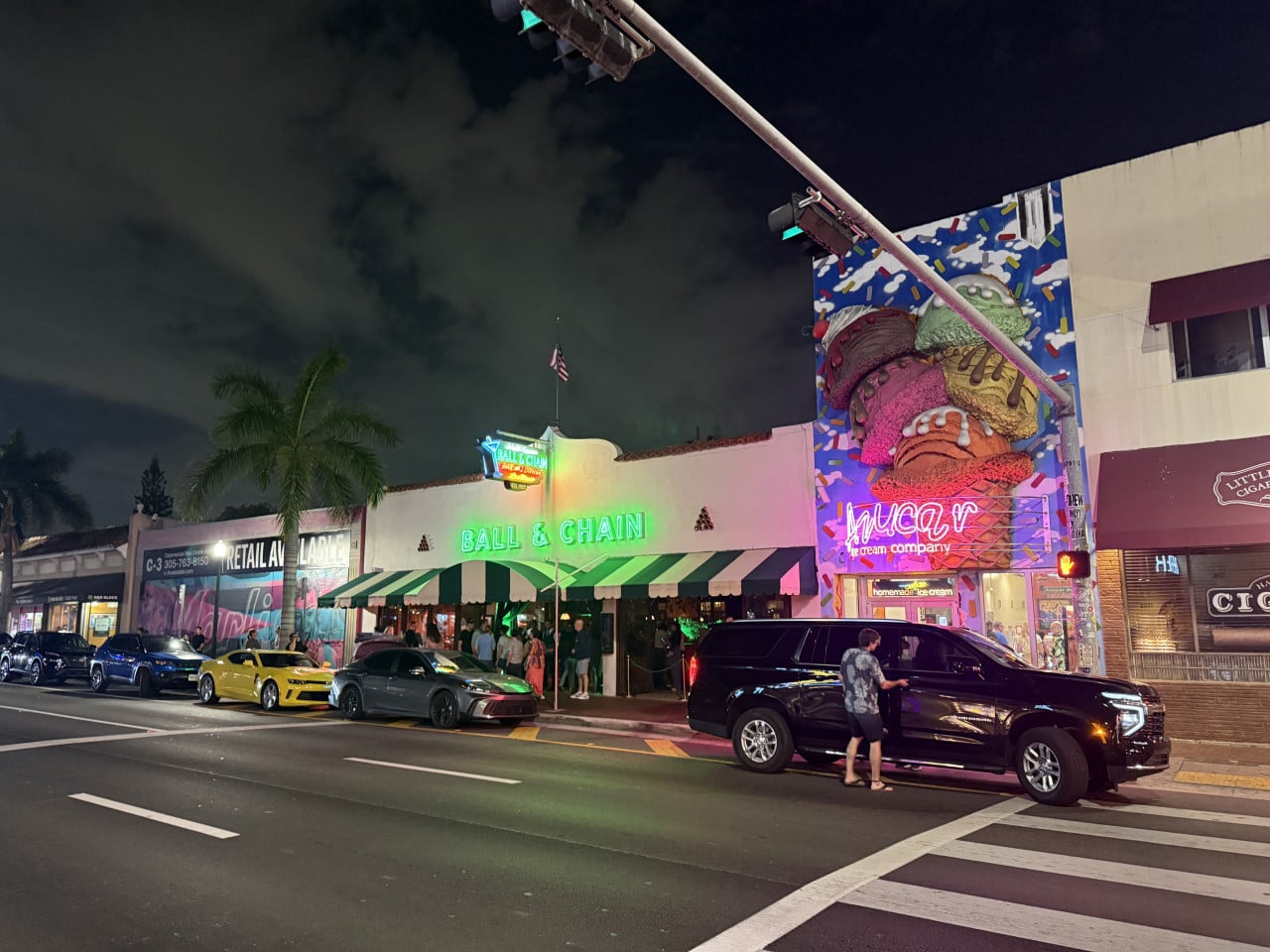
One of the venues that caught our attention was the famous Ball & Chain – an iconic bar and lounge directly on Calle Ocho that has been operating since 1935 and is known for live salsa and Cuban cocktails.
Azucar Ice Cream – the best ice cream in Little Havana
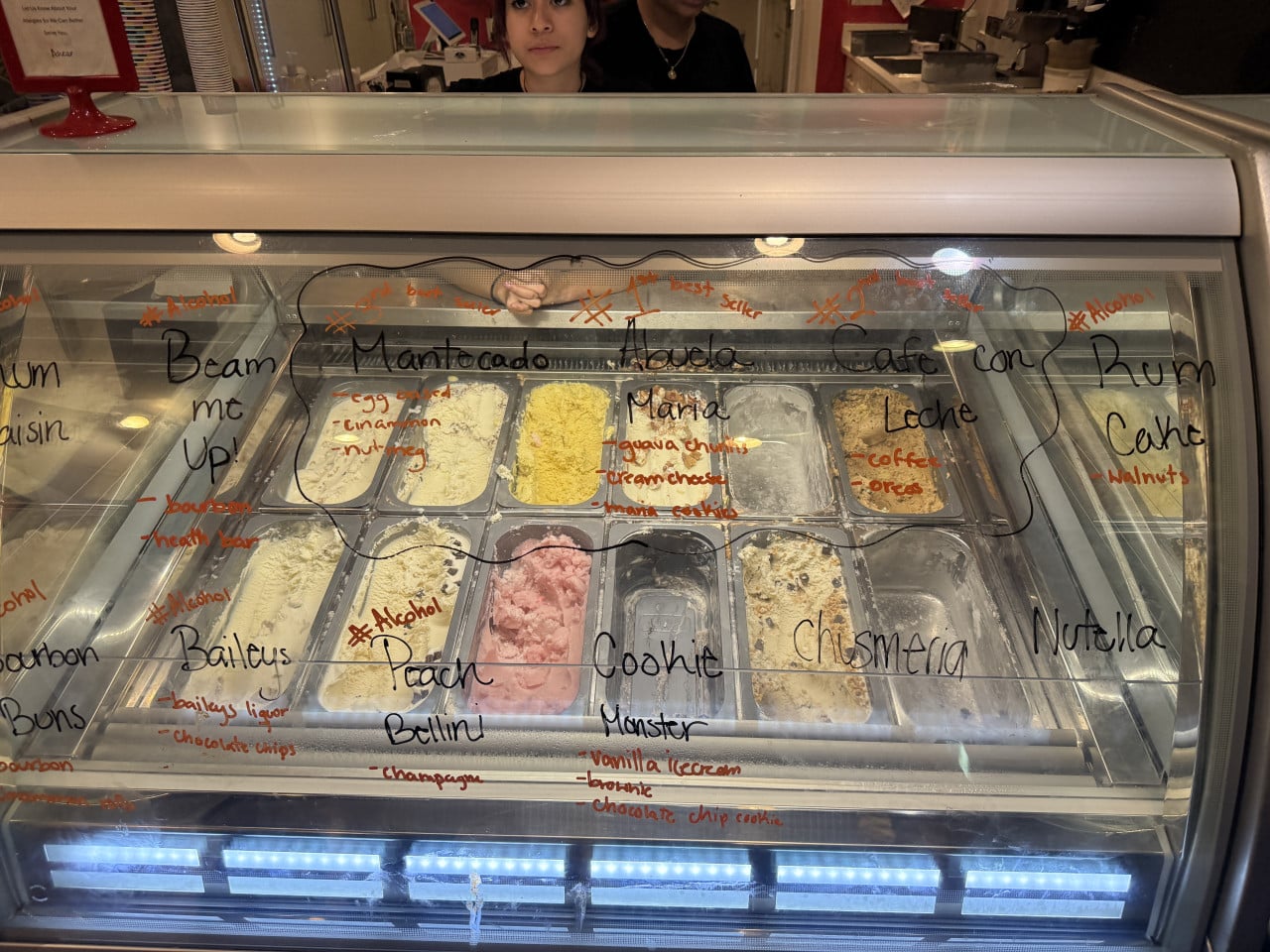
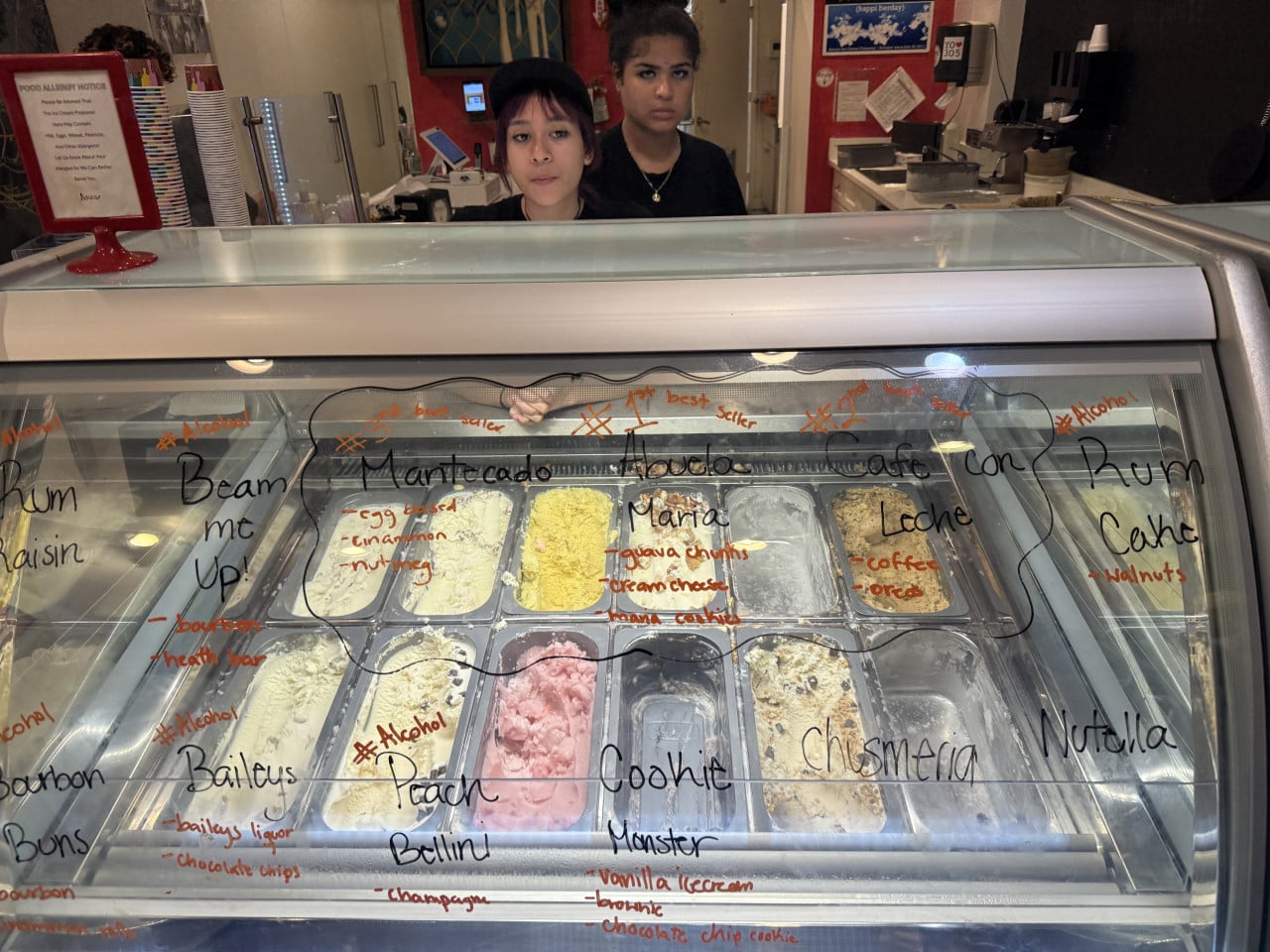
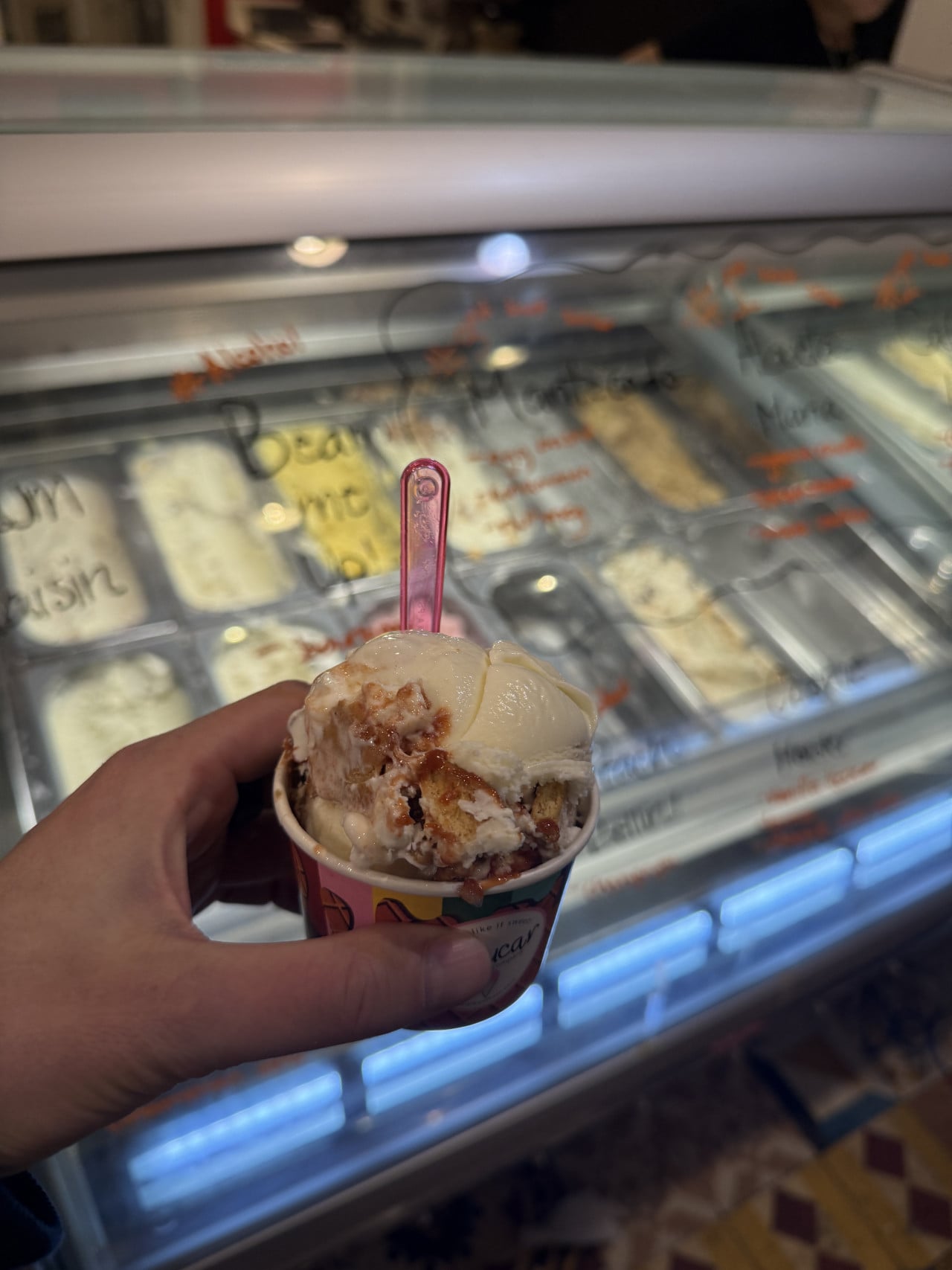
One thing that really caught my attention was our stop at the local Azucar Ice Cream Company. This ice cream shop was founded in 2011 and is inspired by Cuban culture and the founder's memories of her grandmother (Abuela). The ice cream is handmade from natural, locally sourced ingredients – they literally buy the fruit just a few streets away at a local tropical fruit stand.
They offer flavors you won't find anywhere else: Abuela María (vanilla ice cream with pieces of guava, cream cheese, and María cookies), Plátano Maduro (sweet plantain), Café con Leche, Flan, or even Mamey – a tropical fruit typical of Cuba. And then there is the cheeky Burn in Hell Fidel flavor – chocolate ice cream with cayenne pepper.
The ice cream was absolutely delicious, so I definitely recommend it. The ice cream shop is right next to Ball & Chain, and you can't miss it – you'll recognize it by the enormous mural of an ice cream cone on the building's facade. It was packed inside, which only confirms how popular the place is.
Tower Theater – a historic Calle Ocho landmark
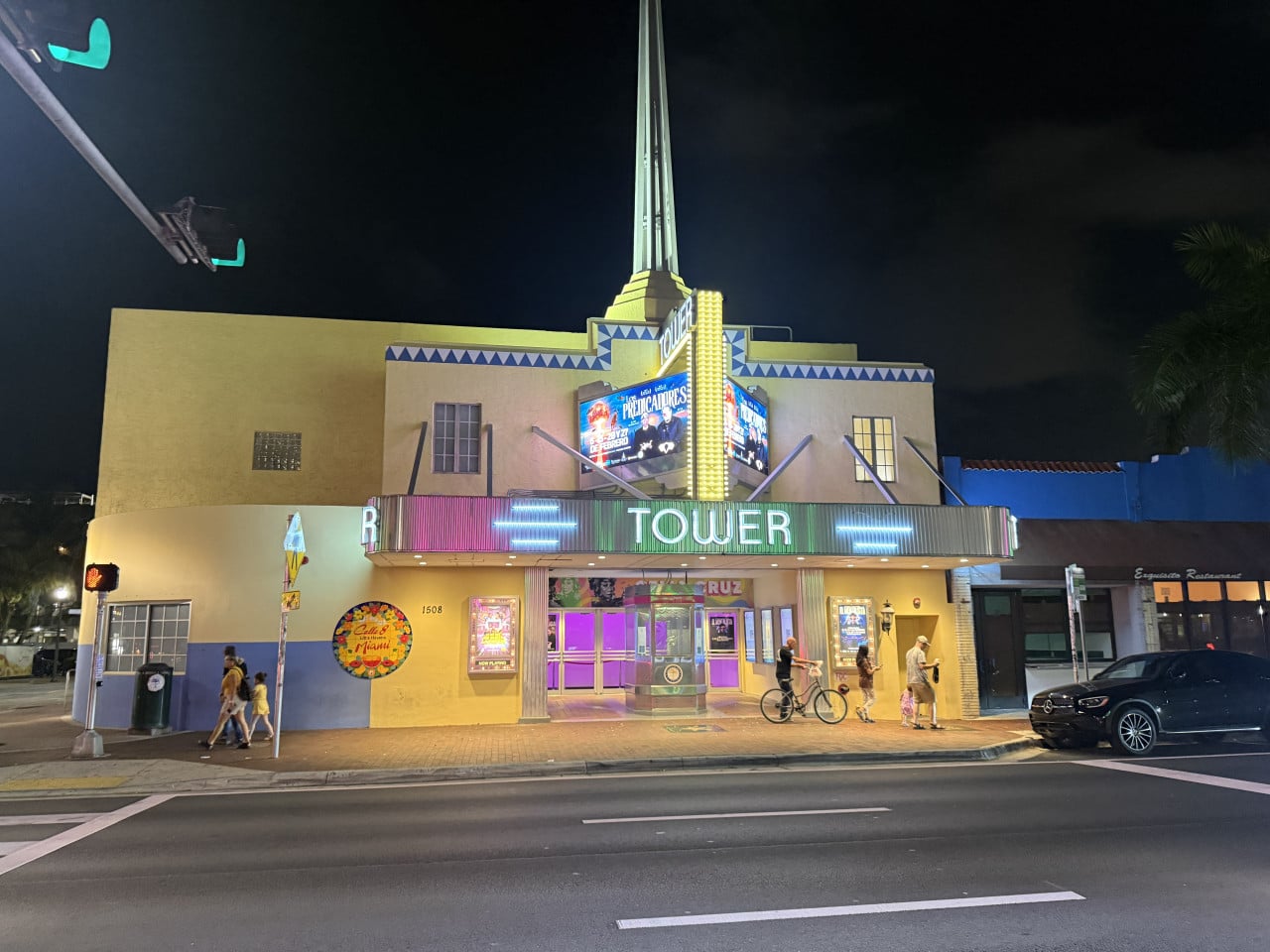
During our walk, we came across the Tower Theater – and it caught my eye immediately. The Art Deco building, with its striking 12-meter steel tower and neon signs, looks exactly like something from a 1930s American movie.
The Tower Theater opened in December 1926 and was considered the most modern movie theater in the entire southern United States at the time. It originally screened silent films – the first was the romantic comedy “The Palm Beach Girl” starring Bebe Daniels. In 1931, it underwent a major renovation led by architect Robert Law Weed, who gave it the distinctive Art Deco appearance it has retained to this day.
The Tower Theater held a very special significance for the Cuban community. In the 1960s, when thousands of Cuban refugees were arriving in Miami, the theater became a kind of “window into American culture.” It began showing English-language films with Spanish subtitles, which helped Cuban families acclimate to their new country. Later, it also added films entirely in Spanish. For many Cuban families, the Tower Theater was the first place where they encountered American culture – while also being a place where they could preserve their own.
After nearly 60 years of operation, the theater closed in 1984, but Miami Dade College took it over in 2002 and reopened it as an art-house cinema and cultural center. It became home to the Miami Film Festival and other film showcases.
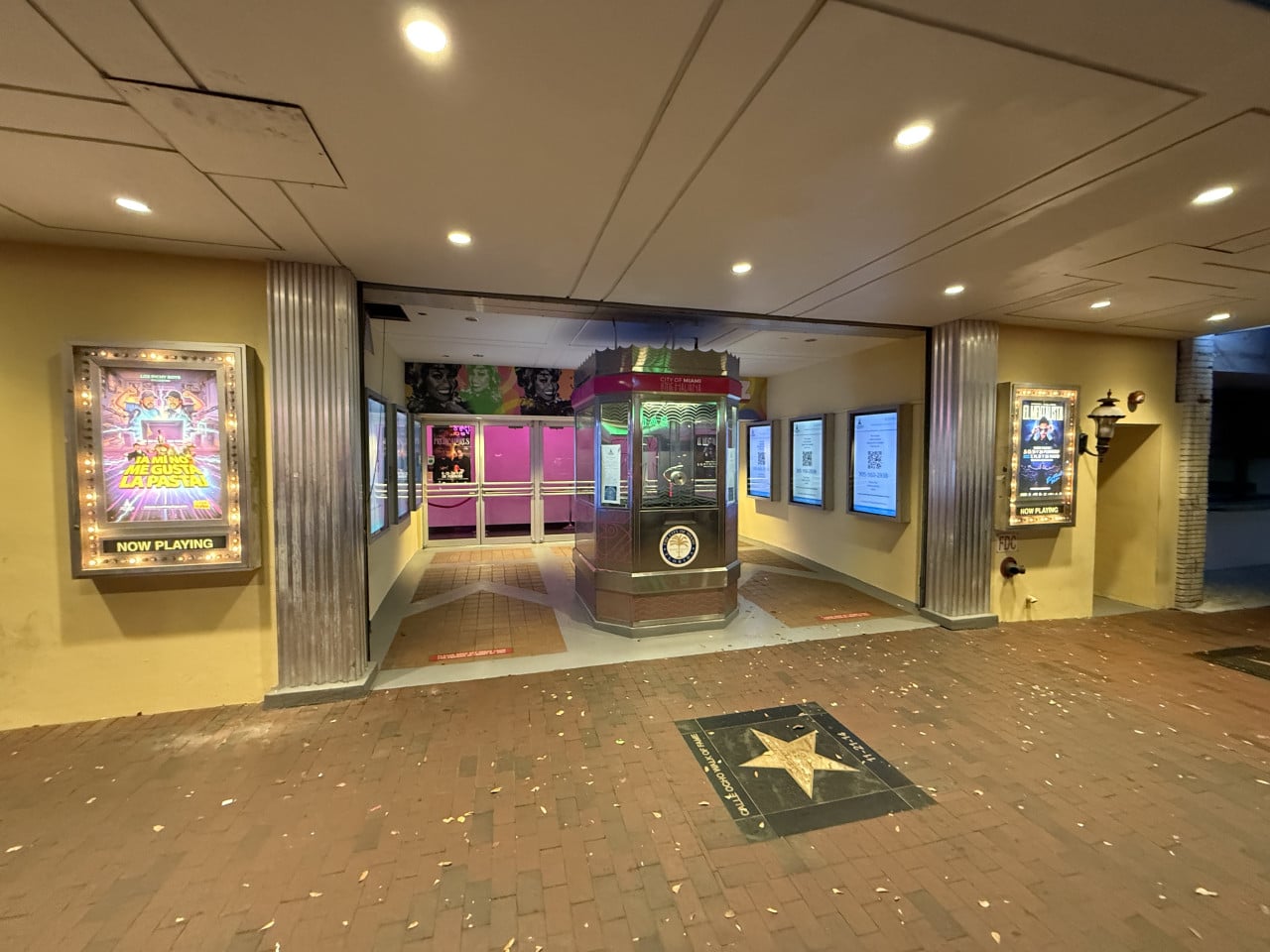
What caught my attention about the Tower Theater was the little ticket booth standing out front – a box office behind glass, exactly like the kind you see in American movies or in South Park when they were buying movie tickets. It perfectly evokes the nostalgic atmosphere of old American movie theaters.
Overall assessment of Little Havana
We walked around there for just under an hour, Anetka – Štěpán's wife – bought something in one of the small shops, and then I got into an Uber and went back to the Airbnb because I was flying to Dallas the next day.
Little Havana is definitely great, and I absolutely recommend visiting it. But don't expect it to keep you entertained for an entire day – it's more of a place to have a meal, soak up the atmosphere, walk along Calle Ocho, and enjoy the Cuban energy. Don't expect anything groundbreaking, but it is very pleasant and authentic.
Just like Wynwood, where our conference was held, Little Havana is one of Miami's more interesting neighborhoods and is well worth visiting. If you don't want to keep going back to South Beach and Ocean Drive, Little Havana is a great alternative. It has a wonderful Cuban feel, a diverse menu of food, and more than enough restaurants – just choose one based on the reviews, and it is definitely worth trying.