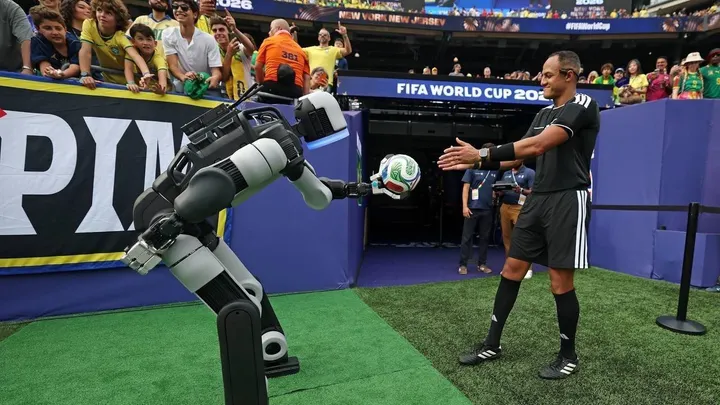
During halftime of the round-of-16 match between Brazil and Norway, something happened that the World Cup had never seen in its ninety-six-year history. The humanoid robot Atlas walked onto the stadium pitch holding a ball and handed it to the referee in front of roughly 80,000 spectators and millions of viewers watching on screens.
It was the first-ever deployment of a humanoid robot directly into the live environment of a World Cup match. By the tunnel, Atlas performed a pirouette, bowed slightly, and handed over the ball so the second half could begin.
Pirouettes, a bow, and meditation
During its appearance, the robot also indulged in a few playful football references. It imitated several goal celebrations, including the meditation pose of Norwegian striker Erling Haaland. These moves were precisely what turned the entire performance into a great show.
The robot was created by Boston Dynamics, which is owned by automaker Hyundai Motor. Hyundai is the tournament's official robotics partner and has been working with FIFA for twenty-seven years. According to Sungwon Jee, executive vice president and global chief marketing officer at Hyundai Motor, preparing for this moment took five years of work. He described the handover of the ball as the moment Atlas entered the public consciousness for the first time.
A robot that learns
The Atlas that people saw on the pitch is the fifth generation of the machine. It is fully electric, roughly human-sized, and was built by Boston Dynamics for the most demanding industrial work. It has fifty-six independent joints, a reach of 2.3 meters, can lift more than fifty kilograms, and can replace its own battery, so it does not have to stop working to recharge.
Alberto Rodriguez, director of robot behavior at Boston Dynamics, explained that the machine is no longer programmed in the traditional sense. Instead of following a fixed set of commands, the robot learns and adapts to changing variables, operating more like large language models than a robotic arm in a factory.
Before Atlas even touched the ball, it “watched a movie.” The developers showed it footage of professional footballers training, and the robot studied the mechanics of their movements much like a player reviewing footage of their own match.
A robot on the pitch
The performance itself was built on three technical foundations. Retargeting technology enables Atlas to translate and adapt human movements, allowing it to perform football celebrations and the pirouette by the tunnel. Reinforcement learning then trains the movements through thousands of simulations before the robot goes outside. Whole-body control ensures that its movements remain smooth and balanced.
The stadium presented problems that do not arise in the laboratory. Standard Wi-Fi communication was not an option because tens of thousands of fans with mobile phones congested the 2.4 and 5 GHz bands. The engineers solved this with a dedicated radio channel using a device attached to the robot's back.
The grass was another challenge. “We had to change the way Atlas learns to walk, jump, and run to make it more robust,” Rodriguez explained. The team solved both problems before the robot stepped onto the pitch, and Atlas completed the entire performance without a single issue.
Atlas in the factory
The World Cup appearance was not a departure from the main direction pursued by Hyundai and Boston Dynamics. It showcased the same capabilities the robot is expected to demonstrate in industry, only on a stage where any potential failure would have been seen by several hundred million people.
This year's entire production run of Atlas robots has already been reserved. The robots are headed to Hyundai's application center in the U.S. state of Georgia and to Google DeepMind, which is developing AI models intended to expand the range of tasks Atlas can handle. Starting in 2028, Hyundai plans to produce 30,000 units annually at a plant near Savannah and deploy them at its U.S. factory in Georgia for hazardous and repetitive work.
Two days after the performance, Hyundai released a short documentary showing everything that went into the robot's halftime appearance. Atlas is no newcomer from the laboratory. The original hydraulic version was introduced back in 2013, while the fifth generation debuted at CES this January.
Sources: hyundaimotorgroup.com and reuters.com