This week, the American company Cognition launched SWE-1.7, which it describes as the most capable model it has ever trained. It promises performance on par with the best models on the market, but at a significantly lower operating cost. The company claims it is pushing the price-to-performance ratio to a level its competitors have yet to reach.
Few people in the Czech Republic are familiar with the name Cognition, even though its main product has attracted attention around the world. Before we get to what the new model can do, it is worth recalling where the company came from.
A group of Olympiad medalists who started out in cryptocurrency
Cognition was founded in San Francisco in late 2023. It was established by Scott Wu, Steven Hao, and Walden Yan, three former competitive programmers who won gold medals at the International Olympiad in Informatics. The entire founding team has won ten such medals in total. Wu often says that teaching artificial intelligence to program is a deeply algorithmic task, and that his team is exceptionally well prepared for precisely that challenge.
What is interesting is where the company began. Initially, it focused on cryptocurrency. It was only when interest in large language models surged following the release of ChatGPT that the founders changed direction and moved into artificial intelligence.
The turning point came in March 2024. Cognition unveiled Devin and described it as the first AI software engineer. It was not merely a coding assistant like those offered by competitors, but an agent capable of planning, writing, debugging, and testing code on its own. The demo caused a huge stir as well as a wave of skepticism, because some developers questioned whether the tool could actually do what the company claimed.
Devin officially launched in December 2024 at five hundred dollars per month for entire development teams. A few months later, in spring 2025, Devin 2.0 arrived with pricing starting at twenty dollars. In the summer of that year, Cognition acquired the Windsurf development environment, which had previously become the subject of a tug-of-war among major technology companies. This transformed the originally single-product company into a software development platform.
The best model the company has ever trained
And now to the latest development. Cognition built SWE-1.7 on the Kimi K2.7 base model. It had already undergone extensive post-training through reinforcement learning, yet the company still achieved another major improvement. According to Cognition, this challenges the idea that such training has a ceiling. The company says reinforcement learning can push a model's capabilities much further than previously expected.
The model is primarily aimed at long, sequential tasks that run in the background without constant human supervision. According to the company, that is the core of high-quality software development.
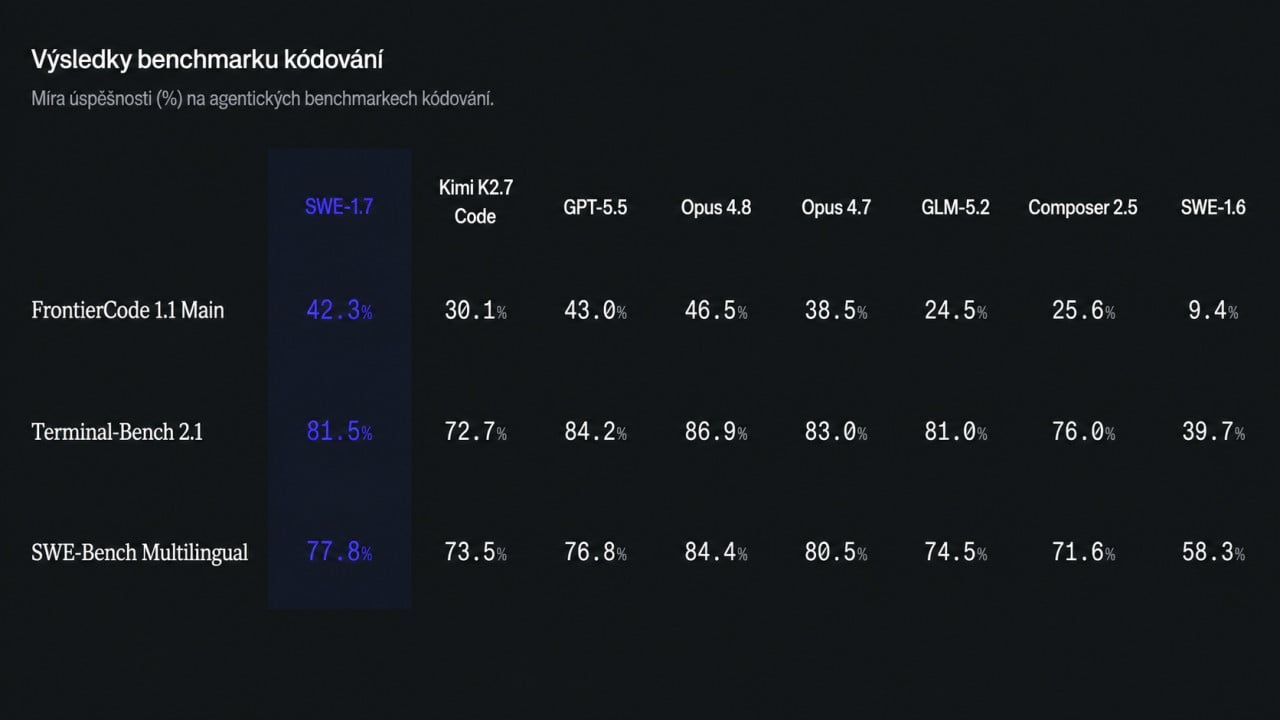
Cognition also published its test results. On the demanding FrontierCode 1.1 benchmark, SWE-1.7 achieved a success rate of around forty-two percent, bringing it close to the strongest closed models and putting it ahead of its Kimi K2.7 base model. It completed more than eighty percent of tasks on Terminal-Bench 2.1 and just under eighty percent on the multilingual version of SWE-Bench. Compared with the previous-generation SWE-1.6, which managed only around nine percent on FrontierCode, this is a huge leap.
It can take notes and work for hours at a time
Several technical solutions are behind the improved results. Cognition calls one of them automatic summarization. When the agent approaches the limit of how much text it can retain in memory, it writes a summary of where it is in its work and then continues from that summary. During training, the model learned to write these notes as concisely as possible while also making the best possible use of them. As a result, its training sessions lasted up to six hours.
To prevent the model from being unnecessarily verbose, the company introduced alternating length penalties. In one phase, it focuses solely on solving the task, while in the other it is penalized for excessively long solutions. The result is a model that responds concisely to simple tasks but gives itself room to think through difficult ones.
The change in behavior compared with the base model is also noteworthy. SWE-1.7 examines code much more thoroughly before making changes. It runs more queries, reads more files, and performs more searches. This is most apparent when fixing bugs. While a bug report usually describes a single symptom, the true cause often lies deeper. According to Cognition, the new model is far more likely to trace a problem to its root cause and consider edge cases as well. When it is unsure how a program should behave, it prefers to verify it with a small script rather than guess.
At the same time, the company points out one trade-off for this more thorough reasoning. The model modifies more files and writes more tests than the task necessarily requires. According to Cognition, expanding the scope of changes is an industry-wide trend that accompanies stronger reasoning capabilities, and the company wants to keep bringing it under control.
Pricing and availability
SWE-1.7 is available now within Devin, whether in the browser, the desktop application, or from the command line. The model runs on Cerebras chips at around one thousand tokens per second, so it responds quickly. Access to Devin starts at twenty dollars per month, while the team plan with a higher compute allowance costs five hundred dollars per month, and Cognition offers custom plans for large companies. The entire premise of SWE-1.7 is that the company can deliver cutting-edge performance at a lower cost than before.
Cognition is now one of the most closely watched companies in AI-powered programming. Most recently, it raised more than a billion dollars from investors, giving it a valuation in the tens of billions. The company also says that Devin now writes most of its own code.