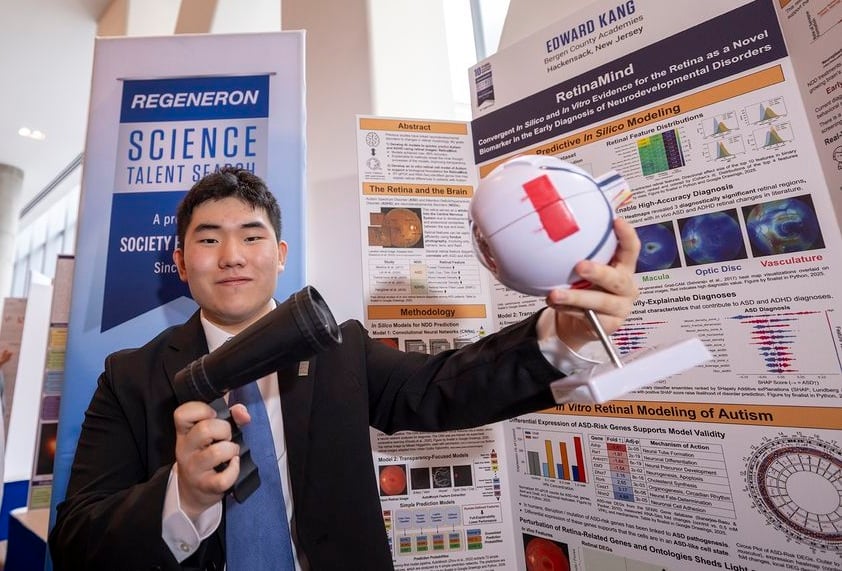
When Edward Kang was reviewing scientific papers for a school project three years ago, he came across a study by researchers at the Chinese University of Hong Kong who used retinal scans to diagnose autism. He was intrigued by the idea, especially by its unexpectedness—the possibility that the eye could reveal what was happening in the brain. Today, Kang is a seventeen-year-old high school senior at Bergen County Academies in New Jersey and the creator of a tool called RetinaMind, which estimates a neurodevelopmental diagnosis from a single retinal image with approximately 89% accuracy. The student used artificial intelligence, among other technologies, to create the tool.
Kang taught himself coding and the fundamentals of machine learning through online tutorials and several internet courses. His first model was deliberately simple: it was a basic convolutional neural network, a type of deep learning designed primarily for image classification, and essentially a replica of the model from the original Hong Kong study. The goal was to take an image, generate a diagnosis, and train the model based on how accurately it could predict that diagnosis. This first version later served as a baseline against which he measured each improved variant.
He Wanted to Detect Both ADHD and Autism
In the next prototype, he took a step that advanced the entire project. He added ADHD to the model. According to Kang, a useful diagnostic tool should not merely determine whether someone has a disorder, but should also be able to distinguish between disorders. This is where he encountered a problem: distinguishing a neurotypical person from someone with autism is not particularly difficult, and existing studies achieve accuracy approaching one hundred percent. Distinguishing two specific disorders from each other is significantly more challenging and much more clinically useful.
To improve accuracy, he turned to more advanced techniques. The key technique was ensemble learning, which involves using multiple models simultaneously for the same task. Each model is shown the same retinal image and asked to make a prediction; the individual estimates are then combined and averaged. According to Kang, this principle of multiple models “voting” produces more reliable and accurate results than relying on a single model.
AI Sees What Doctors Cannot
Differences in the retinas of people with autism or ADHD do exist, but they are extremely subtle. Specialized devices such as optical coherence tomography can measure minute variations in the thickness, length, and depth of the macula or the retinal nerve fiber layer. However, these differences overlap substantially with the normal range among neurotypical people, to such an extent that no doctor can identify them simply by looking at an image. Artificial intelligence approaches the problem differently: instead of searching for a single obvious feature, it analyzes thousands of microscopic characteristics simultaneously and identifies relationships between them that humans cannot detect. This is precisely what makes RetinaMind a tool capable of producing a diagnosis.
Moreover, Kang did not want just a “black box” that spits out a result. He used GradCAM, a so-called explainable AI technique that shows which areas of the image were most important to the model’s decision. This allowed him to look inside the network and determine which part of the retina the model focused on when making a diagnosis. The resulting tool therefore also creates a heat map for each diagnosis, highlighting key areas in red. RetinaMind then provides a percentage confidence level for each possibility—neurotypical development, autism, or ADHD—and the diagnosis with the highest confidence becomes the result.
From Code Back to Cells
What sets Kang’s project apart from purely “AI” projects is its connection to laboratory biology. Since the end of 2024, he has been trying to understand why these retinal differences arise in the first place. He created a cellular model of autism and investigated which genes might be responsible for the retinal differences. He identified around a dozen genes; one he highlights as particularly interesting is ABCA4, a gene that encodes a protein that helps “detoxify” the retina. In his cellular model of autism, ABCA4 expression was lower than in the control, which he believes could indicate greater toxicity and retinal degradation and partially explain the observed differences.
It was this combination that impressed the judges of the Regeneron Science Talent Search, the oldest and most prestigious American STEM competition for high school students. In 2026, Kang won second place and a prize of $175,000. According to the president of the organizing institution, the project stood out for combining AI with laboratory biology; Kang did not stop at developing the model but also investigated genetic changes, giving the entire project greater scientific weight.
The Future of RetinaMind
Experts remain cautious. Neurodevelopmental pediatrician Paul Lipkin of the Kennedy Krieger Institute points out that autism and ADHD are developmental conditions rooted in the brain and expressed through behavior, and that they overlap considerably with other disorders; retinal abnormalities may therefore not be specific to these conditions, but may instead indicate a more general neurological condition. Kang agrees. He acknowledges that the model currently provides only a “broad” diagnosis of autism or ADHD, even though both encompass a wide spectrum of different manifestations. He therefore views RetinaMind as a proof of concept and wants to continue training it to distinguish between mild, moderate, and severe forms, because the more specific the information the tool provides, the better it can guide the treatment and support a child needs.
Source: inc.com