OpenAI announced that its system had solved one of the seven Millennium Prize Problems, specifically the Navier–Stokes equations. The question of whether smooth three-dimensional flow can break down had remained open for approximately ninety years. According to the company, the artificial intelligence needed roughly 88 hours and around ten thousand agents working simultaneously to answer it. A one-million-dollar prize is offered for the solution, but OpenAI is not interested in claiming it. Even before the announcement had time to spread across social media, troubling accusations began to pile up around it.
What the equations are used for
Stir a cup of water with a spoon. A vortex forms, one part of the liquid begins moving faster than another, the pressure changes, and internal friction comes into play. This is exactly the kind of behavior that can be described by the Navier–Stokes equations, which emerged in the nineteenth century from the work of Claude-Louis Navier and George Gabriel Stokes. They are based on Newton’s second law of motion and treat a liquid as a continuous medium rather than as a collection of individual molecules. Engineers use them to design aircraft, meteorologists use them to calculate forecasts, and doctors use them to describe blood flow.
The equations themselves are therefore no mystery. Mathematicians were troubled by something else. They wanted to know whether this continuous description of a liquid could break down. They investigated whether the equations for a three-dimensional incompressible fluid with constant density could produce what is known as a singularity, even if the flow starts out smooth. In this case, a singularity means that velocities in the fluid begin to grow without bound in finite time. And this would happen despite internal friction, which normally smooths out motion. A real liquid cannot move infinitely fast, so this would constitute a failure of the model itself.
In 1934, Jean Leray proved that solutions exist in a more general sense, but the question of their smoothness remained open. In 2000, the Clay Mathematics Institute included this puzzle among the seven Millennium Prize Problems.
A vortex stretched like spaghetti
OpenAI’s system produced both an analytical proof and a formalization in the Lean language. According to them, a fluid that starts out smooth and at rest can form a singularity in finite time. The fluid is acted upon by a smooth external force, while its total energy remains bounded throughout. According to the company, this resolves variants “C” and “D” of the Clay Institute’s official problem statement.
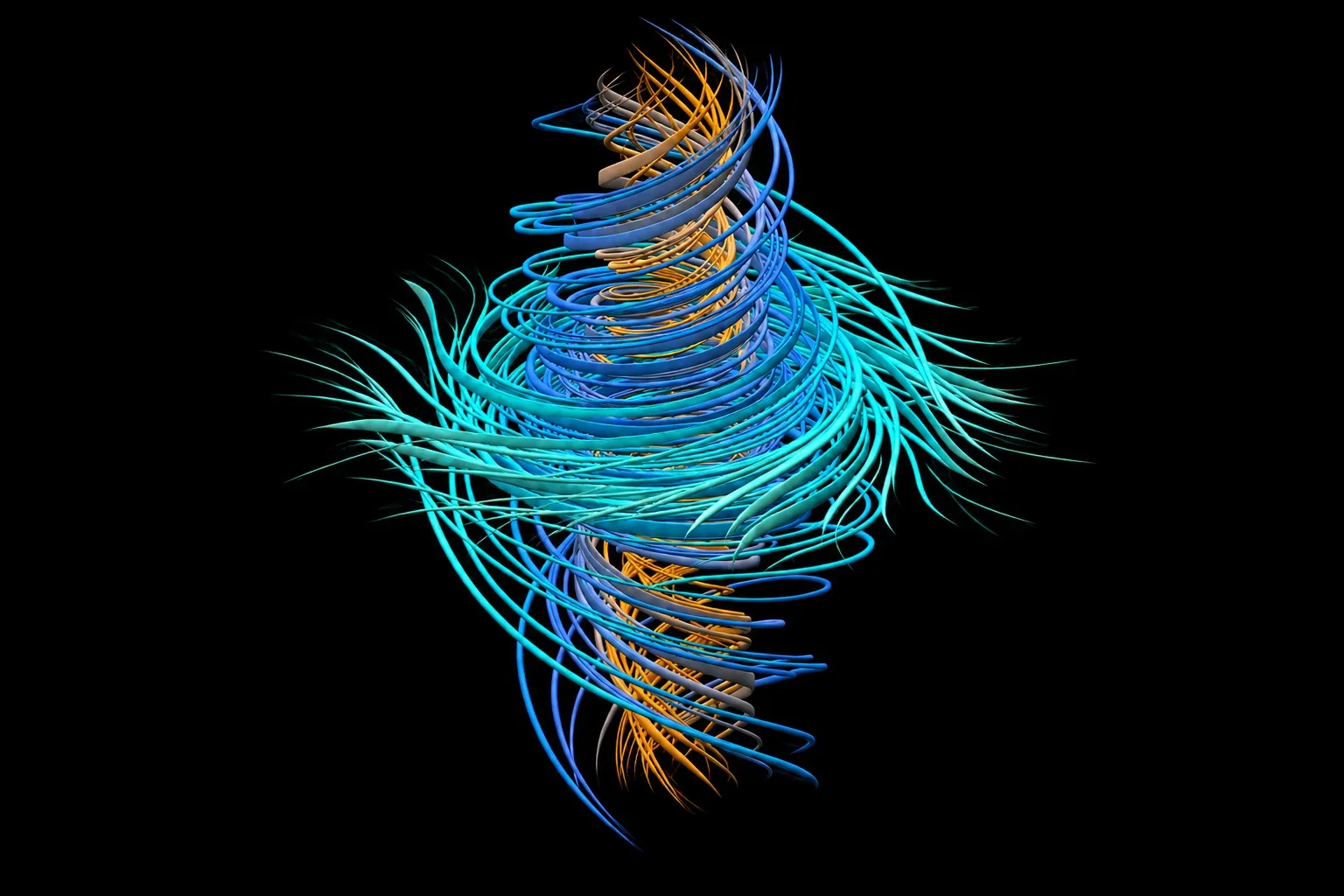
The idea behind this phenomenon is surprisingly intuitive. It involves a rotating vortex that twists inward while becoming increasingly elongated, somewhat like spaghetti. Its core shrinks while simultaneously accelerating in such a way that the energy remains finite, as required by the laws of physics. The tricky part is that the breakdown must arise from the motion of the fluid itself, rather than from someone manually introducing an infinite force into it. Acceleration, pressure gradients, momentum transfer, and viscosity must all suddenly grow to enormous values while canceling one another with great precision.
One detail can easily get lost here. Nobody is claiming that water left to itself will begin accelerating for no reason until it reaches infinity. OpenAI is addressing a variant in which the fluid is acted upon by a smooth external force, which is explicitly part of the official problem statement.
Thousands of agents worked on the equation
Since August 28, OpenAI has been training a new model that it says surpasses its own benchmarks, including mathematical ones, and this training is still underway. On Tuesday, September 1, the company heard rumors that someone had solved two Millennium Prize Problems. This prompted it to deploy the new model against all the still-unsolved Millennium Prize Problems and several other difficult questions. Instead of one model tackling one question, an army was brought in. The agents were given access to tools, could read a stored copy of the internet and run code, and were divided into groups that communicated internally. The group that produced the solution to the Navier–Stokes equations consisted of roughly ten thousand agents running simultaneously.
But first, something smaller fell. The company also deployed agents on easier tasks, including an analogous question for the Euler equations, which are the Navier–Stokes equations without the term describing internal friction. The agents solved it, which OpenAI says caught the company by surprise. Just under a hundred agents worked on this part for about fifty hours. When the company saw the Euler result, it shifted resources away from the other problems and provided it to the agents tackling the full equations. It then used the Codex tool to circulate the most useful insights among the groups. The solution was completed on Saturday, September 5, approximately 88 hours after the effort began.
Next came verification. Lean is a formal proof system that uses a machine to check whether every individual step follows the specified rules exactly. With a hundred-page text, there is a risk that it may sound convincing while still concealing an error. Formalization and verification in Lean took another seventeen hours and were carried out by the GPT-6 Astra model.
The bill for this skirmish looks more like something from a data center than a mathematics seminar. For the Navier–Stokes equations alone, the agents exchanged 2.7 million messages and produced around 130 billion tokens. Across all the problems combined, the total was 4.9 million messages and about 300 billion tokens. If this computing time were billed at the Astra model’s standard rates, it would cost approximately 22.5 million dollars.
Was OpenAI really first?
Before OpenAI’s announcement, mathematician Tristan Buckmaster of New York’s Courant Institute published a text describing how he and Levent Alpöge, a scientist working for Anthropic, had arrived at a nearly identical solution to one part of the problem with the help of several models from both companies. This partial result is a major achievement in its own right and a significant step toward solving the entire puzzle.
According to Buckmaster, while the pair were completing their work, they learned that information about their progress had reached OpenAI. He says the first prompt sent to the rival company’s model was submitted only in the final days, after the other side had learned about their research. Buckmaster also described a meeting on September 6, pressure concerning publication and authorship, and an attempt to exclude Alpöge because of his employment at Anthropic.
Sébastien Bubeck, head of OpenAI’s mathematics team, rejects these accusations. According to him, the model did not gain access to the pair’s data in any way. At a press briefing, he stated that the company had not used their prompts or proofs to guide its agents. Bubeck also acknowledges that the full Navier–Stokes proof followed a path similar to the one used by Buckmaster and Alpöge, but says the internal model solved the Euler portion in a completely different way. In its own text, OpenAI acknowledges that the pair were first to solve the forced Euler version. It says it offered them a joint announcement and claims that no one on the team, including the agents, had seen their work before publication.
One observation from the other side is also noteworthy. Buckmaster and Alpöge verified their proof in Lean, but they said the explanation written out in words by the language models was almost unreadable. They therefore had to analyze and rewrite the individual steps so that other people could understand them as well.
Colleagues in the field also dislike the way the results are being presented. Terence Tao, whom many consider the greatest living mathematician, complained on social media as the rumors spread that companies were using these long-standing problems as marketing evidence of their models’ power.
Mathematicians are keeping their options open for now
The mathematical community still has to determine whether the result meets the requirements for an official solution to the Millennium Prize Problem. Initial reactions, however, suggest that the mystery has indeed been solved.
The version without an external force remains open—the one that would most closely resemble ordinary water left to itself. Princeton mathematician Stan Palasek pointed out an obstacle in one of the proposed paths toward such a result. According to his argument, the loss of energy through internal friction would outweigh the mechanism intended to drive the velocity upward. Tao praised his observation and suggested investigating a simpler model in which this interaction could be studied more clearly.
Sources: bbc.com and theverge.com