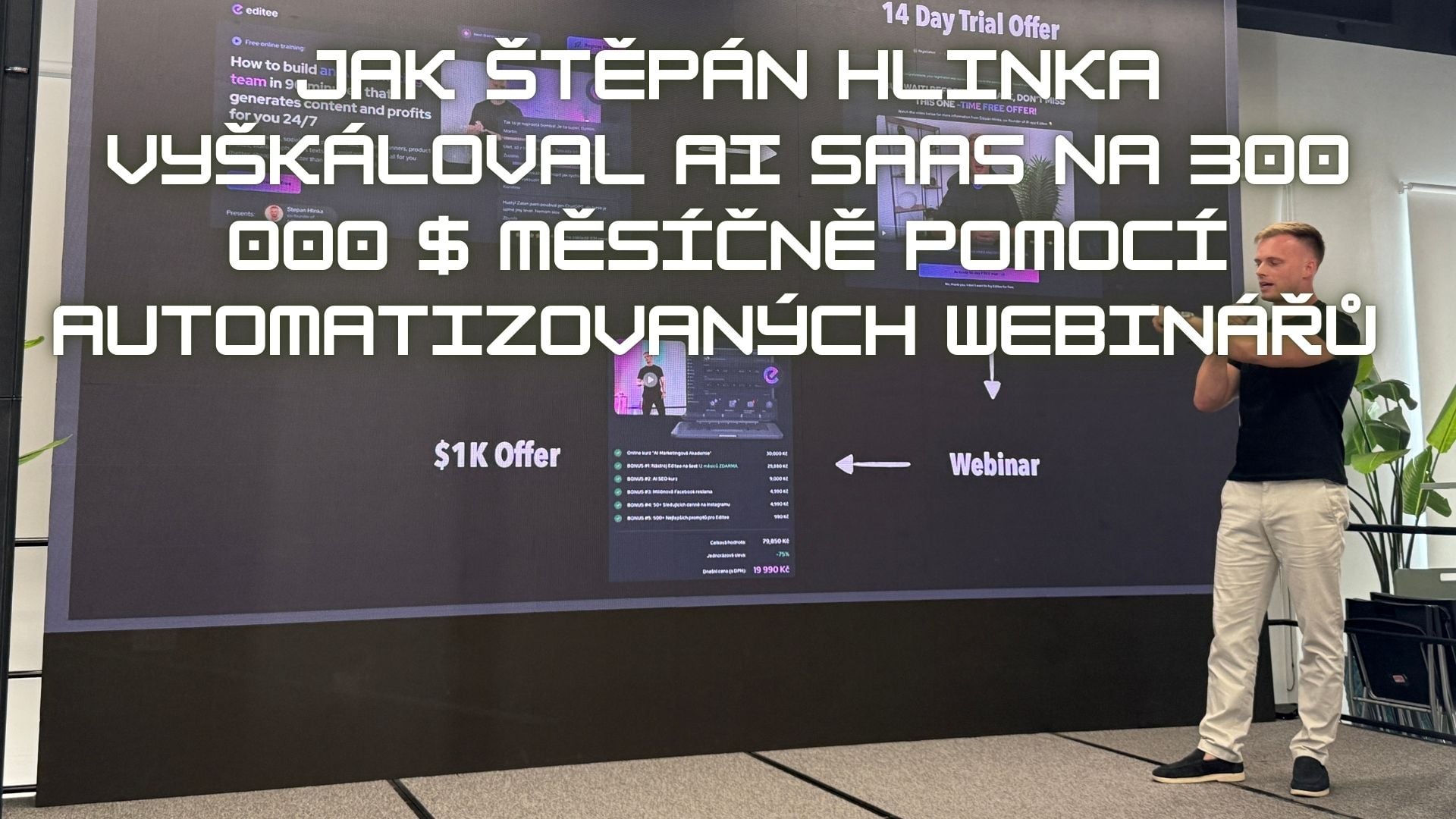
At this year’s Epic Webinar Summit in Miami, one of the speakers was Štěpán Hlinka — co-founder of the Czech AI application Editee, as well as my associate and business partner. And his presentation was, frankly, one of the most practical sessions of the entire conference.
On stage, Štěpán revealed the complete system their team used to scale a SaaS product from approximately $80,000 to more than $300,000 per month. And they did it all without a single live webinar and without investors. A bootstrapped business, a Czech company, and the Czech market.
I took notes throughout the entire presentation and transcribed them because I believe there is tremendous value in it for anyone selling anything online — whether software, courses, or services. Here are the key takeaways.
The problem: getting people into a subscription is really hard
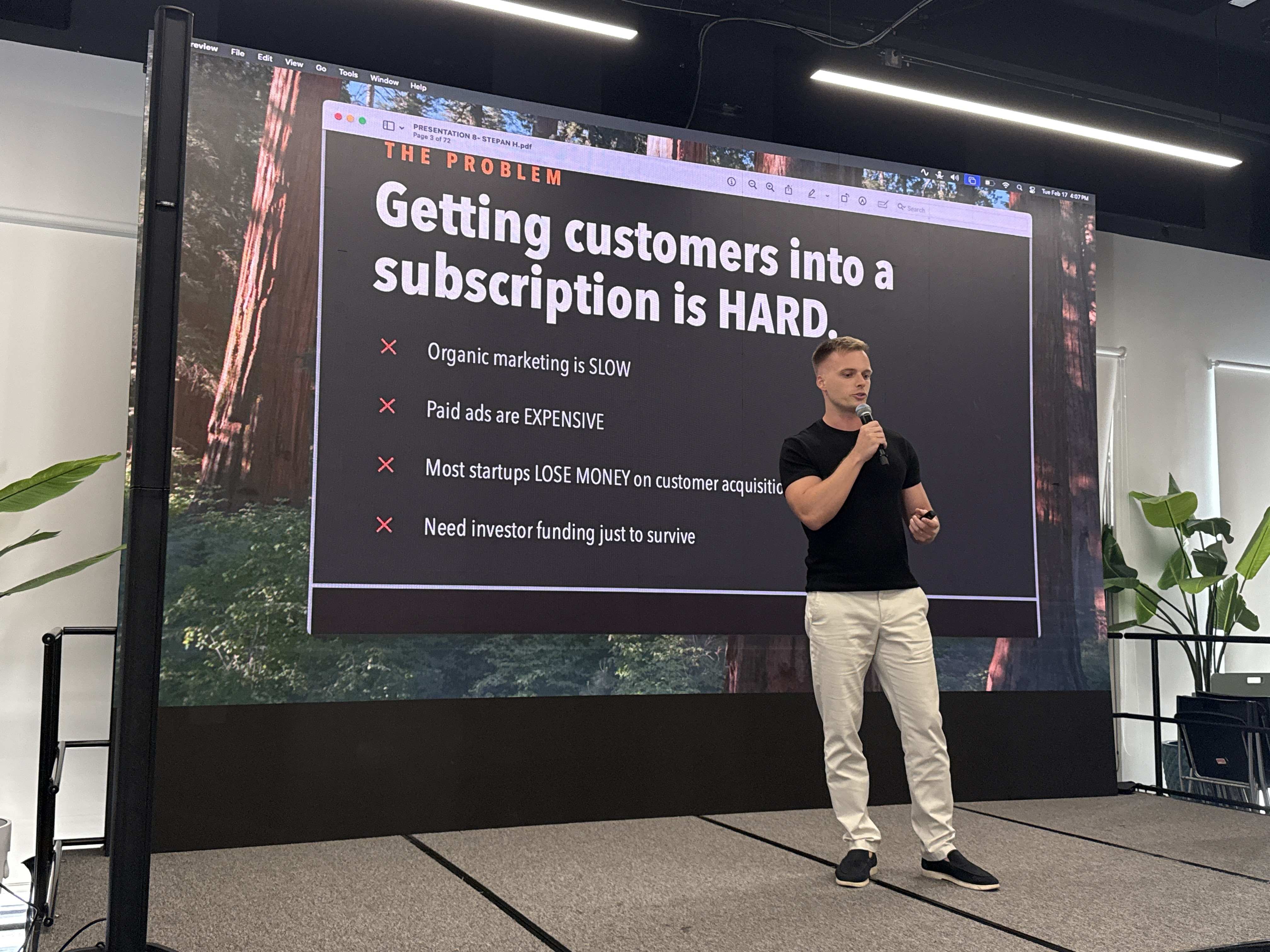
Štěpán began with something virtually every SaaS business struggles with. Organic marketing is slow. Paid ads are expensive. Most startups lose money acquiring customers and survive only thanks to investors.
But Editee does not have any investors. They are bootstrapped. So they could not afford the traditional model of burning through investors’ money and hoping to earn it back through future subscriptions.
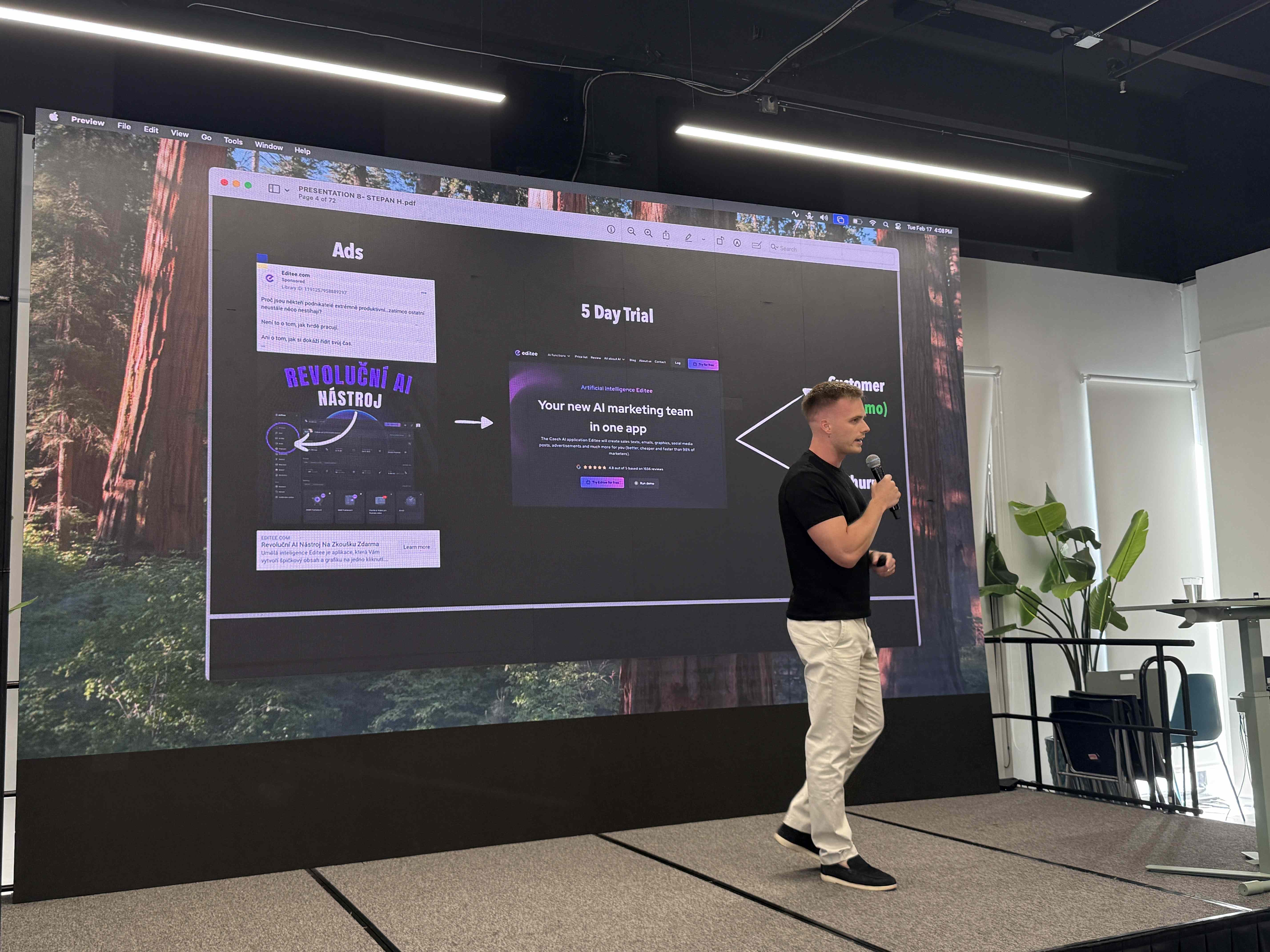
Their first attempt looked simple — they ran ads directly to a 5-day trial of their tool. It worked with a small budget, but as soon as they tried to scale, their customer acquisition cost shot up to an unsustainable level.
And that was the turning point.
The solution: sell something more expensive on the front end
Štěpán’s reasoning was simple and brilliant at the same time. If their competitor sells a monthly subscription for $70, the most they can afford to pay for a customer is $70 to break even. That does not leave much room for scaling.
But what if we sold something for $1,000 on the front end? Suddenly, we can afford a CPA (cost per acquisition) of up to $1,000 — and still break even. At the same time, we have collected leads, built the brand, brought customers into the tool, and can continue selling to them.
That is how the idea of selling through a webinar was born. Not a monthly subscription — that is not sexy, and no one will buy it on a webinar. Instead, they created an 8-week online course on AI marketing for approximately $1,000 (CZK 19,990) and included a one-year software subscription for free as a bonus.
Positioning is key: do not sell a subscription, sell a course
In my opinion, this was one of the strongest moments of the entire presentation. Štěpán showed how he completely repositioned the offer:
Before: “Buy an annual subscription to our software for ~$1,000.” People’s reaction? Boring. Why would I buy a year in advance when I can try it for free and pay monthly?
After: “Buy an AI marketing course for $1,000 and receive a full year of access to Editee completely free as a bonus.” People’s reaction? A total game changer. The same product, but a completely different perception of value.
People suddenly felt they were getting the software (normally priced at $1,200/year on the website) for free. At the same time, Štěpán’s main goal — getting them into an annual subscription — happened automatically. After the course year ended, customers naturally transitioned to a monthly subscription, increasing MRR.
The 4 steps he used to build the entire system
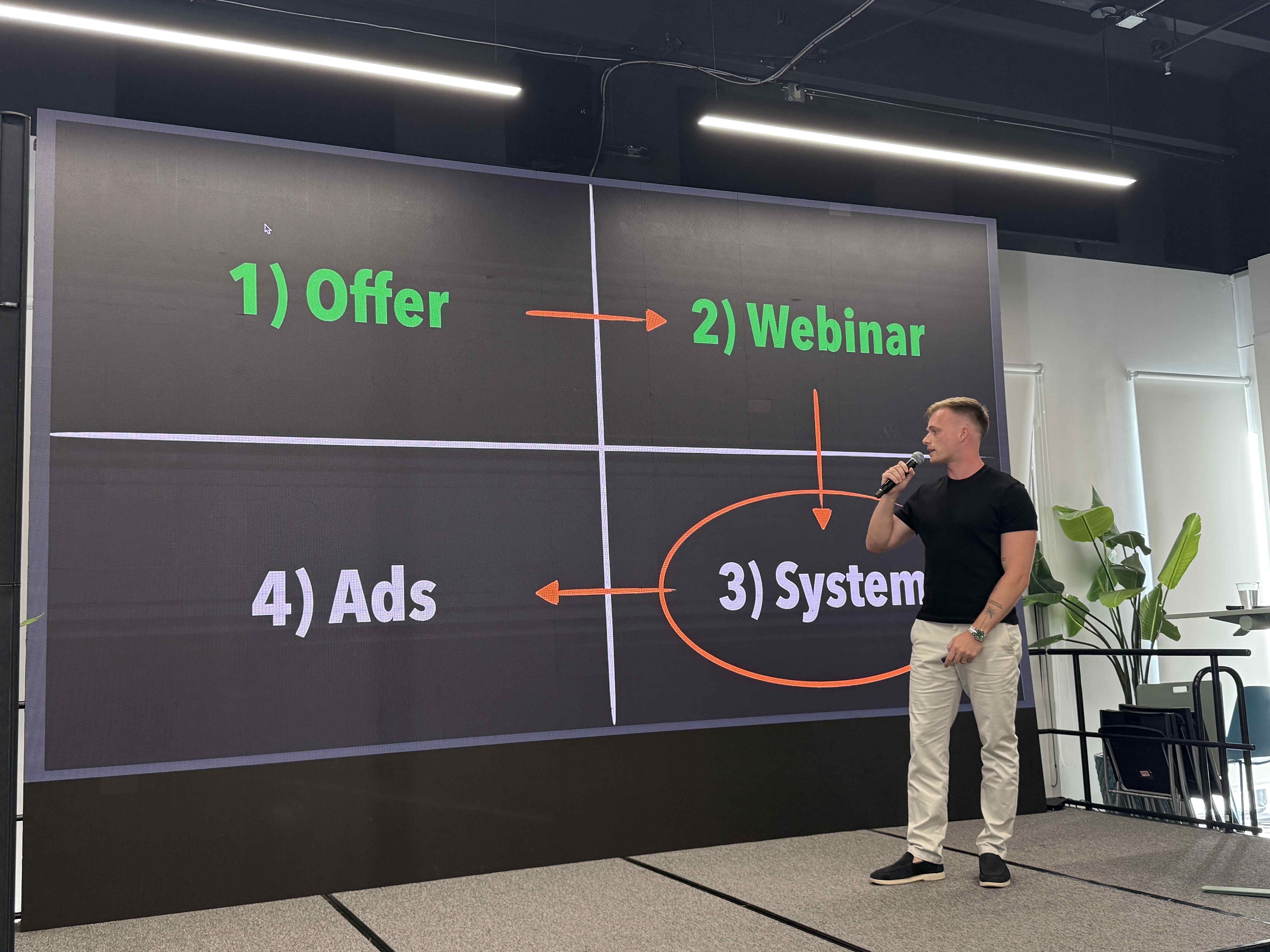
Štěpán described his process as a four-step framework that he uses every time he builds a webinar funnel:
1) Offer — He always starts with the end in mind. First, you need an offer so good that people simply have to have it. Even those who came to the webinar determined not to buy anything.
2) Webinar — The presentation itself, which sells the offer. But be careful — you do not wait until the end to sell. You are selling throughout the entire webinar without the viewers realizing it.
3) System — The automated funnel surrounding the webinar. Registration page, thank-you page with a trial offer, webinar, checkout page, and follow-up emails.
4) Ads — Paid acquisition that drives traffic into the entire system.
How to build an offer people cannot resist
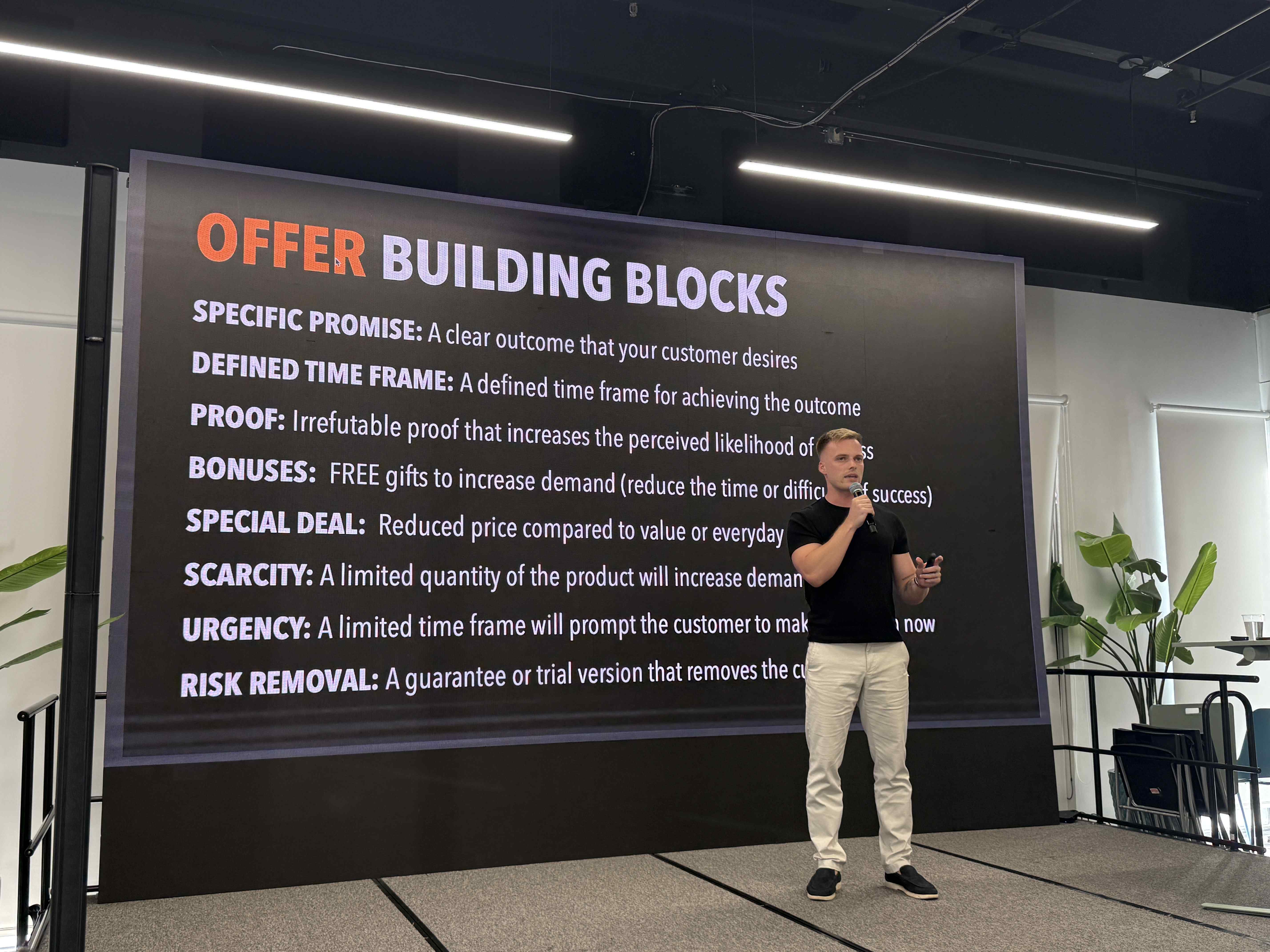
On the “Offer Building Blocks” slide, Štěpán showed the building blocks of a strong offer. You do not always need all of them, but the more you include, the more attractive the offer will be:
Specific promise — a clear outcome the customer wants. Not a generic “access to the members’ area,” but a specific “you will learn XY in 8 weeks.”
Defined timeframe — people want to know how quickly they will achieve the outcome. That is why an 8-week course converts significantly better than a “membership.”
Proof — reviews, numbers, and case studies. Štěpán said that when creating an offer, he always thinks about the biggest skeptic and asks how he can convince them.
Bonuses — it is human nature. We all love free gifts. Bonuses should help the customer achieve the outcome faster or more easily.
Special price — the customer must feel that it would be foolish not to take advantage of the offer.
Scarcity and urgency — limited quantities or a time-limited offer encourage people to make a decision.
Risk reversal — a money-back guarantee or trial. Editee offers a 30-day guarantee.
The total “value” of the package on the slide came to approximately CZK 80,000, while the selling price was CZK 19,990 with a 75% discount. A classic but effective structure.
Webinar: do not wait until the end to sell — sell from the beginning
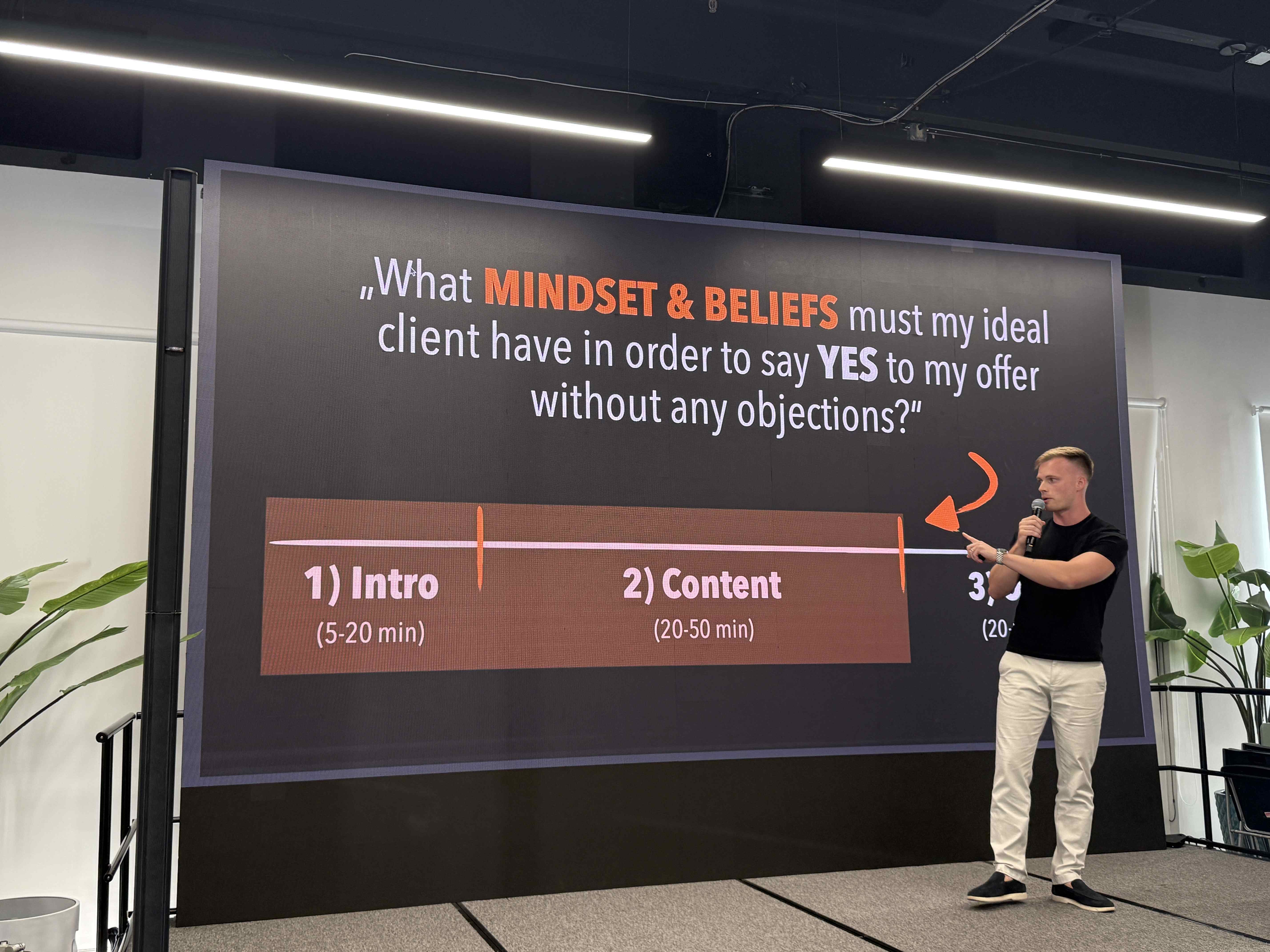
According to Štěpán, the webinar structure looks like this: introduction (5–20 minutes), content (20–50 minutes), and offer (20+ minutes). Ideally, you should transition to the offer at around the one-hour mark.
But the key insight he repeated several times was this: most people think you only start selling in the offer section. But that is a fundamental mistake. You are selling from the very beginning.
The entire purpose of the webinar is to shape the viewer’s mindset and beliefs so that saying “yes” at the end feels completely natural. Before every webinar, Štěpán sits down and writes a list of beliefs his ideal customer must have in order to buy.
Three universal beliefs that always work:
They must believe in you — that is why a section establishing your credibility, your story, and your proof is important.
They must believe in your solution — that is why the content section shows what the tool can do, how it works, and why it is the best path to the desired outcome.
They must believe they can do it themselves — that is why you must overcome objections such as “I do not have time,” “it does not work in my industry,” or “it is too complicated for me.”
According to Štěpán, software products are a little different from information products. In the content section of the webinar, he directly demonstrates what Editee can do — and viewers become so excited that they start asking, “How can I get it?” before the offer section even begins.
And then there is one more underrated moment — the end of the webinar after presenting the offer. Many people introduce the offer and say, “Thanks, that is all, goodbye.” But Štěpán stays for another 20–40 minutes and answers frequently asked questions and objections. Why? Because the people still watching at that point are interested — they are just afraid. And this is exactly where you have the opportunity to put those fears to rest.
Tip: have AI generate 100 possible objections to your offer and turn them into FAQ questions for the end of the webinar.
The system: an automated funnel from A to Z
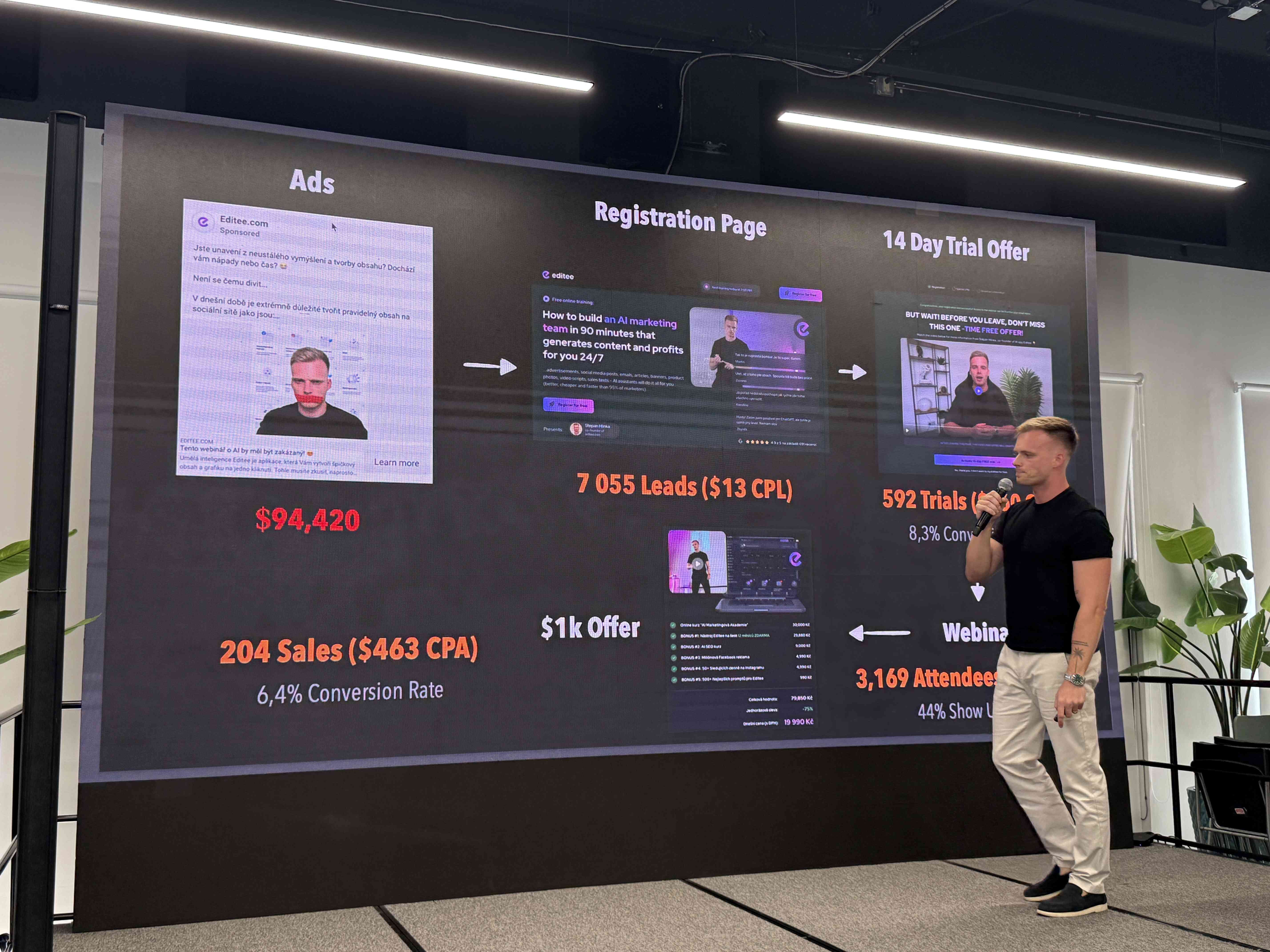
The complete Editee funnel looks like this:
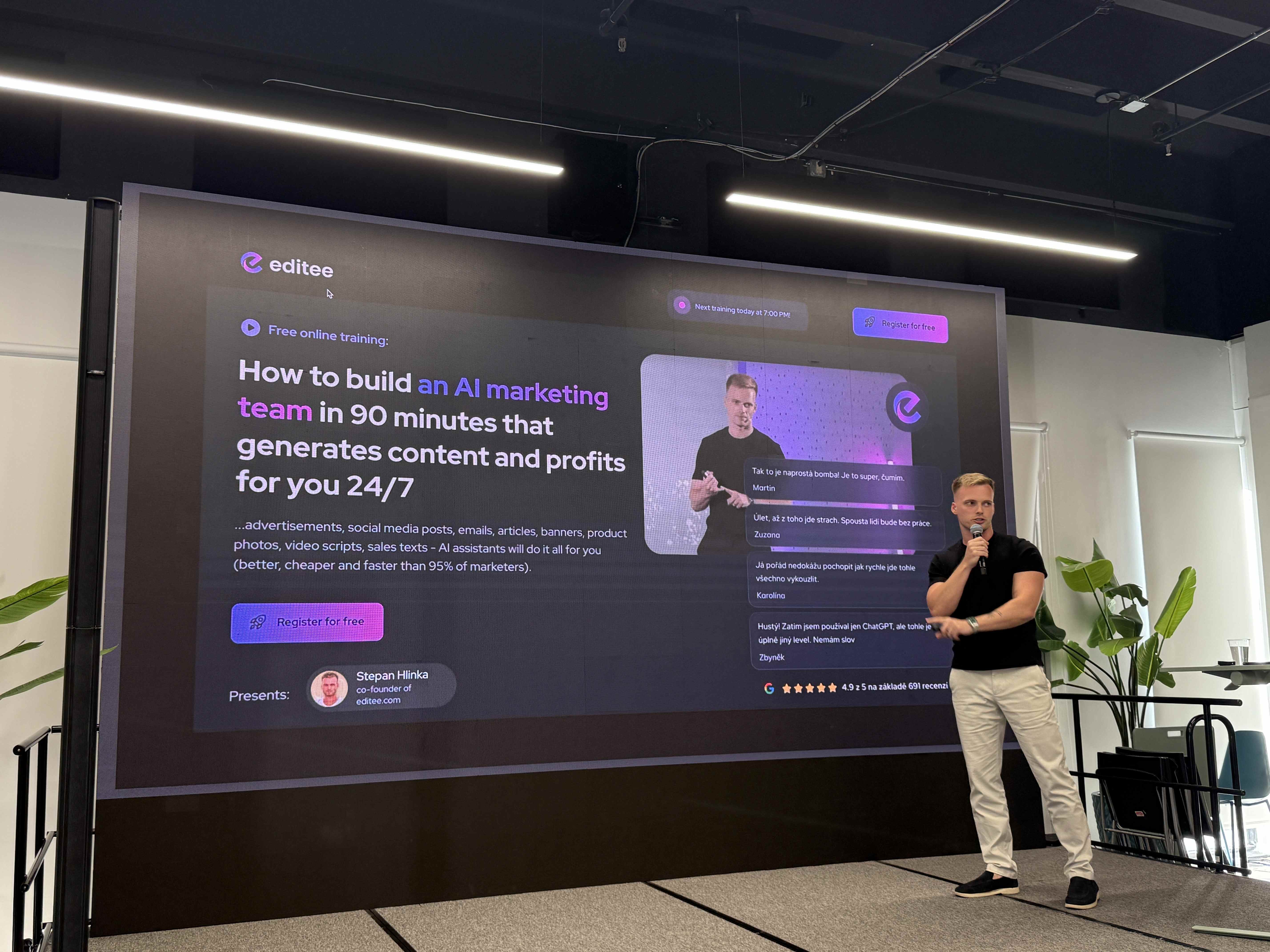
Registration page → A classic webinar landing page. It is important for everything essential to be visible above the fold — the webinar title, what it will cover, and the registration button. Mobile optimization is critical, as most traffic now comes from mobile devices. Štěpán also added social proof — comments from the webinar such as “this is amazing, I cannot believe what it can do.”
Thank-you page with a trial offer → According to Štěpán, this is one of the most underrated pages of all. Why? Because 100% of leads see it. It is the only page that absolutely everyone who registers will see. Most people only put “thanks, the webinar will take place at this time” on it. Instead, Editee offers a 14-day software trial requiring a credit card. Even if they do not buy during the webinar, their trial is already running, and some of them will convert to a subscription.
Webinar → Automated, running either every 15 minutes or at 7:00 p.m. It has never been run live. The conversion rate is lower than with a live webinar, but the show-up rate is significantly higher — around 44–50% compared to 25% for live webinars. So the overall results are better.
Checkout page → A simple page summarizing the offer and containing a payment form. If the deadline is within 24 hours, a full sales page is unnecessary — people already know the offer from the webinar.
The investor mindset: the numbers that hold it all together
Here, Štěpán showed real monthly numbers, which is what moves the entire presentation from theory into practice:
In one month, they spent $94,000 on ads. They generated 7,055 leads at a cost per lead of $13.30. Of those, 3,169 people watched the webinar (a 44% show-up rate). 592 people started a trial, and 204 customers made a purchase. The CPA came to $463.
And now for the key mindset: Štěpán does not optimize for profit from the first transaction. He optimizes for the number of customers.
Even if the entire funnel only broke even — they spend $94,000 and make $94,000 — it would still be an amazing result. Why? Because:
-
He acquired 7,000 email contacts completely free.
-
Nearly 600 people activated a trial with a credit card.
-
Hundreds of people saw the brand thanks to the ads.
-
He can continue selling to those customers — upsells, special promotions, and subscriptions.
As an example, he mentioned a Black Friday promotion from 2025 — in a single day, they generated $70,000 purely from their email list, without spending a single cent on advertising.
He compared the entire process to investing: if the average customer spends $50 on their first purchase and their lifetime value reaches $250 after one year and $500 after two years — would you invest $50 now to receive $250 in a year? Of course you would.
What should you take away from this?
![Two men, Ondřej Barták and Štěpán Hlinka, wearing badges in front of an [EPIC] WEBINAR SUMMIT photo wall, badge: SPEAKER STEPAN](https://cdn.codedtrip.com/images/blogposts/epic-webinar-summit-ai-saas-ondrej-bartak-a-stepan-hlinka-mmKjcdxo0W.jpg)
If I had to summarize the three main takeaways from Štěpán Hlinka’s presentation:
First, do not sell the subscription directly — package it as a bonus to a more attractive offer. It is the same product, but the perception is completely different.
Second, you are selling from the first minute of the webinar, not just at the end. The purpose of all the content is to build the beliefs that lead to a purchase.
And third, think like an investor, not a salesperson. You do not need to make a profit on the first transaction. If you can break even on acquisition, you have an entire list of customers you can sell to for months and years to come — and that is where the real money is made.
At the end, Štěpán also managed to mention that psychology is more important than the algorithm — but unfortunately, he ran out of time to discuss it. Maybe next time.